A small machine is two numbers: what it can reach, and what the motor can remove
The machines in this category are not machining centres. Fifty-eight records, all typed as tool and cutter grinders, forty-two of them declaring in the record that the machine is not CNC controlled. What they share is the decision a buyer has to make: an envelope and a motor, and a body that has to hold both steady. This page reads the CNC machine category by those two numbers and shows where the rest of the mass went.
The name on the category is not a specification
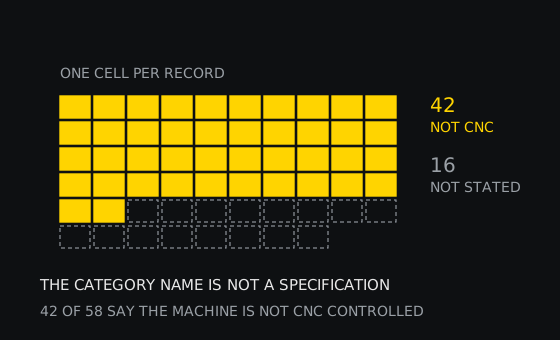
All 58 records in this category carry the same type, tool and cutter grinder, and 42 of them fill the field that asks whether the machine is CNC or not with the word normal. That is not a contradiction in the listing; it is a description of what the category contains. These are tool-room machines: end mill sharpeners, drill bit grinders, saw blade sharpeners, chamfering machines, a tapping machine. The work goes in by hand, the feed is a handwheel or a lever, and the skill is in the operator and the setup.
That matters for the way the numbers are read. A machining centre is bought on travels, spindle taper and tool count. A tool-room grinder is bought on how big a tool it can take, how much of it the wheel can reach, and whether the body is rigid enough to hold a tenth of a millimetre while someone leans on a handwheel. Those are two numbers and one property, and the rest of this page is about telling them apart.
Power classes, and what each one is for
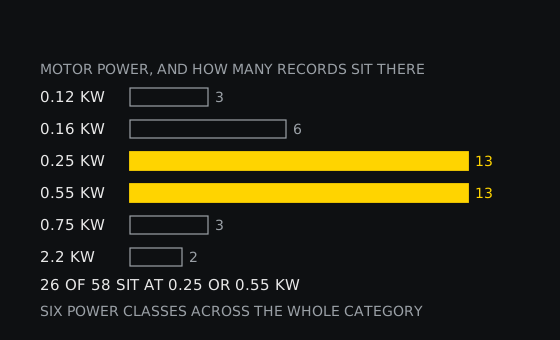
Fifty-seven of the 58 records declare a motor power, which makes this one of the better populated fields in the category. The distribution is narrow and it clusters. Three records sit at 0.12 kW, six at 0.16, thirteen at 0.25, one at 0.37, thirteen at 0.55, two at 0.6, three at 0.75, one at 1.1 and two at 2.2. One record writes 250W into the same field, which is the same class as 0.25 kW written differently.
The two clusters are the useful part. At 0.12 and 0.16 kW the machines are portable end mill and drill sharpeners: a 3 to 13 mm capacity on a 10 kg body, a 4 to 14 mm capacity on a 14 kg body, both turning a small wheel at 4,400 rpm. At 0.25 kW the same job grows to 4 to 20 mm and 12 to 30 mm, with bodies between 18 and 44 kg. At 0.55 kW the work changes character: a drill sharpener covering 3 to 60 mm on a 136 kg body, a saw blade sharpener covering 250 to 350 mm blades on a 110 kg body.
At 0.75 kW there are three records, and all three are universal tool and cutter grinders with a 250 mm maximum cutter diameter and a 260 to 350 mm grinding length on a body of 160 to 168 kg. At 2.2 kW there are two, both saw blade sharpeners for blades up to 450 mm. The power is not a quality score; it is the size of the cut the machine was designed to take, and the envelope it was designed to reach.
The envelope asks three different questions
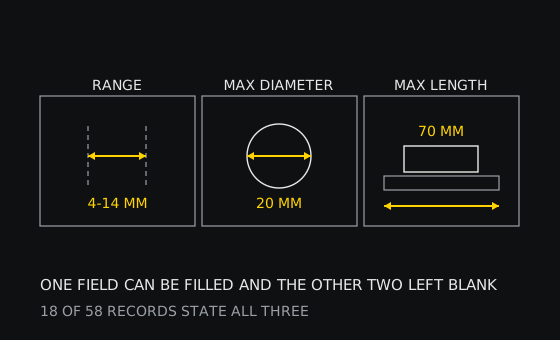
Three fields carry the envelope, and they answer three different questions. Grinding range is the size of the tool shank the workhead will hold: 4 to 14 mm appears seven times, 4 to 20 mm four times, 3 to 13 mm twice, 12 to 30 mm twice, and single records cover 6 to 20, 3 to 60, 3 to 32, 4 to 12, 13 to 30 and 3 to 25 mm. Maximum grinding diameter is the size of the wheel or blade the machine can swing: 14 mm appears seven times, 20 mm six times, but 250 mm three times, 350 mm four times and 450 mm once.
Maximum grinding length is the third, and it is the one that means least until you know what it measures. On a machine with a table it is travel. On a machine with a workhead and no table it is the length of tool that can be presented to the wheel. The two are not the same claim, and the field does not say which one it is making.
The counts are worth knowing before a record is read as complete. Twenty-three records carry a grinding range, 31 a maximum diameter, 29 a maximum length, and only 18 carry all three. A record with a range and no diameter tells you what shank fits and not what wheel you need; a record with a diameter and no length tells you the swing but not the reach.
Envelope and power belong on the same graph
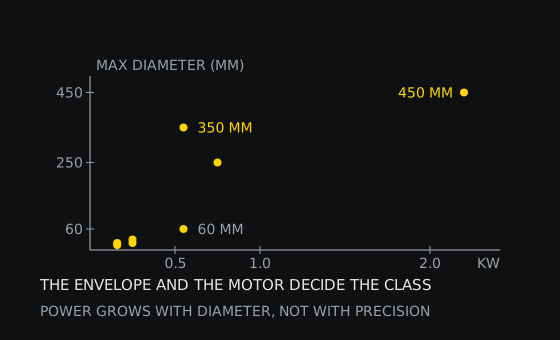
Put the two numbers together and the category organises itself. A 0.16 kW machine holds a 14 or 20 mm tool. A 0.25 kW machine holds the same tool or one up to 30 mm. A 0.55 kW machine jumps to a 60 mm drill or a 350 mm blade, which is a different order of work. A 0.75 kW machine swings a 250 mm cutter, and a 2.2 kW machine a 450 mm blade.
The reason the curve is not smooth is that the machines are not doing the same operation. Sharpening a 14 mm end mill means grinding a small flute with a small wheel and a light pass. Sharpening a 350 mm saw blade means indexing 45 to 180 teeth per minute past a wheel that has to reach the tooth, and the limiting factor becomes the indexing mechanism and the rigidity of the arm rather than the motor. A buyer who compares kW across those two jobs is comparing the wrong number.
Where the comparison does work is inside one class. Two 0.25 kW end mill sharpeners of 22 and 44 kg are the same motor doing the same job in bodies of different mass; the heavier one has more iron between the wheel and the handwheel, and that is what a 12 to 30 mm capacity buys. Two 0.16 kW machines at 14 and 16 kg are, for practical purposes, the same machine in two castings.
Mass follows the slides, not the motor
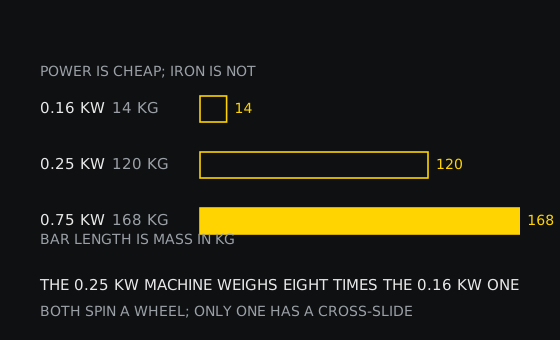
Every record in this category declares a weight, and the spread is from 5 kg to 300 kg. Sixteen kilograms appears four times, 110 kg three times, 10 kg three times, 23 kg three times, and then a long tail of 100, 103, 130, 136, 160, 165, 168 and 300 kg. Sorting by power does not sort by mass: the 0.25 kW class contains a 22 kg end mill sharpener, a 120 kg universal grinder and a 300 kg blade grinder.
The 300 kg machine is the interesting one. It carries 0.25 kW, the same motor as a 22 kg bench machine, and it is fifteen times the mass. What the extra iron is doing is holding a spindle and a workhead rigid enough to grind a polycrystalline blade without the wheel chattering, at 5,500 rpm. The motor did not change because the cut did not change; the structure changed because the tolerance did.
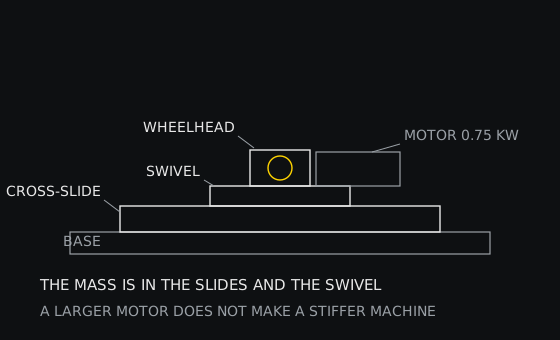
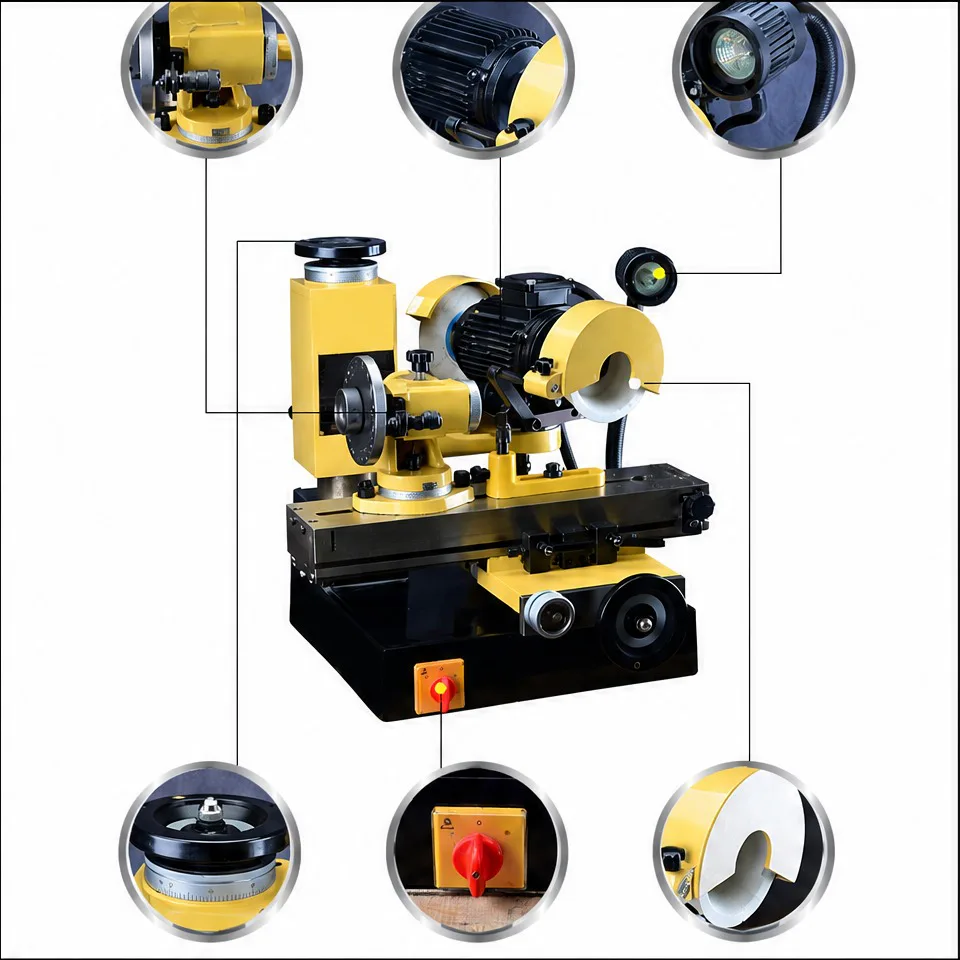
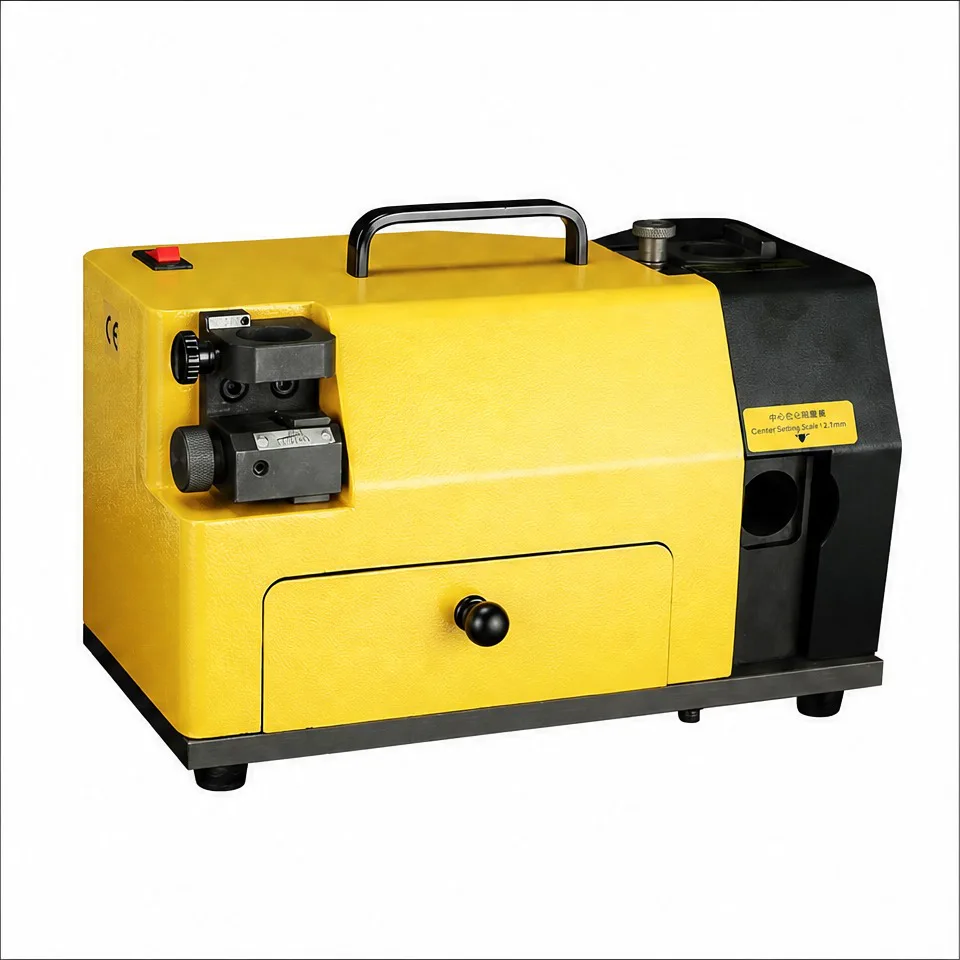
This is the answer to the question of where the cost of a small machine sits. It is not in the motor, which is a commodity in every class from 0.12 to 0.75 kW. It is in the slide that has to move without play, the swivel that has to return to the same angle, and the workhead that has to hold a tool shank concentric while a wheel pushes on it. Those are the parts a photograph shows and a record does not describe.
A field that cannot be true
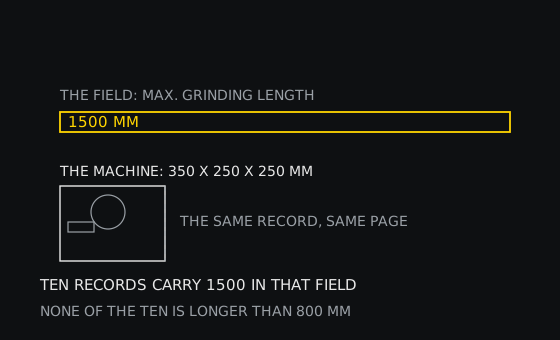
Ten records carry 1,500 mm in the maximum grinding length field. Every one of those ten also gives the overall dimensions of the machine, and none of the ten is longer than 800 mm. One of them is a 14 kg end mill sharpener measuring 350 by 250 by 250 mm; another is a 136 kg drill sharpener at 600 by 420 by 450 mm. A grinding length of 1,500 mm cannot exist inside a machine of 350 mm, in the same way that a 1,500 mm table cannot be carried by 14 kg of casting.
The field is almost certainly a template artefact, copied from a long-table surface grinder and left in place. It is worth raising not because it is a lie but because it is the clearest example of why a record has to be read against itself. The same page gives a dimension and a capacity that contradict each other, and both are in the specification table, in the same font.
The practical rule that comes out of it: when a capacity number is more than twice the machine dimension on the same axis, treat the capacity as unverified until a drawing or a photograph with a rule in it arrives. That rule costs nothing to apply and catches the field before it catches the order.
Wheel diameter and speed are one number, not two
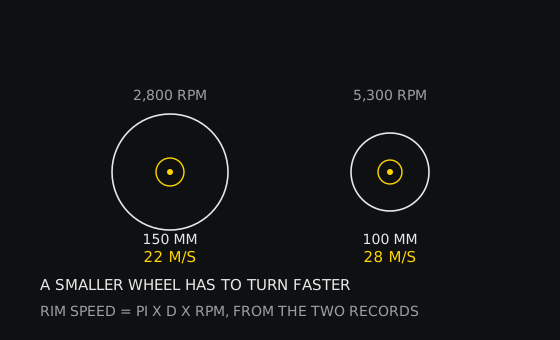
Two records state both a wheel size and a spindle speed, which is enough to compute what the abrasive actually sees. A universal grinder with a 150 by 16 by 32 mm wheel at 2,800 rpm runs its rim at about 22 metres per second. A tool grinder with a 100 by 50 by 20 mm wheel at 5,300 rpm runs at about 28 metres per second. The second machine is smaller, spins faster, and works the abrasive harder.
This is why a small machine is not a slow one. The rim speed is the product of diameter and rotation, so shrinking the wheel forces the spindle up if the cut is to stay the same. It is also why a wheel change is not a neutral act: put a larger wheel on the same spindle and the rim speed rises with the diameter, which is a change to the grinding condition and to the safety margin at once.
Speeds in the category run from 2,800 rpm on the universal grinders to 4,400 on the end mill sharpeners, 5,300 and 5,500 on the tool grinders, 6,000 on one, and 8,500 on the chamfering machines with their small wheels. Read together with the wheel size, those numbers describe a family of machines all working in the same rim speed band with different diameter and rotation pairs.
What the record leaves out, and how to ask for it
Fifty-three records declare a voltage, which is more than declare a range. Most say 220V, seven say 220V and 380V, five say 380V, and three write 380 V with a space. That is a supply question for the shop and a real one: a 380V machine in a 220V workshop needs a different motor or a transformer, and neither is in the record.
What no record describes is the thing the operator feels: how much play is in the cross-slide, whether the swivel returns to zero with a stop or by eye, whether the workhead has an index or a collet, and how the wheel guard comes off for a wheel change. Those are the differences between two machines with the same motor and the same envelope, and they are the differences that decide whether the machine is used or abandoned after a month.
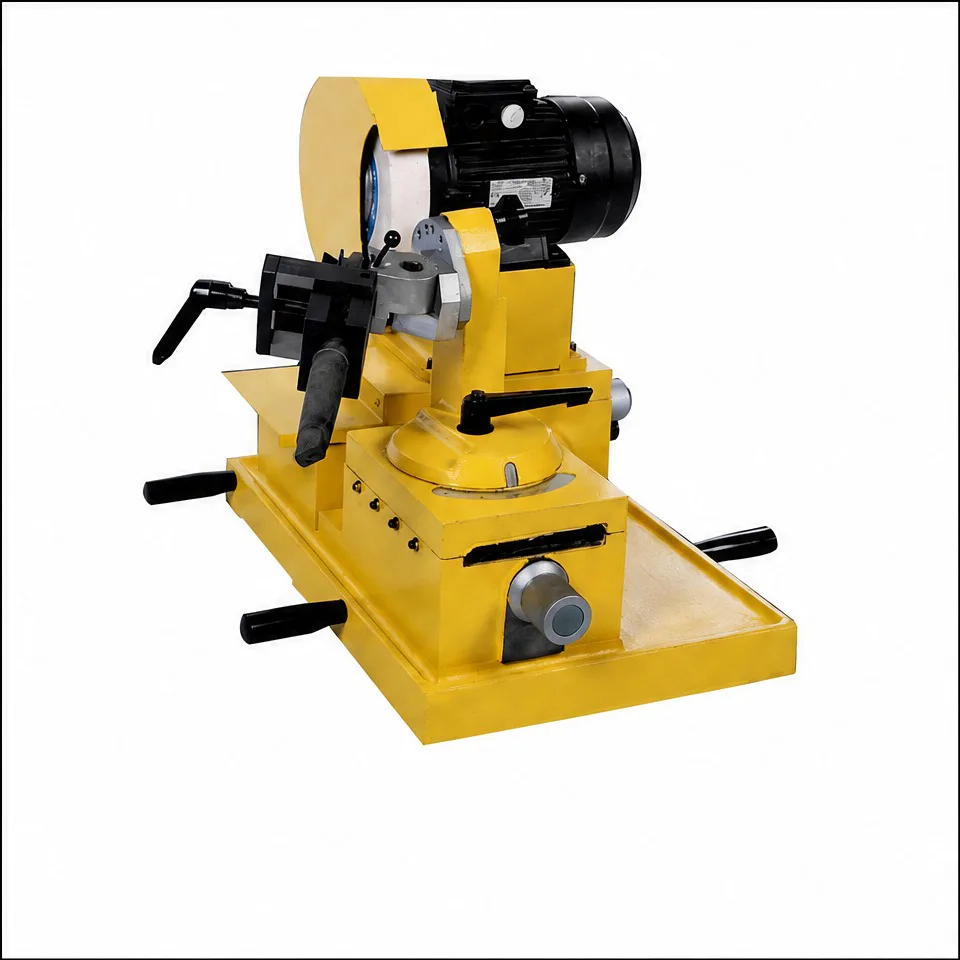
So the questions to send with an enquiry are not the ones the table already answers. Ask for a photograph of the cross-slide with a rule against the travel. Ask whether the workhead takes collets and which sizes. Ask for the wheel arbor diameter and whether a wheel of a different diameter can be fitted. Ask what the swivel stop looks like. Four answers, and the record becomes a machine.
The order to check one in
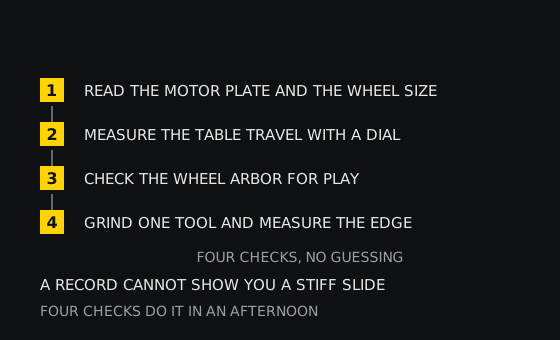
- Read the motor plate and the wheel size together, then compute the rim speed. A machine whose plate and wheel do not agree with its stated speed has been described by somebody who did not measure it.
- Measure the table or slide travel with a dial, not against the scale on the machine. The scale shows what the maker intended; the dial shows what the slide does, play included.
- Check the wheel arbor for radial play with the wheel off. This is the error that shows up as a facet on every tool, and it is invisible with the wheel fitted.
- Grind one tool and measure the edge. One test tool tells you more about the workhead, the coolant and the operator than a page of specification, and it is the only check that uses the machine as a machine.
A machine that passes those four is a machine whose numbers can be trusted in a quotation. A machine that fails the second has a slide that will be adjusted weekly; one that fails the third will produce tools that cut on one edge. Neither failure is visible in the record, and both are cheap to find before the machine is on the floor.
Related reading and the machines named here
The CNC machine category holds the 58 records behind every number on this page. The A12 guide covers what a dresser does to the wheel, which is the other half of the rim speed question. The A6 guide covers when a sharpened tool is worth putting back in the spindle, and the A7 guide covers the collet range that the workhead has to match. If the machine is a grinder but the work is workholding, the A16 guide covers the fixture side.
Machines cited above include the TB-X1 end mill sharpener at 0.16 kW and 14 kg with a 4 to 14 mm range and 4,400 rpm; the TB-13D at 0.12 kW and 10 kg with a 3 to 13 mm range; the TB-X8 at 0.25 kW and 40 kg with a 6 to 20 mm range; the TB-6X at 0.25 kW and 120 kg with a 3 to 25 mm range; the TB-60A at 0.55 kW and 136 kg with a 3 to 60 mm range; the TB-Q5 and the MF126 pattern saw blade sharpeners at 0.55 kW with 350 mm blades; the TB-600 and TB-600G universal grinders at 0.75 kW and 165 to 168 kg with a 250 mm maximum diameter; the U3 tool grinder at 0.37 kW and 5,300 rpm with a 100 mm wheel; the TB-M4 blade grinder at 0.25 kW and 300 kg; and the TB-S450 at 2.2 kW with a 450 mm blade. Send the largest shank, the largest wheel and the longest tool, and the three envelope fields can be checked against the job in one reply.