ER collet clamping range: why the marked size is not what it grips
This page is about choosing the collet, not about measuring runout. It explains what the number on the collet means, what it leaves out, and which figures on a record have to be read in the right place before an order goes in. For the order of runout checks, see the A3 guide.
The number is a size, not a range
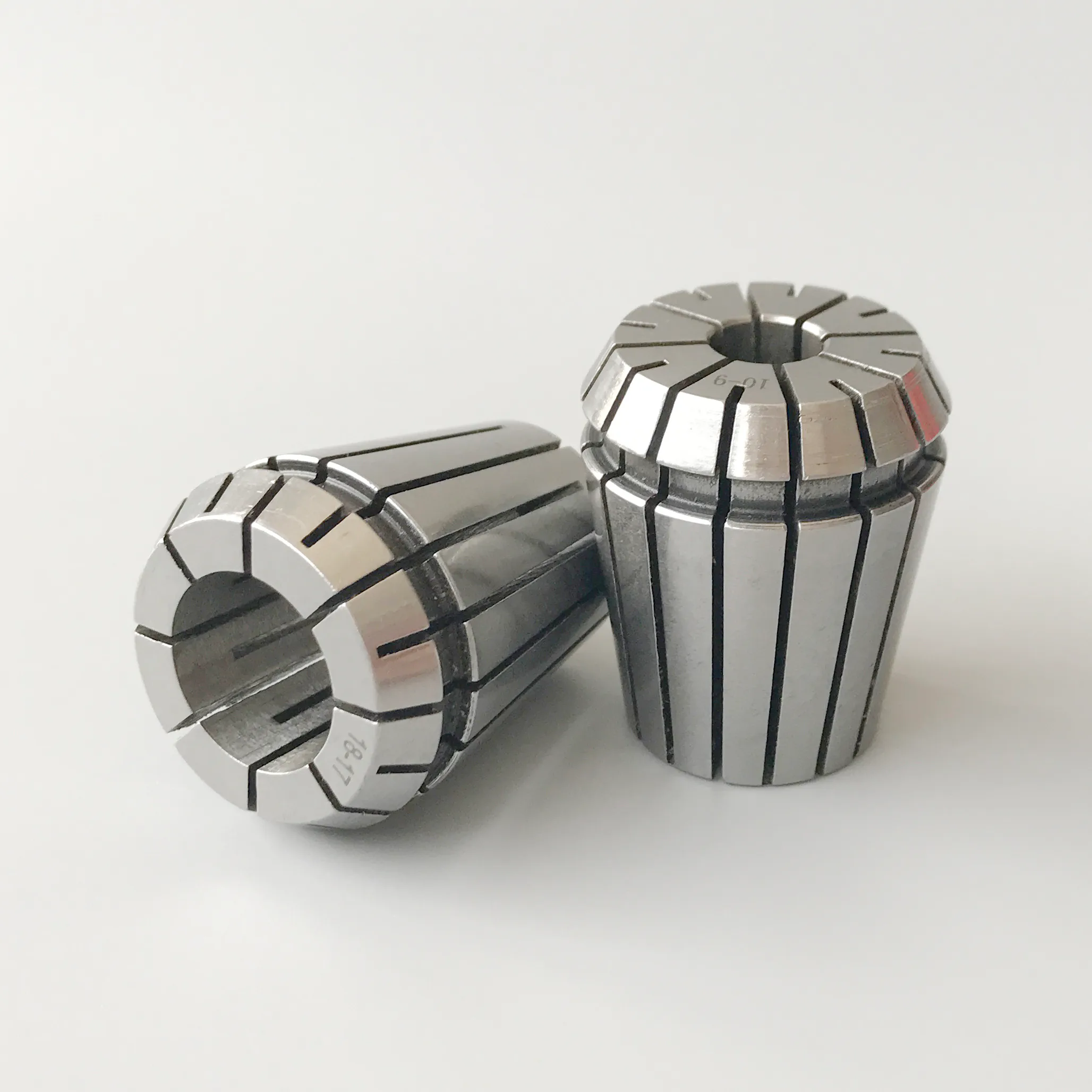
A collet marked 20 is described everywhere as a 20 mm collet, and the description invites the one reading that fails: that it holds a 20 mm shank. It does not. The marked size is the largest shank the collet will accept, and the band it actually clamps runs down from that number. A collet sold as 20 is a working 19 to 20.
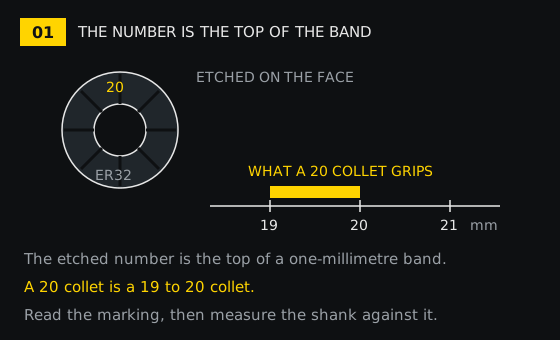
The same convention runs through every step of the series. The face carries the series and the size; the size is the top of the band, and the band is what the nut closes the bore onto. Ordering by the number alone gets a collet that is dimensionally correct and functionally wrong.
Why the band is one millimetre wide
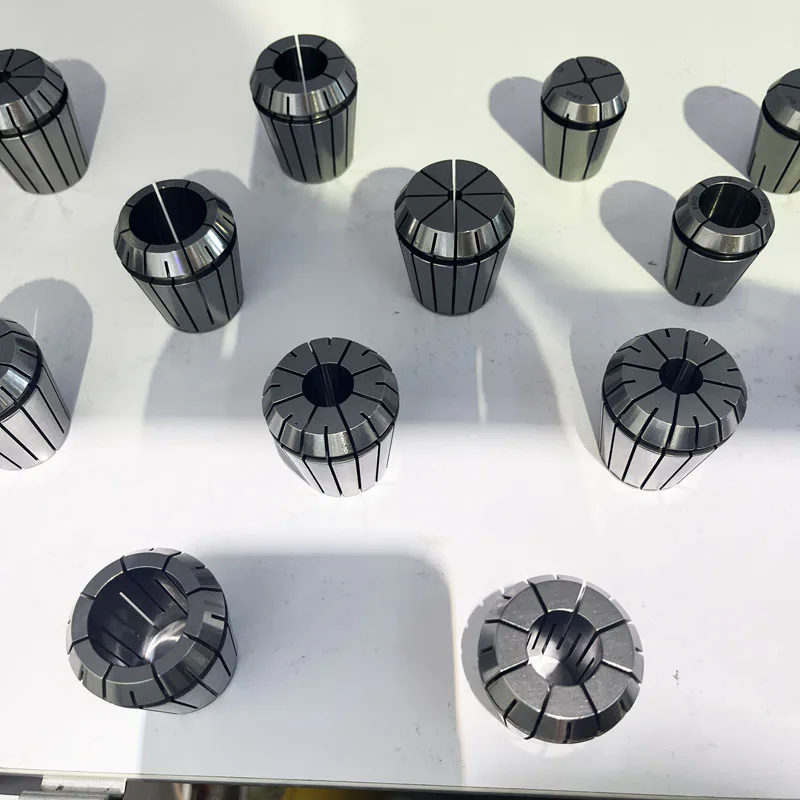
The collet is a spring with a bore through it. Slots are cut along the body from alternate ends, so the material between them can deflect; when the nut drives the collet into the holder taper, the slots close and the bore shrinks with them. Nothing else in the assembly changes shape. The nut does not squeeze the bore directly, and the holder does not either.
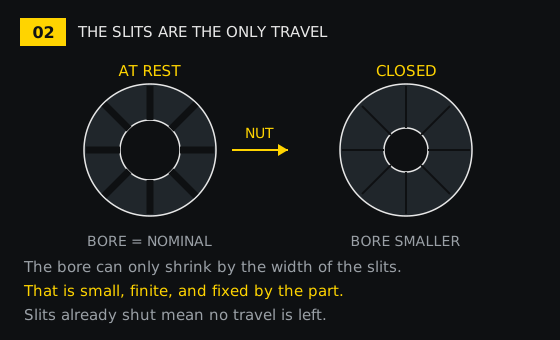
That is also the limit. A collet whose slots are already shut cannot close further, whatever the nut does, so the travel left in the design has to be small. One millimetre of diameter is what it leaves: enough to take up the difference between a nominal shank and the one actually in the machine, small enough that the slots never run out of room in normal use.
When the shank measures exactly nominal
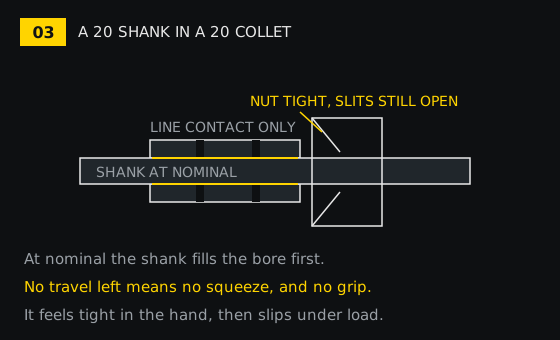
Put a 20.000 shank into a 20 collet and the fit is a light sliding fit at rest. Tighten the nut and the collet has nowhere to travel: the shank already fills the bore, the slots stay open, and the force goes into the collet body instead of into the shank. The nut reaches its stop without ever closing the bore onto the tool.
What holds the tool is then whatever friction the fit happens to give. It feels right in the hand and it indicates acceptably at low speed, then the shank creeps in a heavy cut, usually when the tool is deepest in the work. Nothing about the feel of the nut tells you this has happened.
One millimetre down is where it works
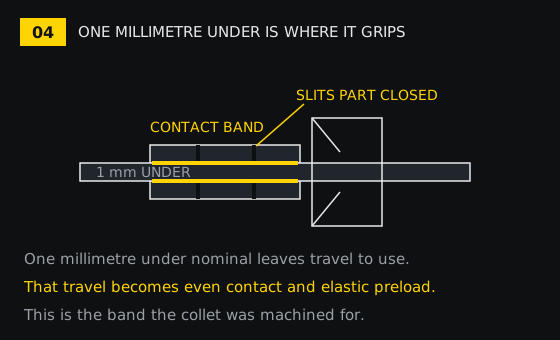
Take the same collet and a shank that measures inside the band, and the geometry changes. There is now half a millimetre of travel on each side, the slots are part closed, and the walls meet the shank along their length instead of on a line. The collet is being used where it was machined to be true.
That is the condition the grade figure describes: contact along the bore, an elastic preload holding the shank, and the drive taken by friction spread over the grip length rather than by a few high spots. It is also the condition in which a collet lasts, because nothing is rocking on an edge.
Below the band: closed, and still not touching
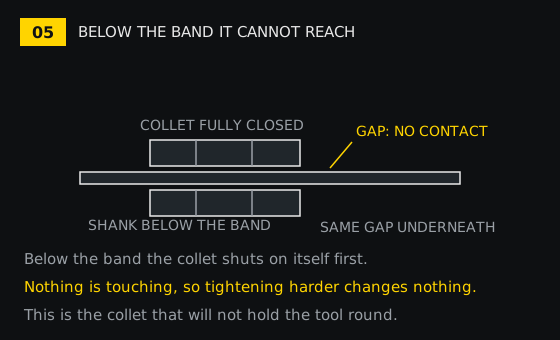
Go the other way and the failure is quieter. A shank below the bottom of the band lets the collet close all the way: the slots shut, the bore stops shrinking, and the walls are still standing clear of the tool. The nut is tight. Nothing is gripping. Tightening further only loads the collet against itself.
- The tool is marked only near the front of the collet, because that is the only place it was ever touched.
- Runout changes when the tool is taken out and put back, and changes again when the nut is indexed.
- Small tools break early, and the break is at the shank rather than at the cutting end.
- A heavy cut pulls the tool out instead of breaking it.
None of those symptoms belongs to a collet that is too large alone. That is why the band is worth checking before the spindle, the holder or the tool is blamed for a problem the collet started.
Two accuracy figures, measured in two places
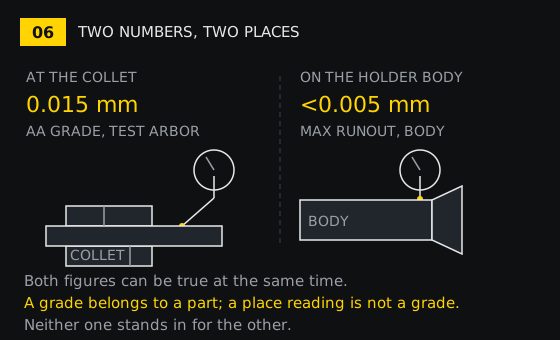
Records in this catalogue quote collet accuracy three ways: 0.015 mm on the AA grade ER set, 0.008 mm on another collet set, and 0.005 mm on one more. Separately, the BT holder records quote a maximum runout below 0.005 mm and a taper tolerance below AT3. All of those are real figures, and none of them replaces another.
They are not interchangeable because they are not measured in the same place. The collet figure is a grade: the part is mounted on a test arbor and indicated at the collet, in a fixture, once. The holder figure is a maximum runout for the body, read on the body itself. One describes a part; the other describes a surface.
So a collet quoted at 0.015 mm does not make the holder worse than its own figure, and a holder quoted below 0.005 mm does not prove the collet. When two offers are compared, compare the same kind of figure, taken the same way, on the same part. A grade read at the collet and a runout read on the body are two measurements, not a ranking.
Hardness without a scale is not a number
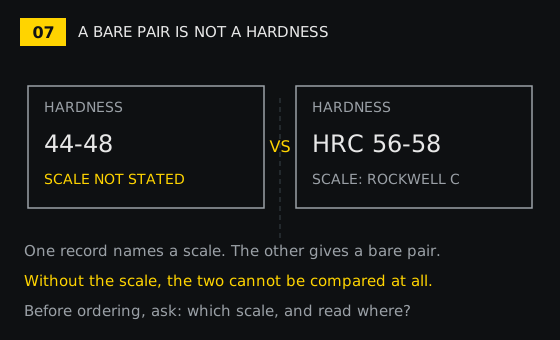
This category writes hardness in more than one form. The ER collet set record gives 44-48 with no scale named. The BT holder record gives HRC 56-58. The 65Mn sharpener collet records give HRC 55-60. Only some of them say what the number was measured on, and only some name the scale at all.
A bare pair is not comparable with a Rockwell C figure, and it is not comparable with the next supplier either, because the scale is unknown. The larger number is not automatically the harder part: without the scale, even the direction is not established. Two records can look like a difference in quality and be nothing more than a difference in notation.
The collet does not grip by itself
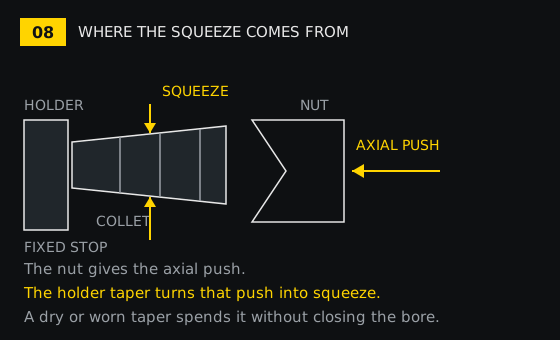
The force path is short and worth following once. The nut is turned, its internal cone bears on the front of the collet and pushes it axially into the holder, the holder taper resists, and the only direction left for the material is inward. That inward movement closes the slots and the bore.
Every part of that path can spend the force without closing the bore: a taper with a chip on it or a film of dried lubricant, a nut face worn or mismatched to the series, a collet already bottomed in the holder, a nut with the right thread and the wrong cone. In each case the nut feels tight and the collet is not clamped, which is the same symptom as a shank at nominal and a different cause.
What the records say, and what they leave out
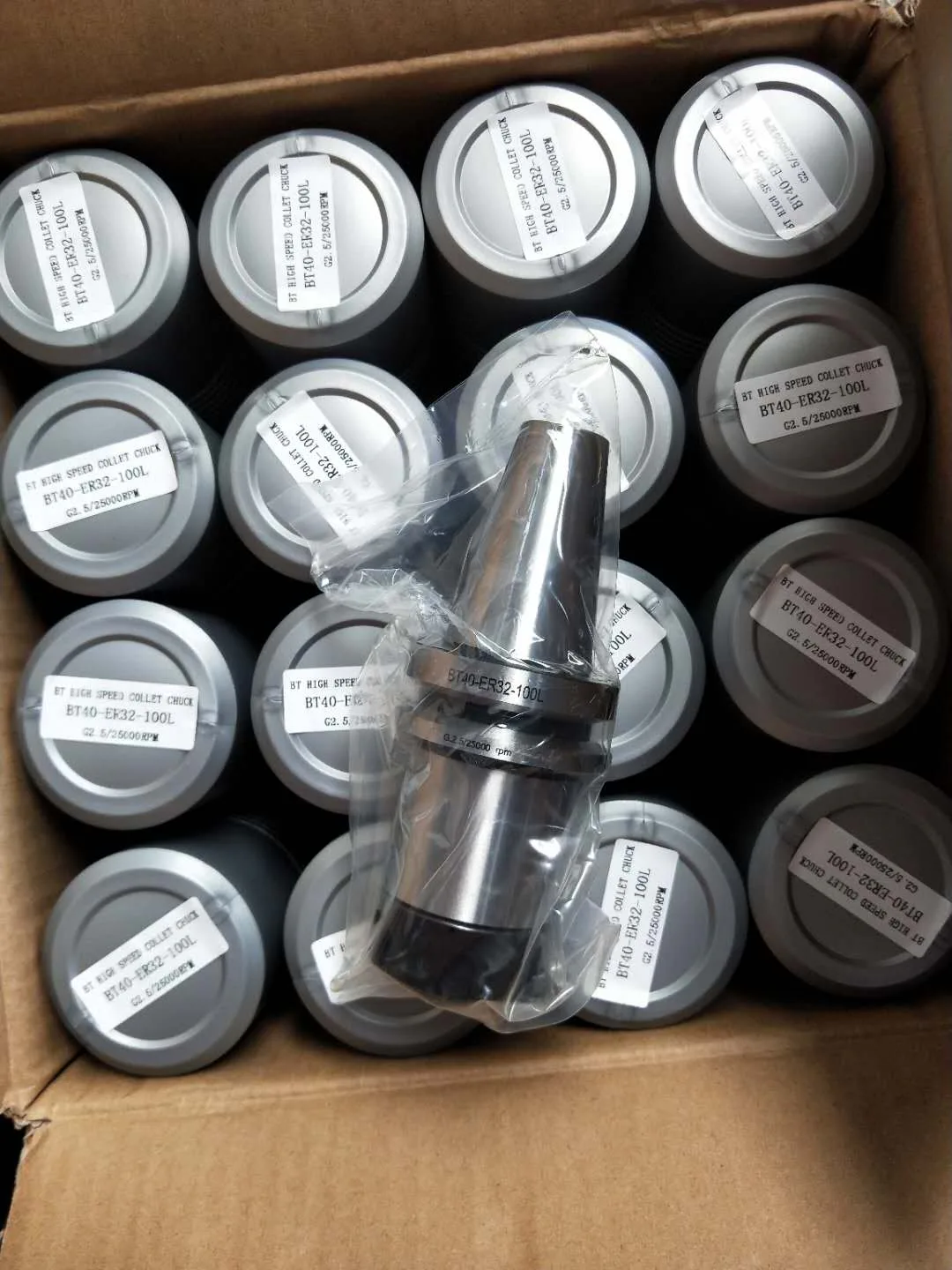
One record in this category lists the series as ER11, ER16, ER20, ER25, ER32, ER40 and ER50, in spring steel, for milling machines, lathes and grinding machines. Others name 65Mn and 65rMn for the spring collets. The toolholder records add a balance range of 12000 rpm to 20000 rpm, a taper tolerance below AT3 and a case depth of 0.8 mm plus or minus 0.2 mm on the records that state it.
What they do not carry is the band for each individual size. The series is listed, the grade is listed, the material is listed; the band is not. It has to come from the marking on the collet in your hand, or from the supplier, before the order goes in. A page like this can explain the rule; only the part can tell you its own band.
The order to choose a collet in
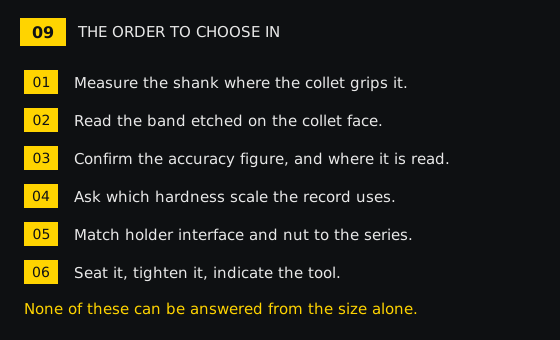
- Measure the shank where the collet will grip it, not at the end of the tool.
- Read the band from the collet marking, and check the shank sits inside it rather than on its top edge.
- Confirm which accuracy figure is quoted and where it is measured before comparing it with another part.
- Ask which hardness scale the record uses, and what it was measured on.
- Match the holder interface and the nut to the series, and check the nut cone for wear.
- Seat the collet in the nut, tighten, then indicate the tool before the first cut.
The list is short because the decision is short. Almost every collet that slips was the wrong band, and almost every wrong band was chosen from the size in the title rather than from the marking on the part.
Related reading and the parts named here
The A3 guide takes the other half of this problem: once the collet is the right band, where the runout comes from and in what order to look for it. The Collets category and the Collet and Holder category list the records behind this page.
Named above: the AA grade ER32 set, the BT30 and BT40 collet chuck arbor, the ER collet set quoted at 0.008 mm and the BT30 to BT50 ER32 holder. Send the shank size and the collet marking and we will confirm the band against the tool you are holding.