Buying a manual slide table by stroke, lead and load, and what the record leaves out
The job is small and awkward: move a fixture 200 mm by hand, leave it where you put it, and stand 30 kg on the plate without the whole thing tipping forward. Three numbers decide whether a manual stage does that — stroke, lead and load — and a fourth decision sits behind all three: a dovetail slide or a linear rail. This page reads those numbers out of a catalogue record that was written by a seller rather than a metrologist. The slide table category holds the 95 records it works from.
Three numbers, and the decision underneath them
A manual slide table is a plate on a slide, moved by a screw or a pinion, with a scale along the edge to say where the plate is. The plate carries the work. The slide decides how the plate behaves when the work is heavy or the hand leans on it. The drive decides how far one turn of the knob takes the plate. Stroke, lead and load come out of those three parts in that order, and a buyer who has all three can choose a stage; a buyer who has only the weight and the material is choosing a photograph.
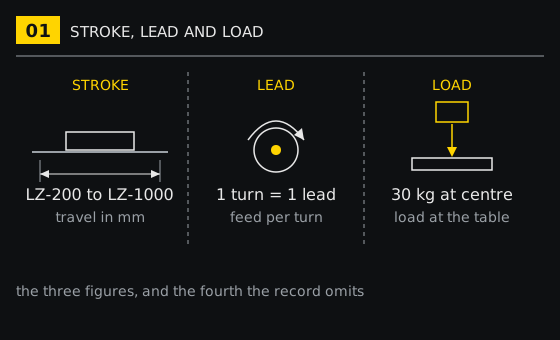
The category holds 95 records. Every one of them is typed Precision Slide Table and every one is a manual stage with an aluminium or stainless body, a scale and a knob. What they do not have is a consistent set of fields: material appears on 77 records, weight on 67, a type on 29, an application on 27, and the fields that would settle a purchase — travel, lead, load at the edge — appear either rarely or not at all. Reading a category like this is a skill in itself, and the A10 guide is the general version of it.
Stroke: the model code is the only place it lives
Nothing in these records is called stroke. Across 95 records the word does not appear as a label once. The nearest thing is a single record carrying a field marked itinerary with the value 10mm, on a stage whose top measures 60x60mm and whose load is given as 2kgf. Itinerary is a translation of the Chinese word for travel, and 10 mm is the travel of that one small stage — not a family figure, and not a number to carry across to anything else.
What the records carry instead is a code. Eleven records name an LZ-axis lifting platform, and the model numbers run LZ-200, LZ-300, LZ-500, LZ-800 and LZ-1000, with one written as a range, LZ-200MM-1000MM. Ten of those eleven list the same table size, 160MM*125MM. The plate does not grow with the code. What grows is the column under it: the same record family reports a unit weight of 5.6KG for the LZ-500 and 8KG for the LZ-1000, which is the mass of a longer screw, a longer column and a longer scale.
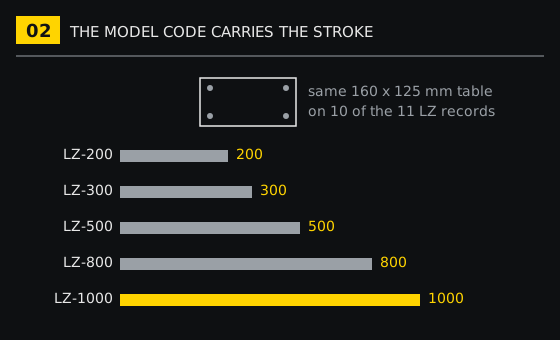
A code is a family position, not a measurement. The same LZ-500 appears in two records with two different load figures, a unit weight of 5.6KG in one and 7kg in the other, and one of the two is titled as a long-stroke variant. So the code tells you roughly where in the family the stage sits; it does not tell you the travel to the millimetre, and it certainly does not tell you what the stage will carry. The travel has to be confirmed against the drawing, and the drawing has to show the plate at both ends of the stroke.
Lead: one turn, one lead, and no field that states it
Lead is the figure that decides how a manual stage feels in the hand. One turn of the knob moves the plate by one lead. A short lead gives a feed fine enough to set a tool with and a traverse slow enough to be tedious over any distance; a long lead gives a quick traverse and a feed too coarse to stop where you meant. No record in this category states a lead. Not one of the 95.
The drive is named in the title instead. Twenty-one records carry rack and pinion in the name, three name a ball screw, one names a lead screw, four name a micrometer head, and 67 name the stage as manual. Those counts come from the product names, which are written by whoever listed the item, so treat them as a description of the mechanism and not as a specification. They are still the most useful thing in the record, because the mechanism sets the arithmetic of a turn.
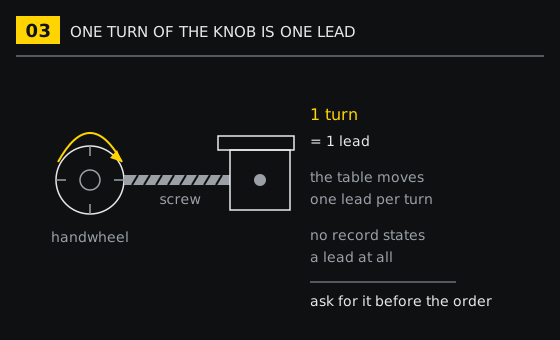
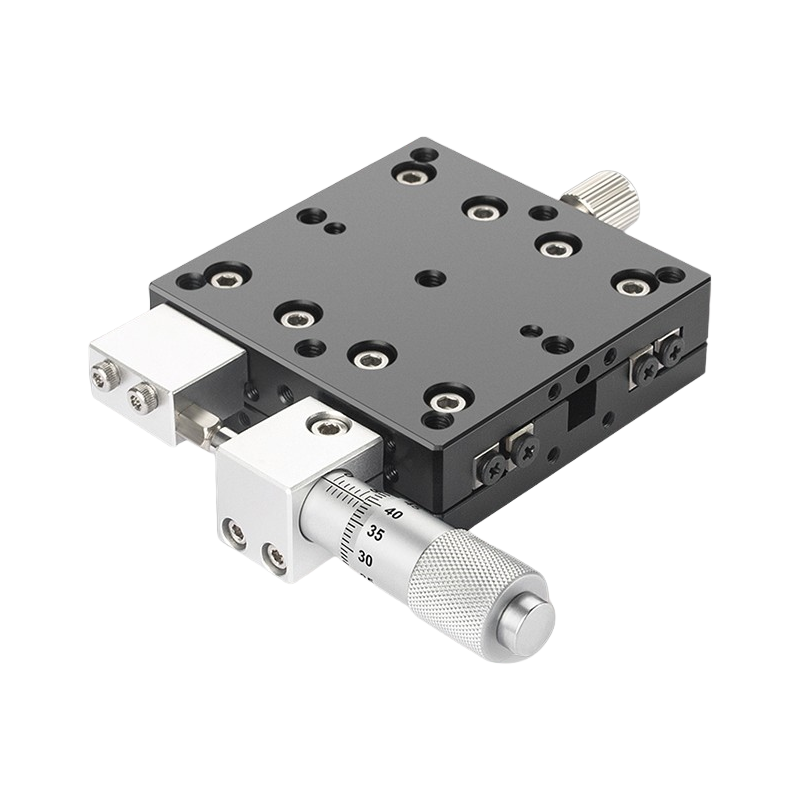
Where a stage has a graduated drum, one division of the drum is the lead divided by the number of divisions on it. That is the whole of the arithmetic, and it is why a lead is worth asking for: two stages with the same drum and different leads have different feeds per division, and the drum looks identical. A micrometer head avoids the question by grading itself — one record in this category states a minimum scale and a parallelism of 0.01mm/0.04, another states a minimum scale of 0.01mm, and a third states an accuracy of 0.02mm with a parallelism of 0.02mm. Those are graduations and geometry of the fixture, not a promise about the position of the plate under load.
Load: three figures in one family, and where they are measured
Twelve records carry a load. Six say 30KG, four say 10KG, one says 50kg and one says 2kgf. The six 30KG records are the hand-crank stages. The four 10KG records are the electric and long-stroke variants, where the moving mass includes a motor or a longer column. The single 50kg record is a ZL-500 with a lead screw named in the title. A buyer who reads one record and assumes the family carries 30 kg has read the hand-crank variant and bought the electric one.
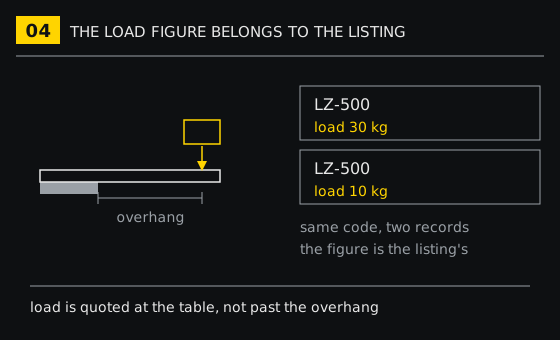
The other half of the question is where the load sits. The plate most of these stages carry is 160MM*125MM, and a load figure is quoted for the plate, not for a bracket bolted to one end of it. Put the mass at the edge and the slide sees a moment rather than a weight: the same 30 kg on an overhang will cock the plate on its guide, and a dovetail with a gib will cock visibly before it stalls. Ask where the load is measured, and then check the worst case on your own fixture rather than the middle of the plate.
Dovetail or linear rail: the decision under the three numbers
The guide decides how a manual stage behaves when the hand is not on the knob. Thirty-three of the 95 names contain dovetail, 21 contain rack and pinion, two name a linear guide and three name a ball screw. Dovetail is the default in this category, and the reason is not that the records are old. A dovetail presents two large angled faces in sliding contact; the area is large, the contact is distributed, and the joint damps. A hand that rests on the plate while a tool is set does not move it the way it moves a carriage on balls.
The cost of that behaviour is friction and clearance. A dovetail needs a gib, and the gib has to be set: tight enough that the plate does not rattle, loose enough that it does not stick and release in steps at a fine feed. That stick and release is the classic complaint about a manual dovetail stage, and it is a setup question rather than a design fault. A linear rail trades the problem for another one: rolling contact has low friction and no stick, it takes a preload cleanly, and it will report every chip that reaches the raceway.
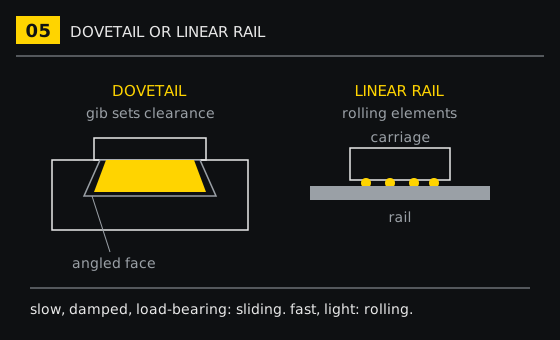
What the records do not do is compare the two. The precision field reads 0.03MM on ten records and 0.05MM on one, and it is worth reading it as a tolerance on the assembly rather than a positioning accuracy over the full stroke. Neither figure is a statement about a rail against a dovetail, because no record in this category carries both guides on the same body. The comparison has to be made on the job: a slow, damped, load-bearing axis suits a dovetail; a fast, light, repeatedly positioned axis suits a rail.
Screw or rack and pinion: how the plate is moved
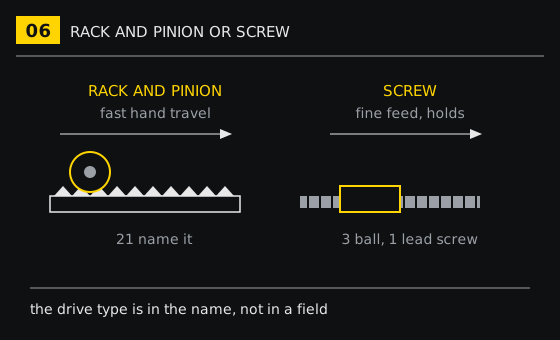
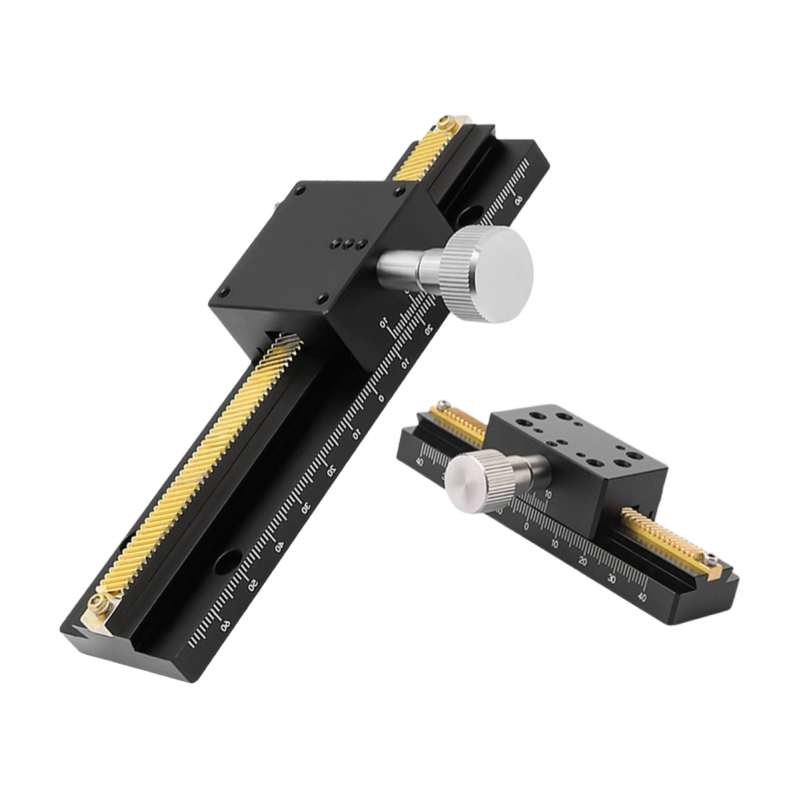
A rack and pinion is the long-travel answer: the knob turns, the pinion walks along the rack, and the plate covers distance quickly for a modest number of turns. Six names carry long travel and seven carry large stroke or long stroke, and the rack is what makes those numbers usable by hand. The same property is a liability on a vertical axis, where a rack will not hold a plate up on its own.
A screw is the setting answer. It holds where it is left, it feeds finely, and it converts a small hand movement into a small plate movement. The LZ family in this category is a lifting platform in eleven records, which is a vertical axis, and every one of those is screw driven: the screw is what keeps the plate from descending when the hand leaves the knob. A ball screw holds less well than a lead screw because it is designed to run with less friction, so a vertical ball screw needs a brake or a counterbalance that the record will not mention.
What the recorded numbers actually bound
Two thirds of this category carries two fields and no more: 59 of the 95 records give a material and a weight and stop. Thirty-six carry three or more. Eighteen answer the material field with the phrase Confirm from captured specification, which is a placeholder rather than a material. Twelve carry a finish reading Black OxideBlack Oxide, a doubled value that came from a scrape. One record puts 0.03MM-0.05MM in the weight field, which is a length sitting in a mass. One label reads Pseudolaric acid, and its value is Three-axis slide table. The precision field, present on eleven records, reads 0.03MM ten times and 0.05MM once.
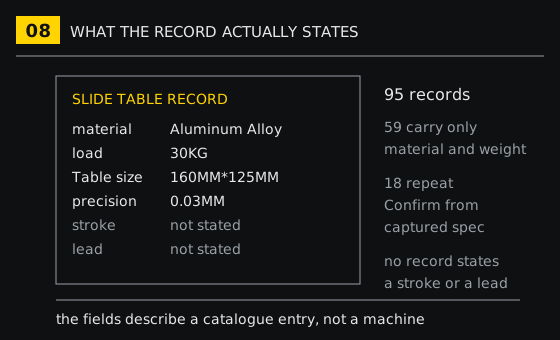
That is not a reason to distrust the category; it is a reason to read it correctly. These fields describe a catalogue entry: what the object is made of, how heavy it is, which family it belongs to, and what the seller expects to be asked. They do not describe metrology, and the numbers that matter for a purchase — travel, lead, load at the edge — are the ones a buyer has to ask for by name. A stage with 0.03MM in the precision field and no lead anywhere is a stage whose feel is still unknown.
Reading order at the bench
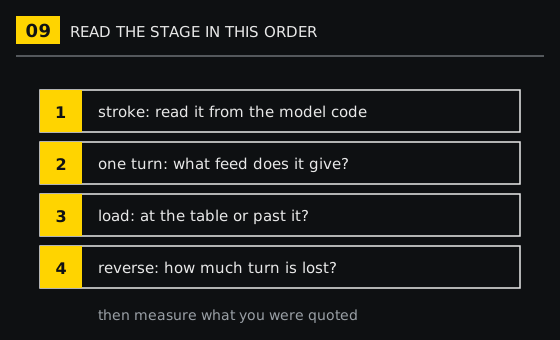
The order matters because each question eliminates a different mistake, and the cheapest questions come first. A stage with the wrong stroke cannot be fixed at the bench. A stage with an unknown lead can be measured in a minute. A stage that cocks under an overhang is a mounting problem as often as a slide problem.
- Read the travel out of the model code and confirm it against the drawing, plate at both ends of the stroke. Do not accept the code alone: LZ-200 to LZ-1000 is a family, not a table of dimensions.
- Turn the knob one revolution and measure how far the plate moves. That is the lead, and one division of the drum is the lead divided by the number of divisions.
- Put the real mass where it will actually sit, not in the middle of the plate. Check for cocking on the guide and for a gib that has to be tightened to stop it.
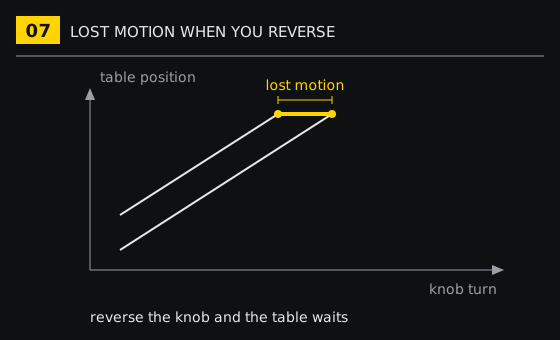
- Reverse the knob and watch a dial indicator on the plate. The turn that produces no movement is the lost motion, and it is the figure that decides whether a manual stage can be used for a setting operation at all.
- Only then look at the fields: material, finish, unit weight. They tell you what will arrive, not what it will do.
Related reading and the parts named here
The slide table category lists the records quoted above, by code and by body size. When a manual stage becomes a motorised axis, the A13 guide covers the axis count, the output type and the handwheel that have to match the machine, and the controller category is where those boards and handwheels are listed. When a plate stops repeating after a rebuild, the A2 guide gives the order in which the machine is checked, and the A10 guide covers how to read a record as a record rather than as a promise.
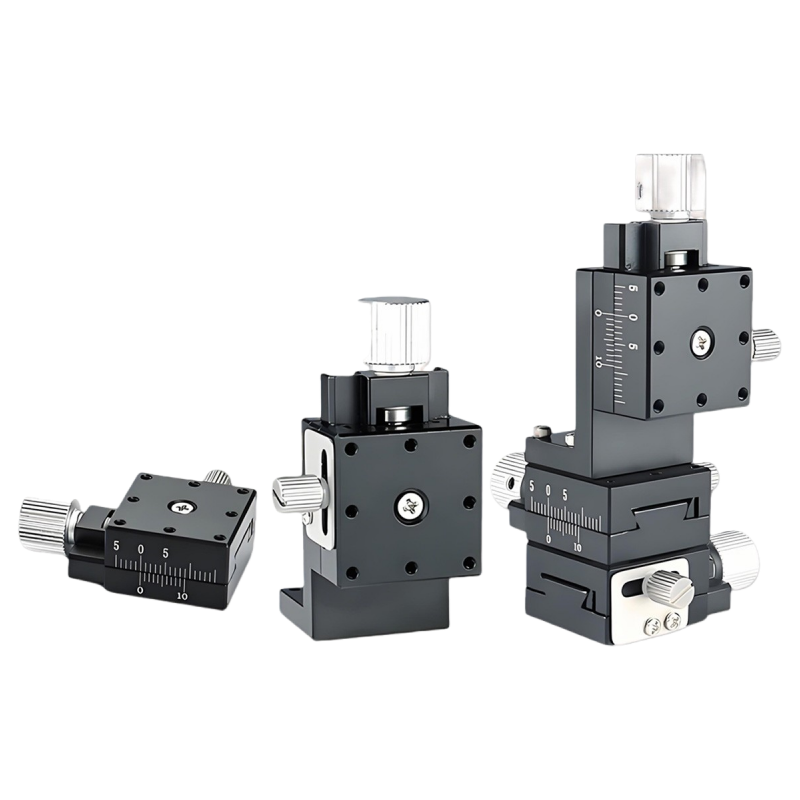
The stages cited above are the LZ-200 to LZ-1000 column family with its 160 x 125 mm table, the LZ-500 hand-crank stage at 30KG, the LZ-1000 at 8KG unit weight, the LZ40 micro-adjustable stage with its 10mm travel and 2kgf load, the LWX25 long-stroke dovetail stage with a rack and pinion drive, and the LWFX multi-axis dovetail platform. Send the travel, the load and where the load sits and the three numbers can be checked against a drawing in one exchange instead of three.