How to read one precision replacement part record before you order it
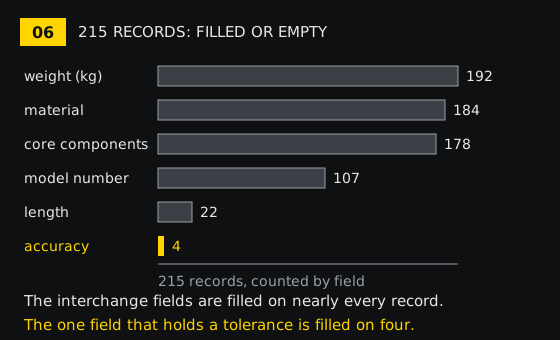
A replacement part is bought from a page of fields, not from a drawing. This category holds 215 records, and the five fields that get filled in most are material, weight in kilograms, core components, model number and length. Read what each one can and cannot decide, and the record turns into a shortlist: good enough to rule out the wrong family, not good enough to confirm that a part will go where the old one went.
A record is a listing, not a drawing
The category collects linear guide rails and blocks, cylindrical shaft and bushing sets, ball screws, lead screws, slide tables, worm gears and the small parts that go with them. All 215 records arrive with specs attached, and every one of them can be searched, sorted and compared on the page. None of them can be inspected on the page.
The fields exist because a listing needs fields, not because a drawing needs dimensions. A spec table generated from a catalogue keeps its empty rows as empty rows, and a row only holds a measurement when whoever wrote the text decided to type one in. That is why a record can look complete and still not say the one thing the buyer needs.
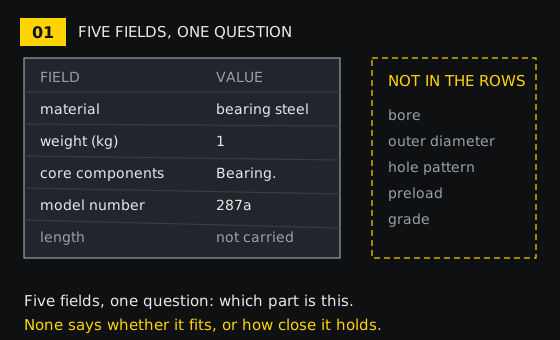
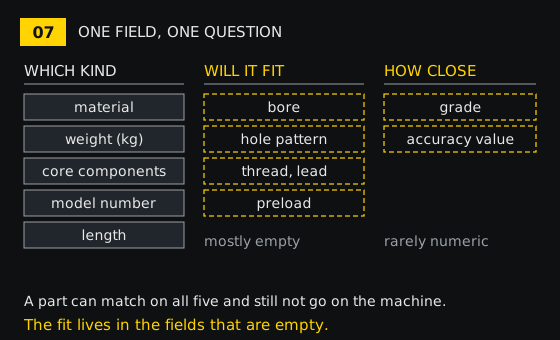
So the reading order is not top to bottom. It is by question. Each field answers one of three: which kind of part this is, whether it will fit the machine, or how close it holds. In this category the first question is answered almost everywhere, and the other two are answered almost nowhere.
The five fields that decide whether it is the same kind of part
Four of them appear on nearly every record, and the fifth appears on few, which is itself information. Read as a set they place the part in a family. Read one at a time, each can mislead in its own way.
material
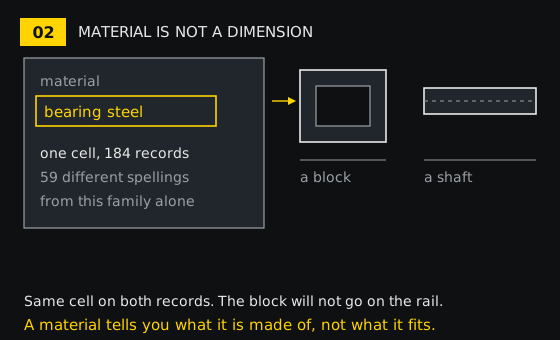
184 records carry it, written 59 different ways: bearing steel, Bearing steel, high carbon chromium bearing steel, acero 45#, Cf53 carbon steel, aluminium alloy, aluminum plastic, epoxy resin. That spread is not a data problem, it is what a material field is. It names the stock, not the geometry, not the hardness, not the grade. A slider record and a ball screw record in this category both answer bearing steel, and nothing about the two parts follows from that.
weight (kg)
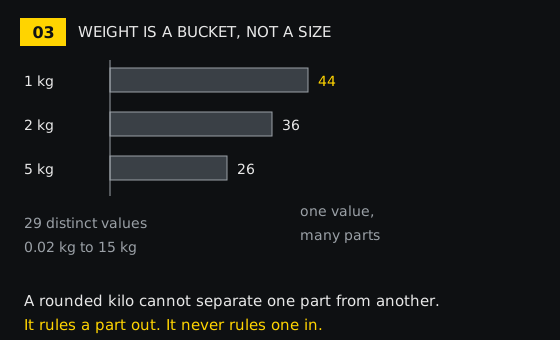
192 records carry it, and the numbers are rounded to a commodity figure. 44 records answer 1, 36 answer 2, 26 answer 5, and the whole category uses 29 distinct values between 0.02 and 15. At that granularity the cell separates a screw from a slide table and nothing finer. It is a shipping weight, not a mass budget, and it is the field most often mistaken for a size.
core components
178 records carry it. 95 say Bearing, ten say Bearing with a full stop after it, 14 say None, and 15 carry the same eight-item menu: Pressure Vessel, Gear, Motor, Gearbox, Engine, PLC, Bearing, Pump. That menu is a marketplace pick-list, not a bill of material. What the field reliably tells you is whether the part contains rolling elements. It says nothing about their class, their preload or their arrangement.
model number
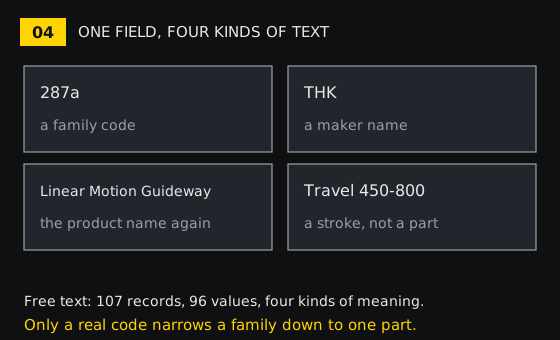
107 records carry it, with 96 distinct values, and the values are of four different kinds. Some are family codes a maker really uses: HGH, MGN/MGW, KK60. One is a maker name, THK. One is the product name typed out again, Linear Motion Guideway. One is a stroke, Travel 450-800, and one is a bare diameter, 20mm. The field is free text, so it narrows a family only when the value happens to be a code.
length
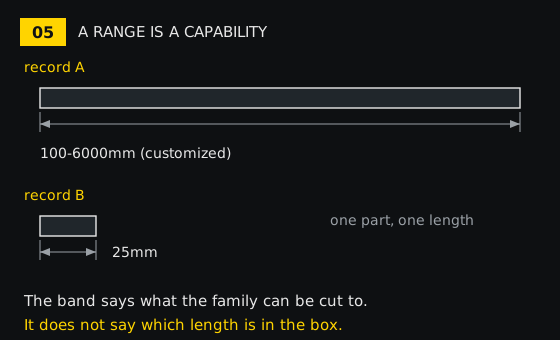
Only 22 records carry it, and most of those are not a length at all: 100-6000mm(customized), 100MM-5000MM, 500MM-1000MM, Customer provided, customizable. Two are actual figures, 300 mm and 25mm. A band tells you what the family can be cut to. It cannot tell you what is in the carton, and on a replacement part the difference between a band and a figure is the difference between asking and guessing.
What none of those five carries
Not one of them carries a tolerance, and that is the point of this page. Four records in the category have a field literally called Accuracy and a number in it, and the numbers are 0.03mm and 0.01mm, some of them with a greater-or-equal sign in front. Two more hide a figure under another name: positioning accuracy at 0.05MM, and lead screw accuracy at C7 (0.05mm or better). That is the entire numeric tolerance content of 215 records.
The rest is worse than missing, because it looks like information. Three records carry a Precision Rating, valued P0 or P0 p6 p5 p4 p2, which is a list of grades the family can be supplied in and not the grade of the part in the photo. Seven carry an Accuracy level, valued P3, P (precision level) and similar codes. One carries a Precision level reading medium to high. A reader who meets the word precision five times in one record has still learned nothing about tolerance.
The second trap is a row that exists with no value in it. The square flanged plastic bearing record lists Hardness, Shaft Diameter, Outer Diameter, Mounting hole diameter, Assembly Height and Allowed Axial Load, and answers every one of them Specifications. The dual axis roller guide record answers Shaft Diameter, Outer Diameter, Basic Dynamic Load and Allowed Axial Load with no. Those are not gaps in a table; they are the table telling you it has no data.
The fields that would decide whether it fits
Twelve of the 215 records carry a diameter field at all, under names like Shaft Diameter, Outer Diameter, Bore Diameter or Inside Diameter. One carries a mounting hole diameter. One carries a preload. Those are the numbers that decide whether a part goes onto the machine, and they are exactly the numbers the five popular fields do not contain. The record is not hiding them: it was built to describe a family, and a family does not have one bore.
Which leaves the product name, and that is where a size usually hides. The double nut record is called DFU2005 3205 3210 2510 1605 40, and 2005 is a diameter and a lead written together, in the name, outside the spec table entirely. A buyer who compares only the fields can line up a 2005 nut against a 1605 screw and discover it at assembly.
Four things to ask before ordering
If the record cannot answer the fit, the order has to. Four questions cover what the five fields leave out, and the first one is not about the new part at all.
- What is stamped on the part that is coming off? The listing name is a description and the stamping is an identity; where they disagree, the part in your hand wins.
- What are the bore or shaft diameter, the outer diameter and the mounting hole pattern, including the spacing between holes? The spacing is the number that decides whether a block bolts onto an existing carriage.
- What is the thread: diameter, lead, number of starts and hand? Left-hand screws appear in this family, and a left-hand nut started on a right-hand screw will engage and then bind.
- Which grade, and which preload, as a value rather than a class name? If the answer is one of five grades the family offers, ask which of the five is quoted.
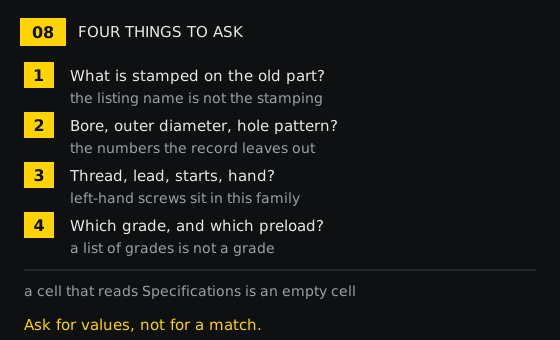
Ask them as values and write the answers down. A reply of Specifications, or no, or standard is not a refusal; it is the same absence the record has, and it means the fit is still unconfirmed. A part that arrives without those four numbers is a part you will measure on the bench, with the machine stopped.
A match is a shortlist, not a fit
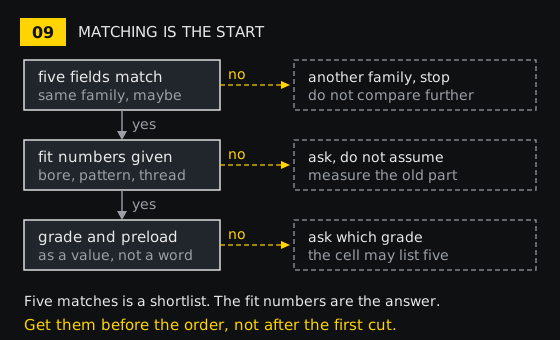
The three stages are not equally hard. The first is a page comparison and takes a minute. The second needs a caliper and the old part. The third needs an answer from whoever supplies the part, because a grade cannot be measured on a bench. Passing stage one and stopping there is the common mistake: a full match on five fields feels like confirmation, and it is only the end of the elimination.
There is a second reason to treat a match as provisional. Two records can agree on all five fields and still come from different production: same material, same weight to the nearest kilogram, same core component, same family code, with a different bore, a different lead and a different grade. Nothing in those five fields would show it, and no photograph would either.
One family read three ways
Three ball screw records show how much the fields vary inside a single family. The double nut record gives five: 1 kg, carbon steel, Bearing, Rolled Thread, and a length of 100MM-1000MM. The custom length record gives the same five keys: 2 kg, Cf53 carbon steel, Bearing, Rolled Thread, and 100-6000mm(customized). The ball screw set record gives three: 1 kg, Carbon Steel, Bearing.
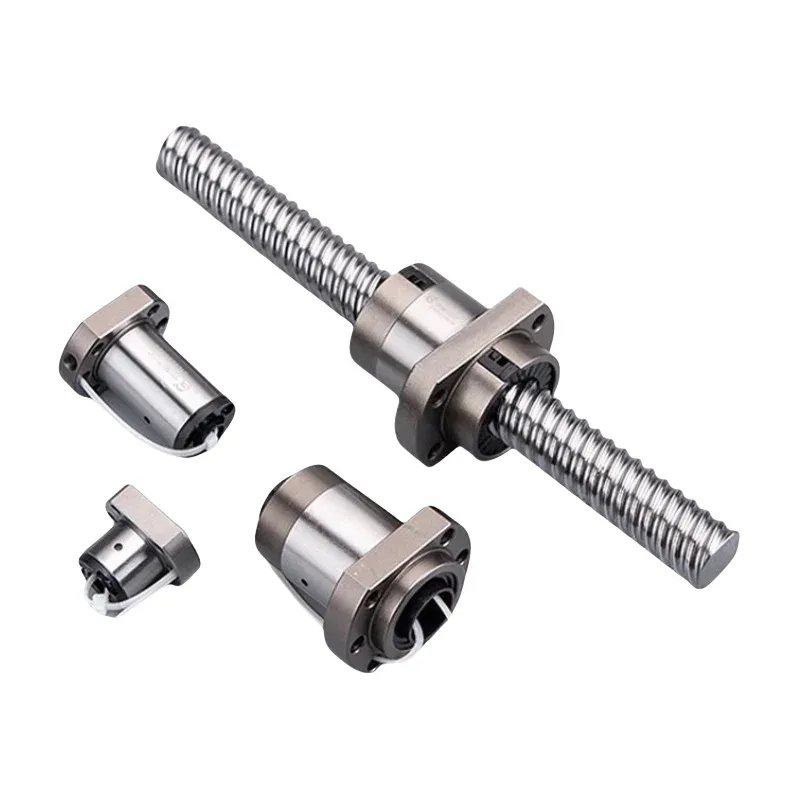
Read across them and the useful signal is small but real. The weight cell separates the 2 kg screw from the two 1 kg items, which is enough to see that they are not the same size and not enough to say which size either one is. The length cell separates a band that can be cut to order from a band that already has a fixed end. Neither cell carries the diameter, the lead, the preload or the grade, and one of the three records does not carry a length at all.
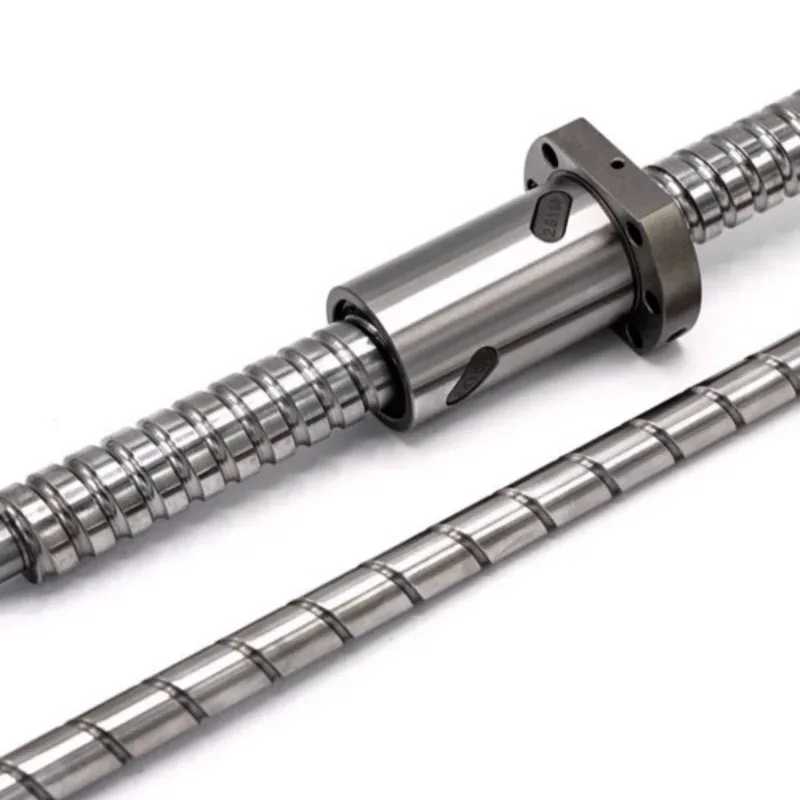
The three-field record is the important one. It is a complete record by the standards of this category: material, weight, core component, and nothing else. The photograph is clear, the part is recognisable, and the record still cannot tell you whether the nut will go onto the screw you already have. That is not a bad listing. It is what a listing is.
The same read on a guide record
Guide records show the opposite case, where the record is long and still stops short of the fit. The cylindrical shaft and slider record carries three fields: Steel, 5 kg, Slider. The square flange guide record carries twelve, including a model number of 287a, a precision level of medium to high, a rated dynamic load of 11.38-208.36kn and a sliding block fixing method of Fixed up and down. Twelve fields, and not one of them is a hole spacing.
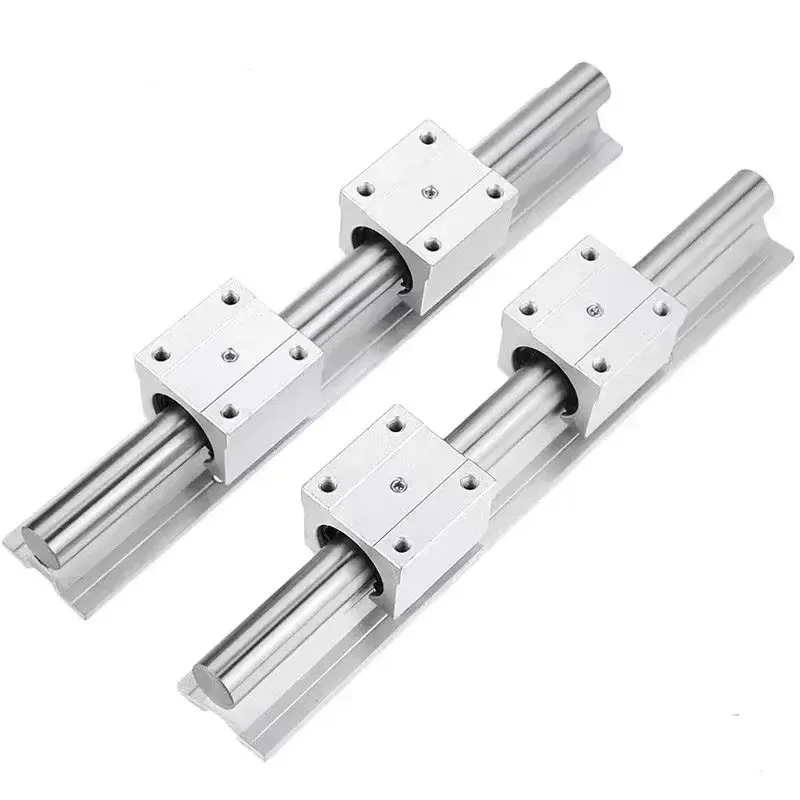
The photograph is the best evidence in the record and it is still not a measurement. It shows the shafts, the blocks, the mounting holes in the block flanges and the split in the housing. It does not show the hole pitch, and it cannot show the grade. A photo answers what the part is; only a number answers whether it fits.
What the five fields are good for
None of the above makes them useless. They are a fast filter, and a filter is what a listing is good at.
- Ruling out. A 15 kg part is not the 0.02 kg part you are replacing, and a copper screw is not a bearing steel rail. Two cells are enough to stop a wrong order.
- Finding the family. A model number code or a core component takes you from a category of 215 records down to a handful, which is the only way a catalogue stays usable.
- Writing the question. The fields give you the vocabulary for the message: material, weight, model, length. Add the four numbers from the old part and the question becomes answerable.
The failure is not in reading the fields. It is in stopping at them, and in treating a filled cell as a checked one. The record tells you what kind of part it is with some confidence, and how accurately it was made with almost none. Those are two different claims, and only the second one decides whether the machine still holds its number.
Related reading and the parts named here
The A3 guide covers the order in which runout is traced once a part is on the machine, which is the measurement side of the same question. The A2 guide covers what to check when accuracy drifts, and where a replacement part sits in that order. The records behind this page are listed under precision parts.
Records cited above: the custom length ball screw, the double nut ball screw, the ball screw set with nut and seat and the cylindrical shaft and slider set. Send the stamping, the bore and the hole pitch of the part you are replacing and we will tell you which records could hold it.