An OK clamp repeats on its seating face, not on its screw
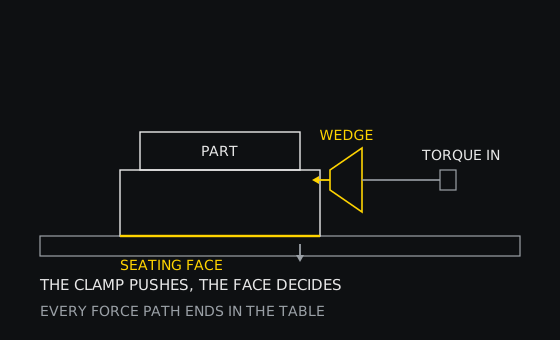
A wedge clamp is a simple machine: a screw pulls a wedge, the wedge pushes the part sideways, and the reaction travels down through the body into the table. Everything that decides whether the second part lands where the first one did happens in that last part of the path.
This category has 28 records. 14 of them carry a technical data field whose entire content is the sentence "confirm by inquiry". Another 18 do not say how the clamp is driven. So the honest starting point is that the geometry which makes these clamps work is almost never written down, and the buyer is expected to ask.
What is written down is worth reading carefully, because it is rare and specific: 3 records state a perpendicularity, 2 a parallelism, 2 a hardness of HRC48-52, and 5 a weight of 0.5 or 1 kg. Those nine numbers are the whole technical surface of the category.

Where the force actually goes
Torque goes in at the screw. The wedge turns it into a horizontal push on the part, and the part pushes back. That reaction has to be carried by something, and the only thing available is the body, sitting on its seating face, bolted or clamped to the table. The screw sets how hard you push; the face decides where the body was when you pushed.
A chip is an angle, not a distance
A chip under the seating face lifts one corner by a few hundredths of a millimetre. That sounds harmless until you notice it is not a translation but a rotation: a 0.02 mm lift over a 40 mm footprint tilts the body, and the part sits 100 mm above the face, so the error at the part is roughly two and a half times the chip. This is why the seating face gets stoned before it gets blamed on the clamp.
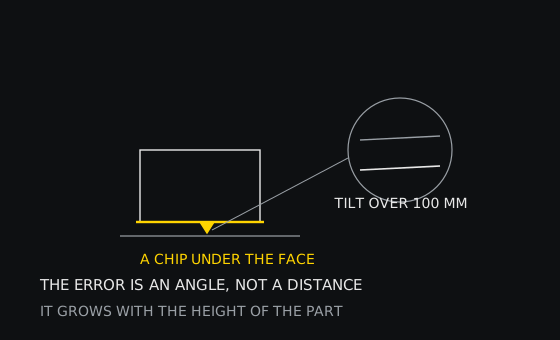
The same argument applies to the T-slot or the fixture plate the body is bolted to. If the plate is not flat, the clamp is not repeating, no matter how good the clamp is. In this category the plate is not sold with the clamp, and nothing in the records describes it.
Two errors that sound alike
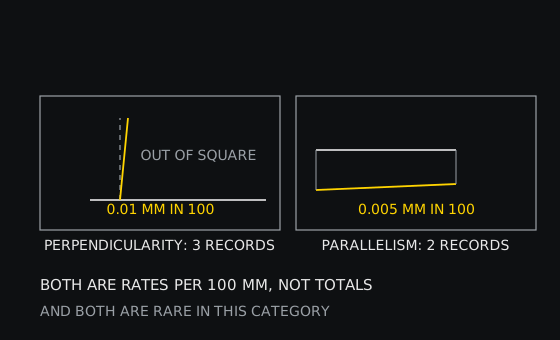
Perpendicularity is about one face relative to another at right angles: the jaw face standing square to the base. Parallelism is about two faces that should be equidistant: the two jaw faces, or the base and the top. Both are quoted here as rates per 100 mm, which means the error grows with size and you have to do the arithmetic for your own part.
The numbers in the records: 0.01 mm per 100 mm appears twice, 0.02 mm once, and 0.005 mm per 100 mm twice. Note the unit difference. One record states a rate, the other states an absolute figure with no length attached, and a reader comparing them side by side would be comparing two different things.
The thread is the ceiling on force
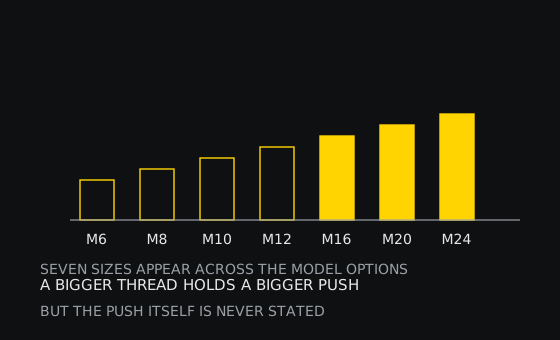
Model options across the category run from M6 to M24: M6, M8, M10, M12, M16, M20 and M24 all appear, in 17 records that list a model set at all. The thread does not tell you the clamping force, but it caps it: a bigger screw can be torqued harder before it yields, and the wedge multiplies whatever you put in. What the records never state is the force itself, not once in 28 records.
Eighteen records do not say how it is driven
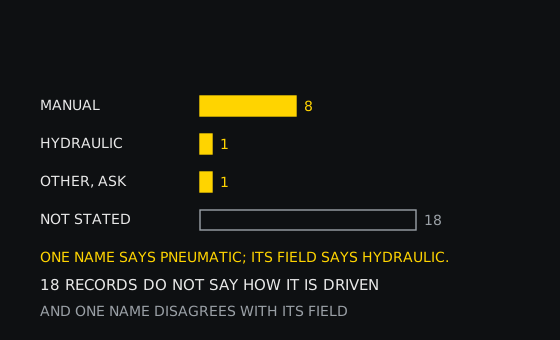
Drive mode appears in 10 records: manual eight times, hydraulic once, and once as "other, confirm by inquiry". The remaining eighteen say nothing. That matters because a manual clamp and a hydraulic one repeat differently: the manual one depends on the operator reaching the same torque, the hydraulic one on the same pressure.
There is also a record whose name says "Pneumatic Locking OK Vise" while its drive mode field says hydraulic. The other pneumatic record carries a separate locking mode field that does say pneumatic. Two records, two different stories, and a reminder that in this category the name and the field are written by different hands.
Expansion fixtures repeat to the bore
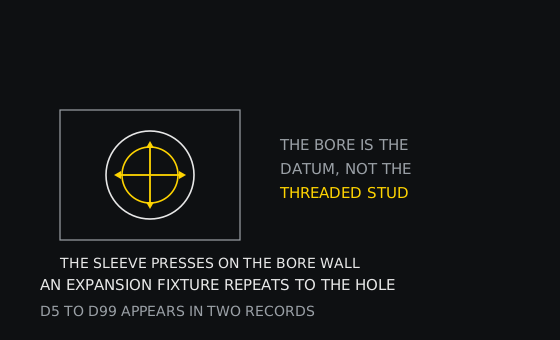
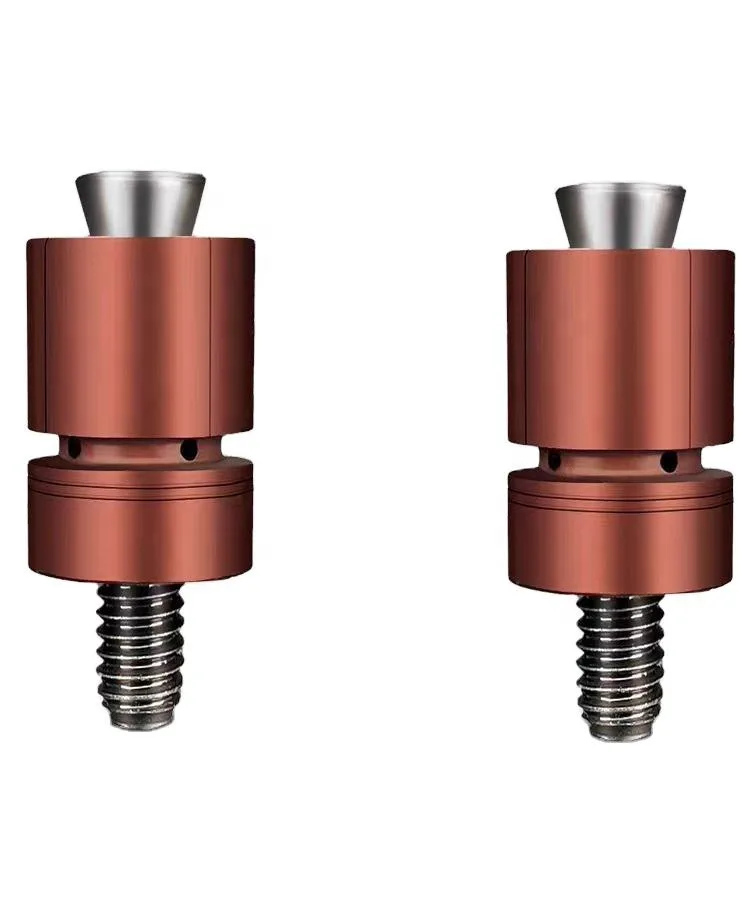
Two records describe internal expansion, one covering D5 to D99. These work differently: a segmented sleeve presses outward against the bore wall, so the datum is the hole itself, not the stud or the table. Whatever error the bore has, the fixture inherits, and whatever repeat the sleeve has, the part inherits. The threaded stud only pulls the wedge that expands the sleeve.
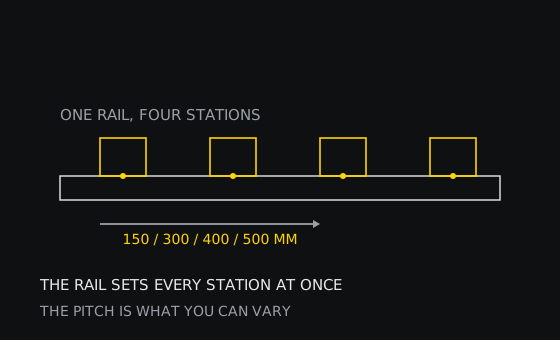
One rail, many stations
One record lists a rail in four lengths, 150, 300, 400 and 500 mm, carrying multiple clamps. On a rail the stations are set once, together, by the rail itself; what you can vary afterwards is the pitch between them. If the rail is straight, every station benefits; if it is bolted down twisted, every station inherits the twist, which is the same argument as the seating face at a larger scale.
Four checks that settle it
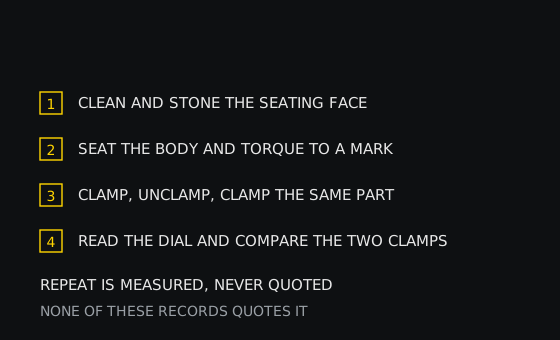
- Stone the seating face and the plate under it, then wipe both. Most repeat problems end here.
- Seat the body, torque to a marked value and note the mark, so the next clamp can be identical.
- Clamp a part, indicate it, unclamp, clamp again, indicate again.
- Compare the two readings. That difference is the repeat, and it is the only number that describes your machine.
None of those four steps needs a data sheet, which is fortunate, because 14 of these 28 records do not contain one. What they do contain is a thread size, sometimes a perpendicularity, and a weight. The rest is decided on the machine, at the face.
There is a second reason the seating face matters more than the screw, and it is arithmetic. A wedge multiplies force by the cotangent of its angle, so a small wedge angle gives a large push for a modest torque; that same multiplying geometry also means the wedge has to slide under load, and it does so on the two faces of the body. Wear there changes the wedge position before the screw ever feels different in the hand.
In practice this is why an old clamp that has been used for years still repeats when it is clean and stops repeating when it is not: the geometry has not changed, but the surfaces the wedge runs on now depend on how much grit has passed through them. The four checks below are aimed exactly at that, which is why none of them requires a data sheet.
One more thing worth saying about torque, because it is where most of these clamps are actually set: a torque wrench tells you what you put into the screw, not what the jaw put into the part. The wedge ratio sits in between, and it is not in any record. If two operators use the same wrench on the same clamp and get different parts, the wrench is not the variable, the face is.
Related reading and the parts named here
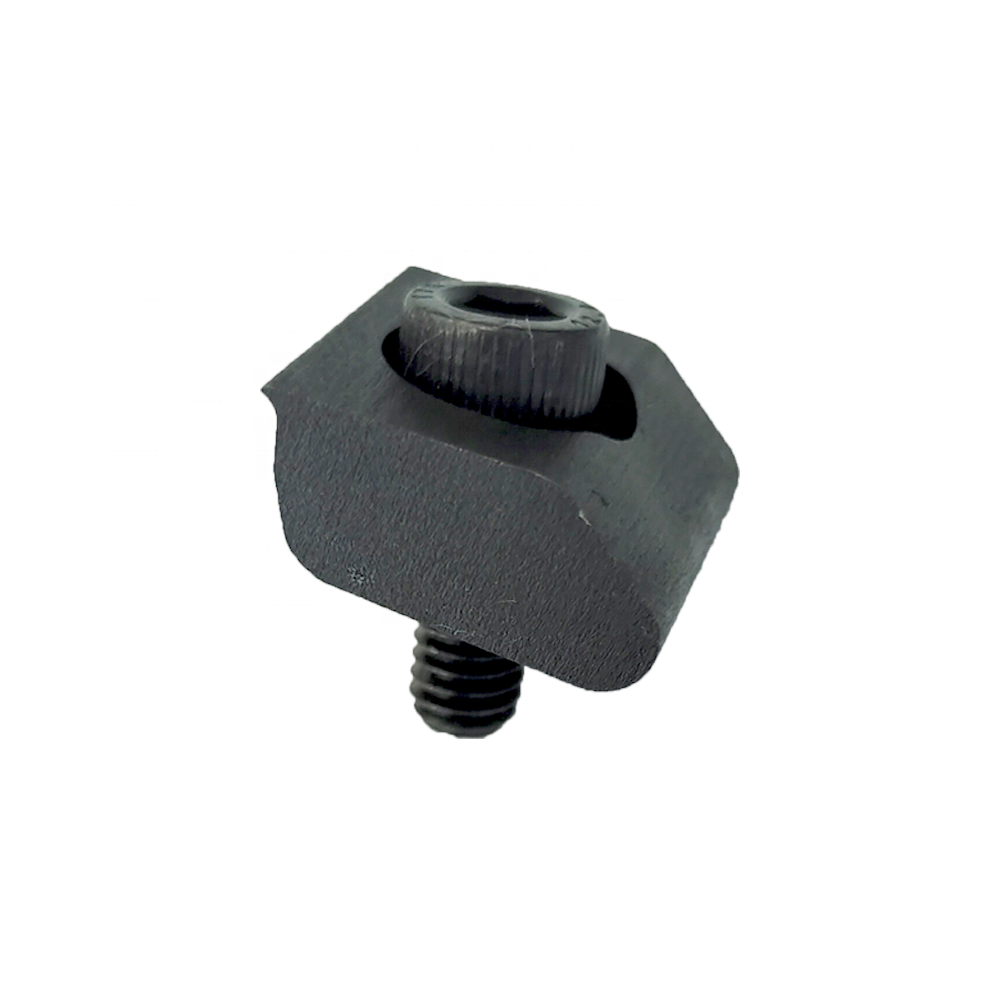
The same logic appears in the self-centering vise guide, where the jaws centre the part but the base decides where the centre is, and in the accuracy loss check order for the case where the clamp is fine and the machine is not. The category is OK clamps, and the parts quoted here are the integrated OK vise, the one-way tooth-surface wedge clamp, the side fixture clamp and the D5 to D99 expansion fixture. For the pump side of the same machine, see the lubrication pump guide.