A lubrication pump is three numbers, and none of them is the tank size
Every other category on this site has a spec table we can argue with. This one does not: all 53 lubrication records carry an empty spec field, so the title is the datasheet. That makes it a good place to learn which number does what, because the numbers are all you get.
A lubrication system fails quietly and then expensively. The pump does not stall, the machine does not alarm; a guideway simply stops getting oil and starts telling you about it in heat and stick-slip. Sizing the system is therefore an arithmetic exercise done once, at the desk, before anything is mounted.
The arithmetic needs three values and they are easy to confuse: how much oil the tank holds, how much the pump moves per minute, and how much arrives at each outlet per cycle. In this category the first appears in 13 titles, the second in 3, and the third in 2. The category has 53 records and 0 fields of structured data, so everything below was read out of product names and types.
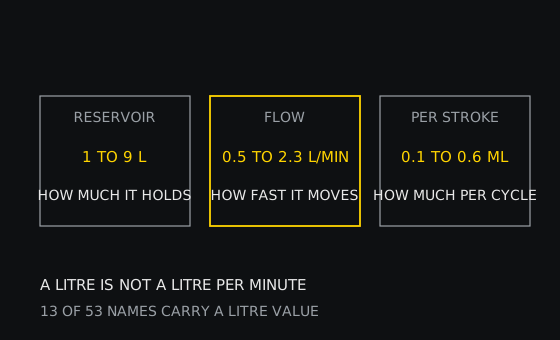
The name is the datasheet
Twenty-two records are typed as an automatic oil pump, twenty-eight as an oil distributor and three as a hand pump. Those three groups behave differently, and the difference matters more than any single figure in the name. An automatic pump decides when to inject; a distributor only divides what it is given; a hand pump waits for an operator who may not come.
Because the spec field is empty, every figure quoted in this article is visible in the product name itself, which means you can check the same numbers on the product page. If a number is not in the name here, the record does not state it at all, and that absence is itself information: it tells you what you will have to ask about before ordering.
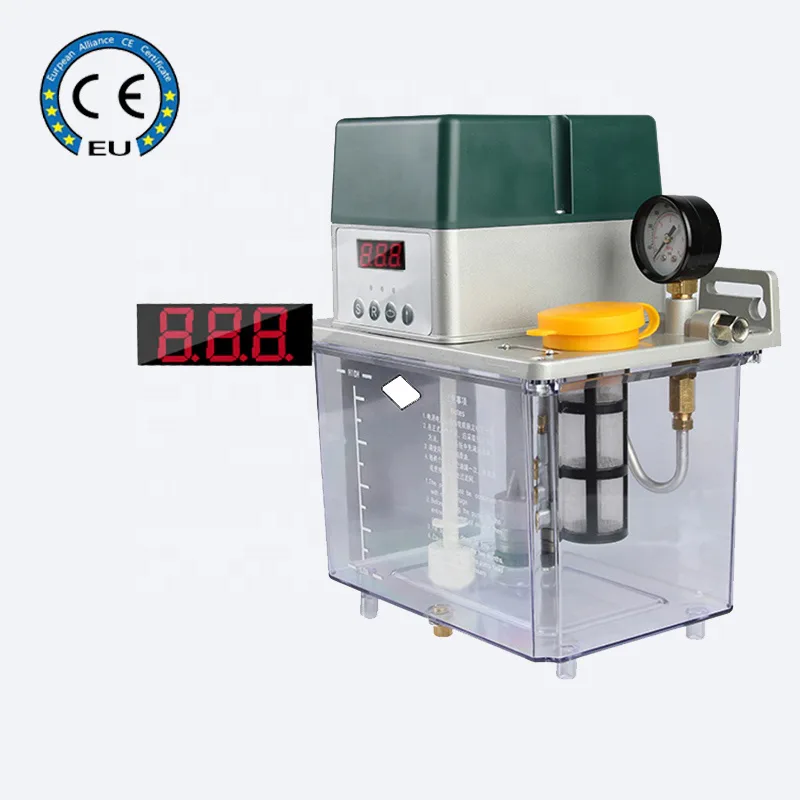
One title, two litres
The record for the DR5-3D reads: 0.5 litres per minute, 3 litres of oil. Both numbers sit in the same line and a hurried reader takes them as one figure. They answer different questions. The flow rate tells you how long the pump has to run to deliver a given dose; the tank tells you how often somebody has to fill it.
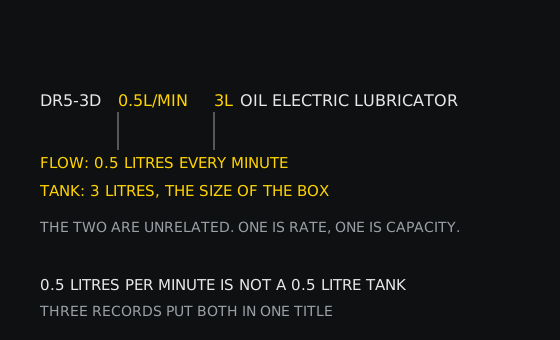
This is why "13 titles carry a litre value" needs a caveat: two of those thirteen are flow figures written with the same L, and only the slash tells them apart. A tank of 1, 2, 3, 4 or 9 litres appears across the category; the flow figures stated here are 0.5 and 2.3 litres per minute. A 2 litre tank on a pump moving 2.3 litres per minute empties in under a minute of continuous running, which is why these pumps run on a timer rather than continuously.
Ways are outlets, not volume
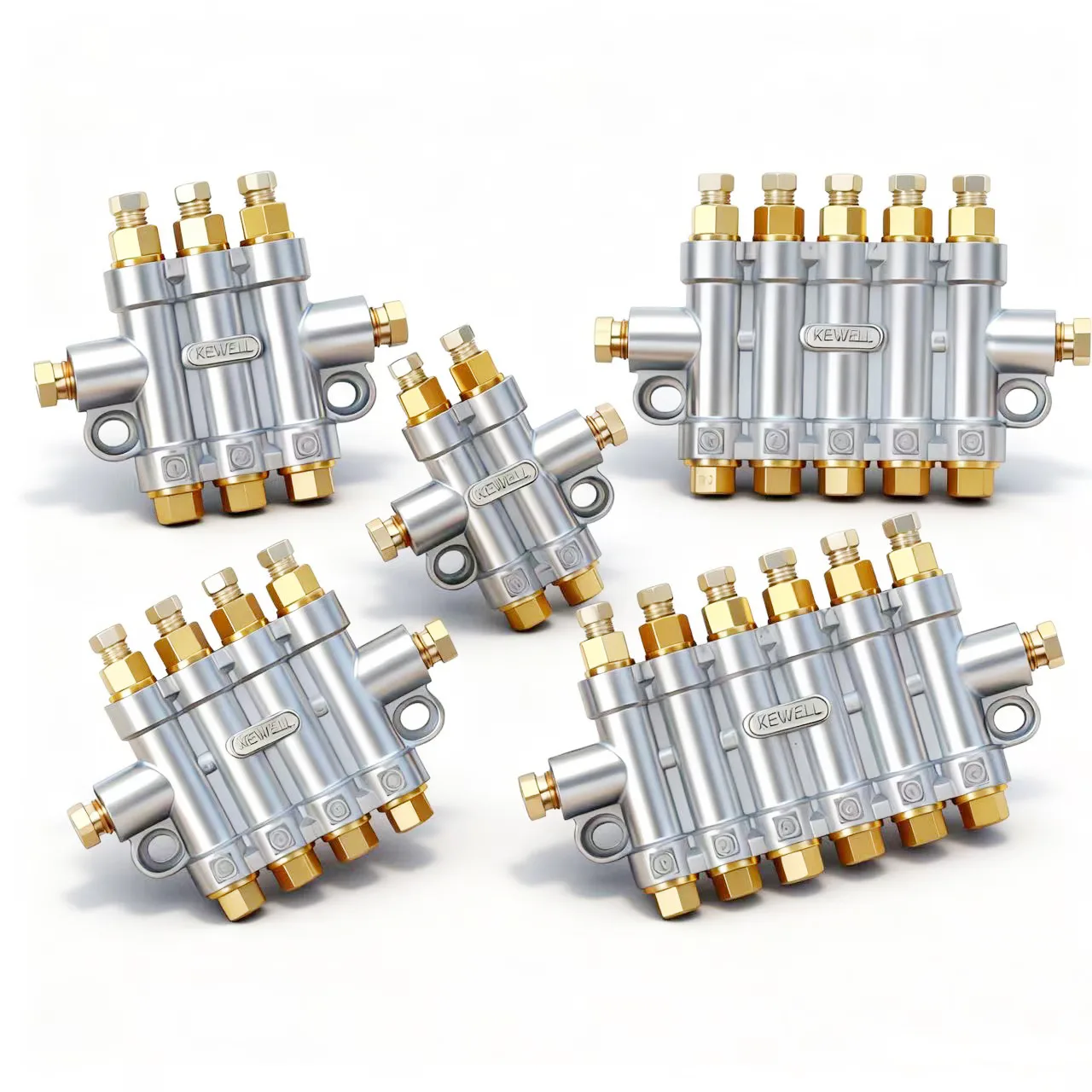
Twelve titles carry a way count: two, three, four, five, six. A way is one delivery point. The distributor blocks in this category are modular: the same body accepts two to six metering sections, and each section feeds one line. Buying a six-way block for a machine with four lubricated points leaves two outlets doing nothing unless they are blanked.
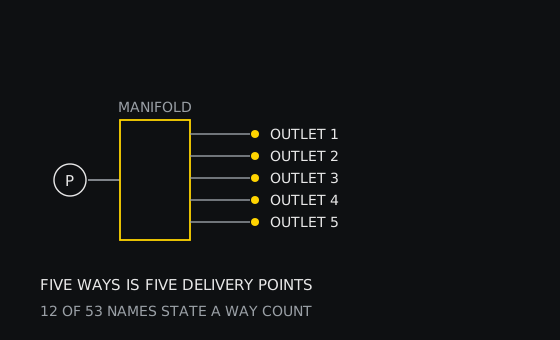
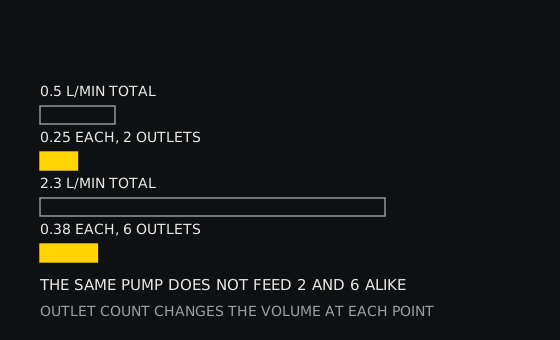
Divide the flow before you buy
The number that reaches a guideway is not the pump flow. It is the pump flow divided by the number of outlets, minus whatever the line loses. At 0.5 litres per minute over two outlets each point sees about 0.25; at 2.3 litres per minute over six outlets each sees about 0.38. Going from two points to six does not give you six times the lubrication, it gives you a sixth of the flow at each one.
Two records state an outlet size rather than a count: 4 mm and 6 mm tube, and two name their thread, M8 by 1 and M10 by 1. Those are the fittings you have to match, and they are a separate question from the way count. A six-way block with M8 outlets will not accept the 6 mm tube already on the machine without adapters.
Two mechanisms, one name
Gear pumps move oil continuously while the motor runs; solenoid pumps deliver one measured shot each time the coil is energised. The category mixes both under the same words, and only two records state a wattage, both 28 W, which is the signature of a small electromagnetic unit rather than a gear pump.
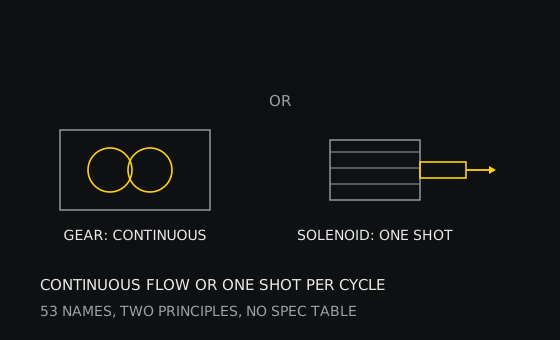
The practical consequence: a gear pump left running with a closed distributor builds pressure against a dead end, while a solenoid pump simply does not stroke. If the machine has long dwell periods, the second behaviour is easier to live with; if the load is continuous, the first delivers a steadier film.
The only number that is a volume
Two records state millilitres per stroke: 0.1 and 0.6. That is the only figure in the whole category that says how much oil arrives per cycle, and it is the one that closes the arithmetic. Ten strokes of 0.1 ml make 1 ml; two strokes of 0.6 ml already exceed it. If your cycle counter is set for a dose and the distributor is the 0.1 ml type, the counter has to run ten times as often as you assumed.
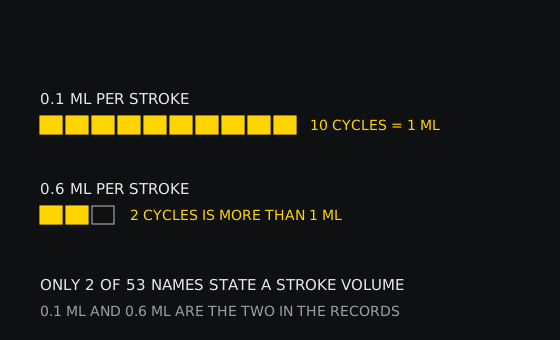
Where the record is silent on per-stroke volume, the question to ask the supplier is specific: how many millilitres per outlet per cycle, at the stated supply voltage. A supplier who can answer it has the metering section data; one who answers in litres per minute is quoting the pump, not the distributor.
How starvation shows up
A starved guideway does not fail at once. The film thins, friction rises, and the slide starts to stick-slip at low feed before any alarm appears. Heat in the nut comes next, and by the time debris shows up in the oil the wear has already happened. The order matters because each stage is cheaper to catch than the one below it.
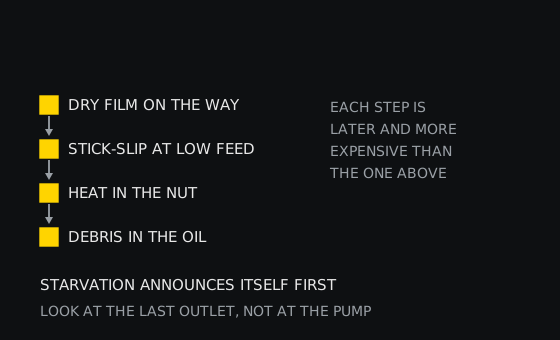
The diagnostic that catches it earliest is not at the pump. It is at the outlet furthest from the manifold: pull the line, run a known number of cycles, and see whether anything arrives. If the last outlet delivers, the divider is working; if only the first two deliver, the metering sections downstream are blocked or the pump is short-stroking.
The supply is part of the pump
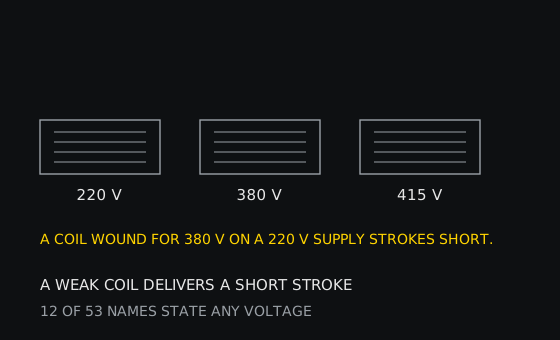
Twelve titles state a voltage: 220, 380 and 415 appear, sometimes as ranges such as 220 over 110, and one states 415 for a grease pump. A coil wound for 380 on a 220 supply pulls weakly and strokes short, which looks exactly like a blocked distributor: oil arrives, just not enough. Before condemning the divider, check the coil against the nameplate.
Four checks before you replace anything
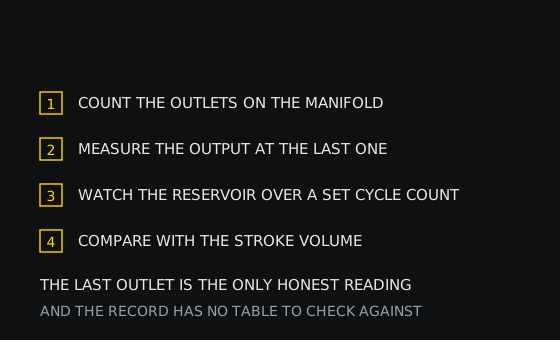
- Count the outlets on the manifold and note which ones are blanked.
- Measure the output at the outlet furthest from the block over a set number of cycles.
- Watch the reservoir level over the same number of cycles and compare with the expected dose.
- Compare the result with the per-stroke figure in the record, or ask for it if the record is silent.
A system that passes all four is delivering what its numbers promise. A system that fails the last one is not broken, it was sized on the pump flow instead of the flow per point, which is the mistake this category invites because the tank and the rate sit in the same line of text.
There is a second reason the seating face matters more than the screw, and it is arithmetic. A wedge multiplies force by the cotangent of its angle, so a small wedge angle gives a large push for a modest torque; that same multiplying geometry also means the wedge has to slide under load, and it does so on the two faces of the body. Wear there changes the wedge position before the screw ever feels different in the hand.
In practice this is why an old clamp that has been used for years still repeats when it is clean and stops repeating when it is not: the geometry has not changed, but the surfaces the wedge runs on now depend on how much grit has passed through them. The four checks below are aimed exactly at that, which is why none of them requires a data sheet.
One more thing worth saying about torque, because it is where most of these clamps are actually set: a torque wrench tells you what you put into the screw, not what the jaw put into the part. The wedge ratio sits in between, and it is not in any record. If two operators use the same wrench on the same clamp and get different parts, the wrench is not the variable, the face is.
Related reading and the parts named here
This article sits next to the guideway relining guide and the accuracy loss check order, because a starved way and a worn way produce the same symptom on a part. The category itself is at pumps and oil distributors, and the parts quoted above are the 2 litre electric pump, the ZLFA distributor block, the 0.1 ml per stroke piston distributor and the 4 mm manual pump. For a machine where the ways are already drilled, the OK clamp parts cover the other half of the setup.