A quick change tool post repeats on two slanted faces, not on the centre bolt
Seventeen records, thirty-three column names, and not one line that states a taper. The repeat of a quick change holder is decided by the two faces its dovetail closes on, and by nothing else in the stack.
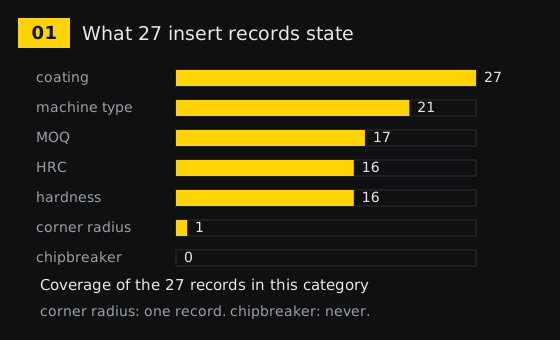
The catalogue carries 17 records in this category, and between them they use 33 different spec column names. Weight is written on all 17. The application line is written 23 times under four different spellings. Material appears 13 times, machine type 10, accuracy 4, repeatability 2. A taper designation appears zero times. A pull stud appears nowhere at all, not in a field and not in a name.
That is the honest starting point. A quick change tool post is bought for one reason, which is that the next tool lands where the last one was, and the attribute that decides whether it will is almost never written down. What follows is what the records do say, what they leave out, and the three measurements that fill the gap.
What a quick change holder actually repeats on
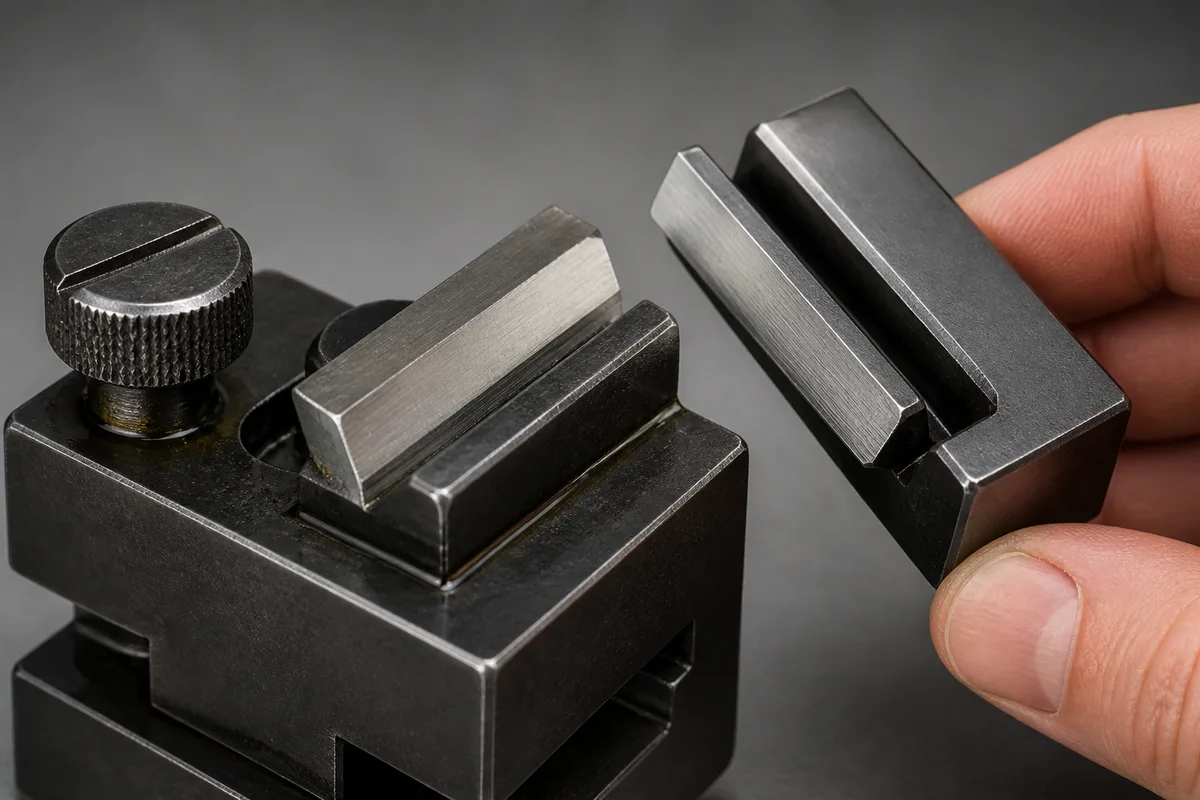
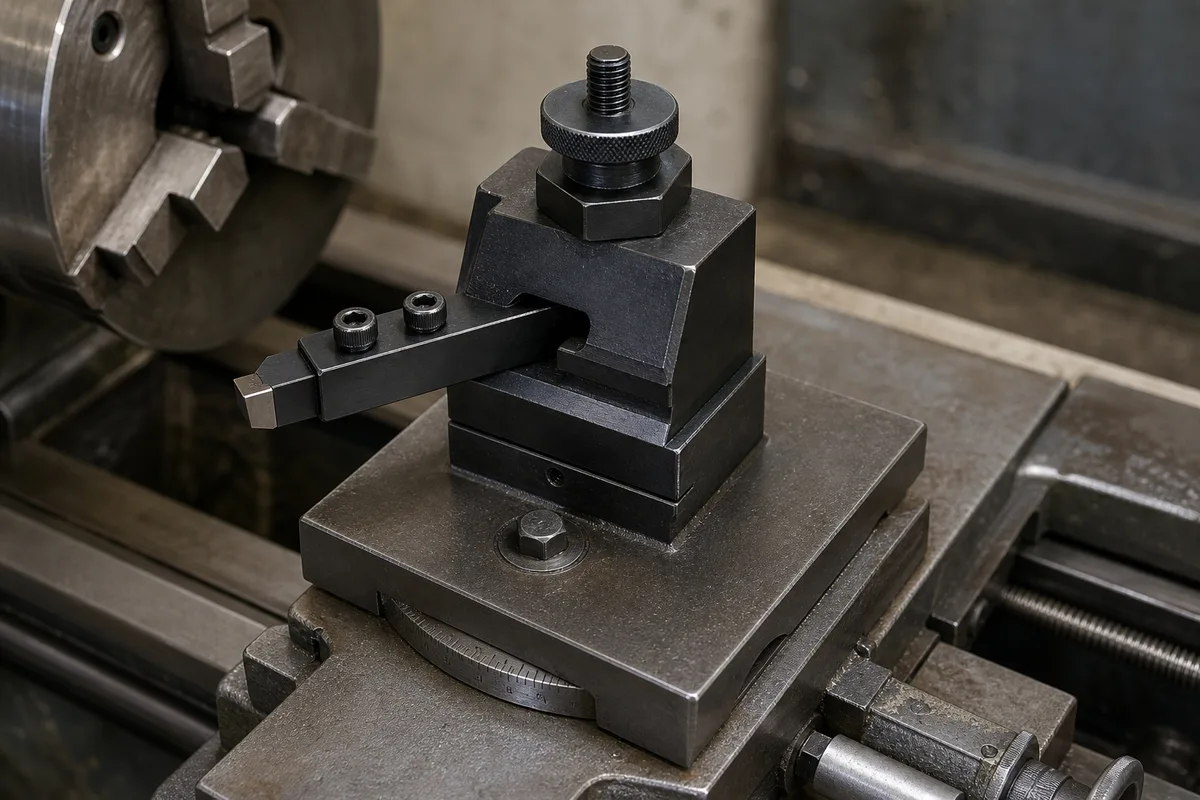
The body bolts to the compound rest and carries a dovetail. The holder carries the matching female form, drops onto the dovetail, and is pulled or pushed until it is seated. When the clamp is released the holder lifts off and the next one goes on. Everything about that exchange is decided by the two slanted faces the holder closes on.
It is worth being blunt about what does not decide it. The centre bolt fixes the body to the compound rest and sets the body's angular position once, at installation; after that it is out of the loop. The height adjuster sets the cutting edge on centre, which is a different question entirely. The T-nut locates the body in the slot, again once. None of those three is touched during a tool change, so none of them can be the source of a change-to-change error.
One flank is pushed and the other reacts. On a well-seated holder both are in contact, and the pair of them fixes two degrees of freedom: height and rotation about the vertical axis. That is the whole locating scheme, and it is why a dovetail with a burr on one flank throws the tool height off rather than sliding it sideways.
Wedge or piston decides which flank carries the load
Two clamping designs share the same dovetail. A wedge type draws the holder inward, onto the flank nearest the body. A piston type pushes the holder outward, so the holder bears on the opposite flank. Both end with the holder held on two slants and both repeat, but the face that takes the load is not the same face.
This is measurable in the wear pattern. A holder that has run for years on a wedge body shows a bright, polished band on its inner flank; the same holder on a piston body shows it on the outer one. If you are matching a second-hand holder to your post, that band is the fastest way to tell which design the holder came off, and a holder with a deep wear band on the wrong flank will not repeat on your body however carefully you seat it.
The records barely help here. The standard field says "Wedge type quick change tool post" once and "USA Type" once. Six more records write "Other" in that same field, and the remaining nine write nothing. So the one attribute that decides which flank wears is captured for two records out of seventeen.
Thirty-three column names for seventeen records
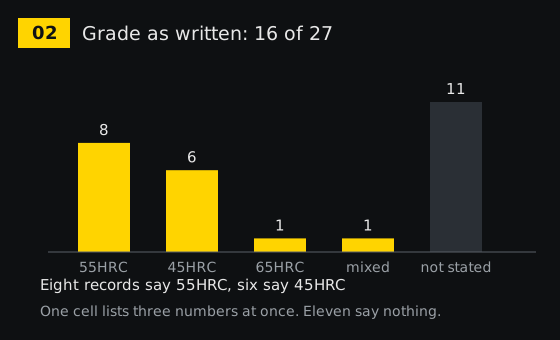
The application text is written under four headings: Application 12 times, application 5 times, Applicaion 3 times, and Application machine 3 times. That is 23 headings across 17 records, because some records carry two of them. Material is written as Material 11 times and as Meterial twice. The standard field appears in two cases. Core components appears in two. Six variants of two ideas, in a category of seventeen records.
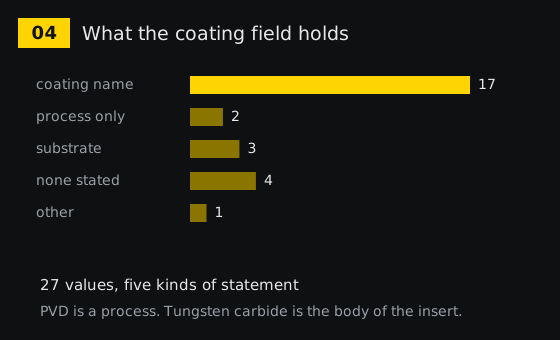
This matters at the counter rather than in a data review. A buyer who filters on the correctly spelled field returns 12 records and concludes that the other five have no application data at all. They do have it, spelled differently, and one of the spellings is a typo that nobody searches for. The same applies to material: 13 records carry the field, and the four that do not still carry a material attribute at record level, so the part is not undocumented, only under-described.
There is a practical consequence for anyone assembling a holder set from several sources. The only fields you can rely on across the whole category are weight, which is present on all 17, and the product name. Everything else is present on some records and absent or renamed on others, which means a comparison table built from these records will have holes in it that are not real absences.
Where the metal is hard, and where the field is borrowed
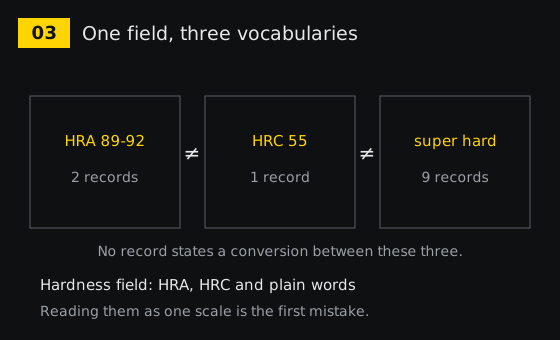
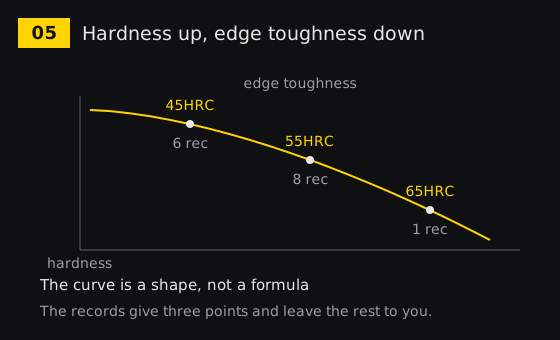
Hardness is written in five records. HRC35-40 appears three times in a plain hardness field. One record says "tool post body 55-62," with the trailing comma and no holder value. One says "tool post body 55-62, tool holder 35-40". So the body is quoted at 55-62 in two records and the holder at 35-40 in four.
Then there is the field that does not belong. Seven records carry a column called Gear Hardness with the value HRC58-62. A quick change tool post does not contain a gear. That column belongs to a lathe, and it has been pasted into a tool post record, most likely because both products were loaded from the same template. Read the category as a flat table and you will conclude that the body is 58-62, which contradicts the two records that say 55-62.
The version that is consistent with the mechanics is the simpler one. A holder at 35-40 running on a body at 55-62 means the dovetail on the holder wears first. That is the arrangement you want, because the holder is the part you can lift off and replace. It also tells you what to inspect on a used set: the body's flanks should still show original grind marks, and the holder's should show a polished band.
The 0.02 mm figure carries two different labels
Six records contain the figure 0.02 mm. Four put it in a field called Accuracy. Two put it in a field called repeatability. No record carries both fields, so nothing in the catalogue lets you compare the two, and no record says what the figure refers to.
The distinction is not academic. Accuracy is how close a reading sits to the nominal value; repeatability is how close successive readings sit to each other. A holder can repeat to 0.02 mm and still put the cutting edge 0.1 mm off where the drawing says it should be, because the offset is constant and the repeat is what varies. For a tool change, the number that matters is the second one. The number that is quoted, four times out of six, is labelled as the first one.
So the question to put to a supplier is not "what is your accuracy" but "what is the spread over ten changes, measured on a bar, with the holder re-seated each time". If the answer is a single figure with no test method attached, it describes a measurement of one part, not a property of the interface.
Names carry a series, not a specification
Nine of the seventeen names carry a 502, 503, 504 or 540 prefix. One is a BXA. Two are described as 40-position sets. Only five records carry a Model line at all, and three of those five say "Standard Model", which is a placeholder rather than a model. The real model information in this category lives in the product name, which is free text maintained by whoever loaded the record.
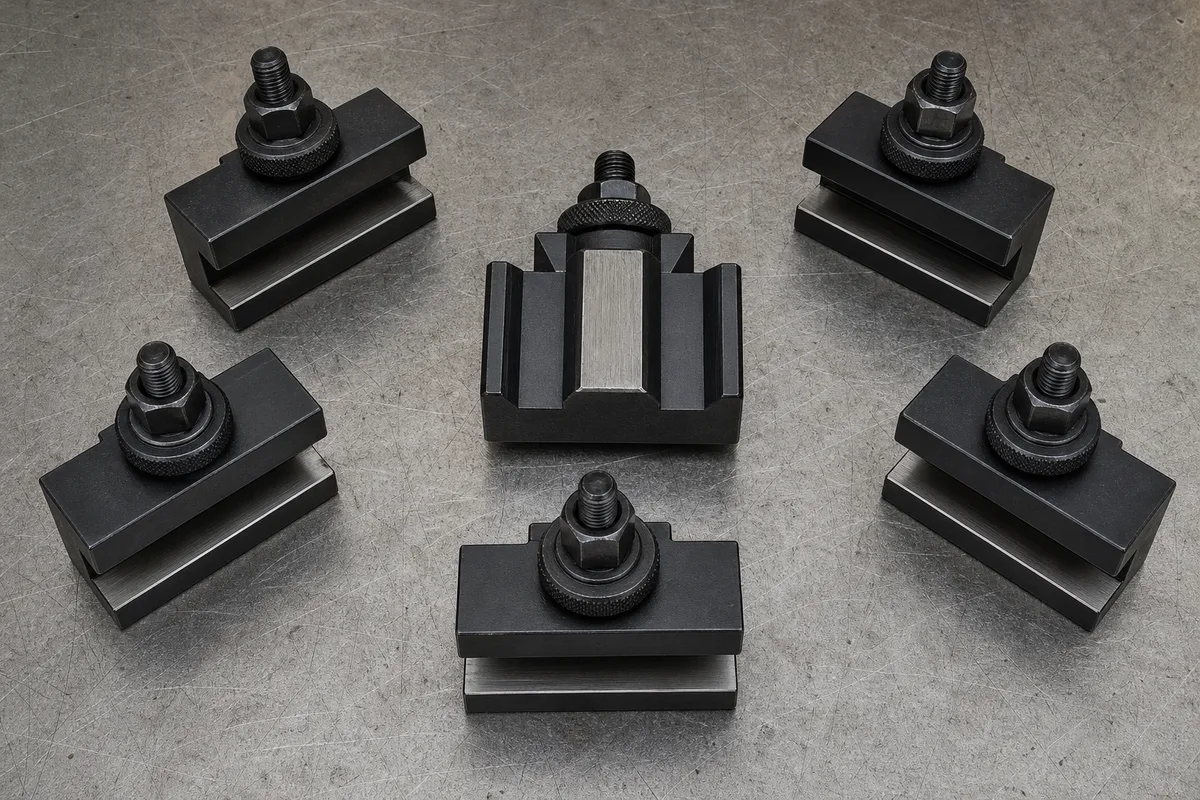
That is not a criticism of the names, which are descriptive enough to work with. It is a warning about treating a prefix as a specification. The records do not state what the numbers in 502, 503 and 504 mean, and nothing in the category states a dovetail angle or a flank width, so a series prefix tells you the family and the rough size class and stops there.
Sets are counted in four records
Four records give a piece count: one body with four holders twice, one body with five holders twice. A fifth record says "1 set" and nothing more. The remaining twelve say nothing, so a buyer comparing two listings has no reliable way to know whether the second one includes five holders or four.
Weight is the most complete field in the category and the least useful on its own. It runs from 1.6 kg to 25 kg, with six records at 10 kg. Two records that both weigh 4.5 kg differ in what they contain: one counts five pieces, the other says "1 set". Weight tells you the shipping class, and nothing about the contents.
Three things you have to measure yourself
The dovetail width, at a stated height. The faces are slanted, so the width depends on where you measure it. Pick a height, write it on the machine, and measure there every time. Two readings taken at different heights are not comparable, and neither is a reading taken at the ends rather than on the flanks.
The centre height. This is the distance from the compound rest top face up to the spindle centreline, and it belongs to the lathe rather than to the tool post. No record in this category states it, because no seller can: it is a property of your machine. Measure it once with a test bar and a dial indicator and keep the number.
The mounting. T-slot width, stud thread and centre bolt thread. The set descriptions mention a centre bolt, and one record mentions an MS bushing as an accessory, but no record states a thread size. Measure the T-slot across its narrowest point, and check the stud against a thread gauge rather than against the drawing.
The ten change test
Clamp a test bar in the chuck, bring a dial indicator onto it, and note the reading. Change holders ten times, re-seating each one the way you would in production, and note the reading after every change. The spread between the highest and lowest reading is the repeat of the interface. The average is not, and neither is the best single reading.
Read the pattern rather than the number. A spread that grows as the dovetail collects dirt is a cleaning problem, and it will come back every shift. A spread that stays put when you change holders but moves when you re-seat the body is a body-to-compound problem, and no amount of cleaning will fix it. A spread that appears only with one holder is that holder's dovetail, usually a burr on the flank or a wear band in the wrong place.
Do the test once on a new machine, write the spread on the headstock, and repeat it after any change of clamping element. It takes an afternoon and it replaces every claim in this article with a number that belongs to your lathe.
Related reading and the parts named here
The same locating logic appears in the collet holder runout guide, where the taper is the datum and the nut is not, and in the arbor taper contact and pull stud guide for the case where two tapers have to meet and only one of them can be adjusted. For the other end of the same spindle, the end mill pullout guide covers what happens when the clamping force is right and the holding force is not.
The category is quick change tool posts, and the parts quoted here are the quick change tool post and tool holders, the 40-position quick change tool post set, the AR-AP tool post and holder set, the 502B 503B style holder, the wedge type tool post and the BXA tool post holder.