When an end mill pulls out: what a collet cannot hold, and what a side-lock holder changes
This page is about one failure mode: the tool sliding in the holder under load. It is not about runout, which is the subject of the A3 guide, and not about which collet size to buy, which is the A7 guide. Here the question is narrower: why a friction joint lets go, why heavy climb milling with a long tool finds that limit first, and what a positive drive actually buys.
The failure is a depth change, not a break
An end mill that pulls out rarely snaps. It creeps: the shank slides a little inside the collet, the tip sits lower than it did, and the next pass cuts deeper than the one before. The sound stays normal, the edges stay sharp, and the only evidence is a step in the floor or a mark on the shank where the collet face used to sit.
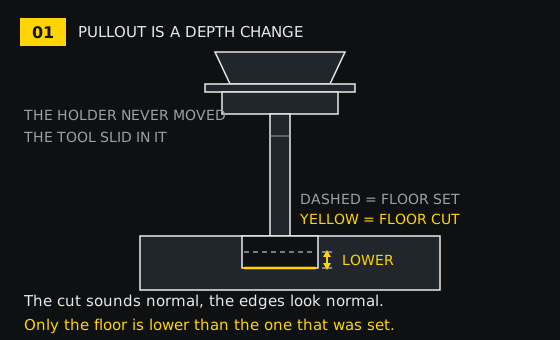
Because nothing breaks, the movement gets blamed on something else. A drifting Z offset, a machine that needs re-referencing, a cutter that is not the length it was measured at: all of those explain a depth change, and none of them is checked as quickly as the shank.
Where the turning force goes in an ER holder
The nut does not grip the tool. It pushes the collet into the holder taper; the taper squeezes the collet inward; the collet bore grips the shank. Every one of those steps is friction on a cone or on a cylinder. There are two friction joints in series between the spindle and the cut, and no key, no flat and no screw anywhere in that path.
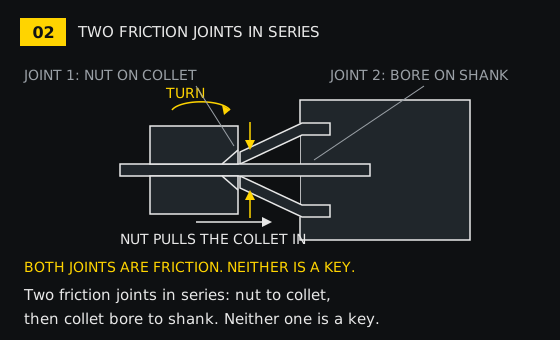
Friction drive is not a defect. It is why an ER holder can take any shank inside its band, at any depth, at any index angle, and why it indicates well when the surfaces are clean. It is also why the grip is a number that depends on the day: the same nut torque gives a different hold on a dry taper and on one carrying a film of coolant.
When the joint does move, both surfaces can move. The shank can turn inside the collet, and the collet can turn inside the taper. The second is easy to miss, because the tool still looks seated and the nut is still tight.
Why heavy climb milling and long overhang find the limit first
Three effects arrive on the same pass: an axial pull from the helix, a load that comes as a step rather than a ramp, and a lever that grows with overhang. None of them is a fault in the holder. Together they decide whether the friction joint is asked for more than it has.
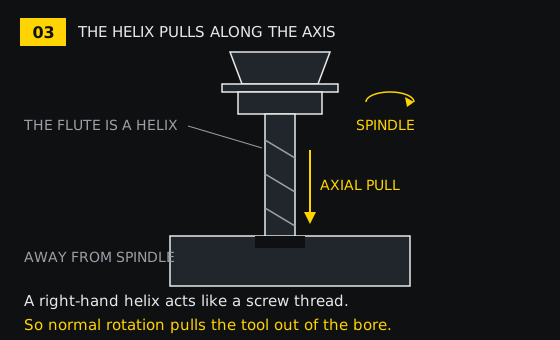
An end mill is a screw with cutting edges. Under normal rotation the helix produces an axial component that points away from the spindle, which is the same reason a drill self-feeds into the work. The holder resists that component with friction alone, and it is present in every pass, not only in the heavy ones.
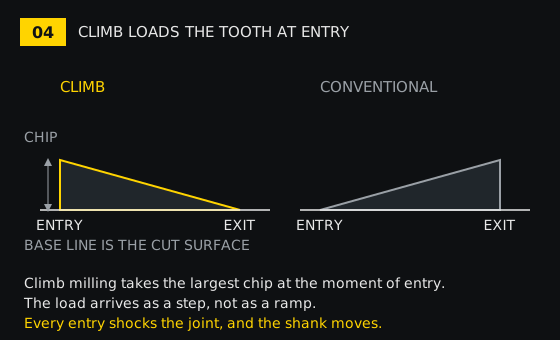
Climb milling changes when the load arrives. The tooth enters at full chip thickness and leaves at nothing, so the cut is a series of impacts rather than a smooth push. Each entry unloads and reloads the joint. A friction joint that is already close to its limit does not need one large force to move; it needs many small ones in the same direction, which is exactly what a climb-milling pass supplies.
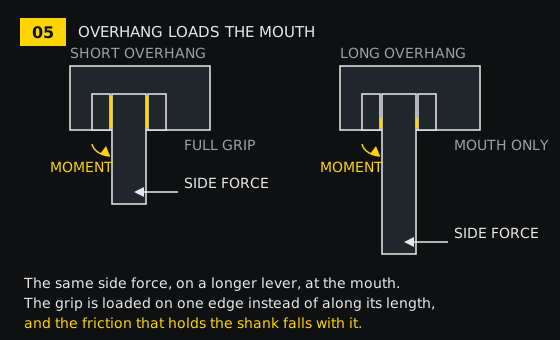
Overhang turns the same side force into a bigger moment at the mouth. The shank rocks in the grip, the contact moves to the front edge, and the friction that holds it falls with the contact area. A longer tool therefore has less grip exactly where it applies more leverage.
Why another half turn on the nut does not buy grip
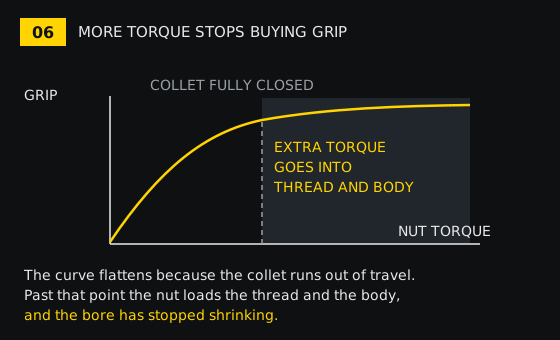
The nut does not squeeze the bore directly. It pulls the collet into the taper, and the taper converts axial pull into radial squeeze. That conversion loses force to thread friction and to the nut face, and the first part of the travel buys grip quickly because the collet still has room to close.
Then the collet closes on the shank, and the curve flattens. The bore cannot get smaller, so extra torque goes into the thread, the nut face and the body. Grip does not rise; wear does. A nut face that has been crushed returns less of the torque to the collet the next time it is tightened.
There is a second reason not to chase torque. The coefficient of friction belongs to the surfaces, not to the effort. On a taper carrying a film, more normal force raises friction in proportion, but the coefficient is still the low one. Tightening cannot clean a taper.
What a side-lock holder changes, and what it costs
A side-lock holder replaces the friction drive with a shape. A screw through the body wall bears on a flat milled into the shank, and the flat cannot pass the screw, so rotation is blocked by geometry rather than by how clean the surfaces happen to be.
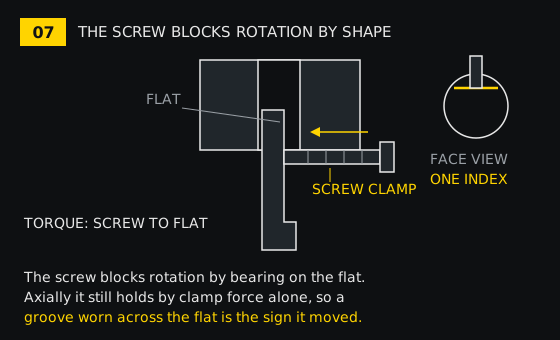
Axially the screw still holds by clamp force, on a much smaller area than a collet bore. A side-lock holder therefore stops the spinning and improves the pullout resistance without making pullout impossible: the witness is a groove worn across the flat, where the screw has pushed the tool along.
- The flat fixes the index. The tool only goes in with the flat facing the screw, so the trick of rotating a tool to average out its runout is no longer available.
- The screw marks the shank. Every clamp presses a burr into the flat. The burr makes the tool hard to withdraw, disturbs balance, and grows with each tightening.
- A small shank has no room for a flat. Milling one removes a large part of the section and leaves a stress riser exactly where the bending moment is highest.
None of that argues against the type. It argues for using it where it was designed to be used: heavy roughing, long overhang, and a tool that has already walked in a collet.
Three reasons a holder lets go in service
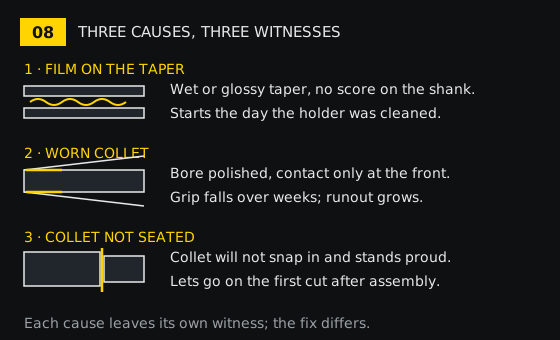
A film on the taper. Oil, grease or a coolant residue lowers the coefficient exactly where the drive depends on it. The tell is the timing: the tool starts moving the same day the holder was cleaned, or after a coolant change. The taper looks glossy or wet, and the shank carries no scoring.
A worn collet. The bore loses contact at the back first and becomes bell-mouthed, so the grip shrinks to a narrow band at the front. The tell is the trend: grip falls away over weeks, runout grows, and a polished band with black oxide debris sits at the front of the bore while the back never touches.
A collet that never seated. The collet has to snap into the nut before the nut goes onto the holder, because the ring in the nut is what draws it out again. Fit it the other way round and the ring does not engage the groove: the collet stands proud, never reaches the taper, and the nut spins on with almost no resistance. The tell is the moment: it lets go on the first cut after assembly, not after weeks.
- Timing: the same day as a clean-down points to a film; a slow decline over weeks points to wear; the first cut after assembly points to seating.
- Witness on the shank: clean and polished means the surfaces slid on a film; fretting and black debris at the front mean the contact band has moved; scoring along the length means the collet never gripped there.
- Index test: rotate the tool a quarter turn and clamp it again. If the pullout follows the tool, look at the shank; if it stays with the holder, look at the taper and the nut.
What the records in these two categories specify
The two categories behind this page hold 140 records under Collet& Holder and 48 under Arbors. Between them they cover the families a pullout question actually lands on: BT30, BT40 and BT50 ER32 bodies, ER collets from ER11 to ER40, SK chucks in BT30 and BT40, HSK63A collet chucks in GSK10 and GSK16, NT30 and NT40 ER bodies, and on the arbor side Morse taper sleeves, drill chuck arbors and through-hole face mill arbors.
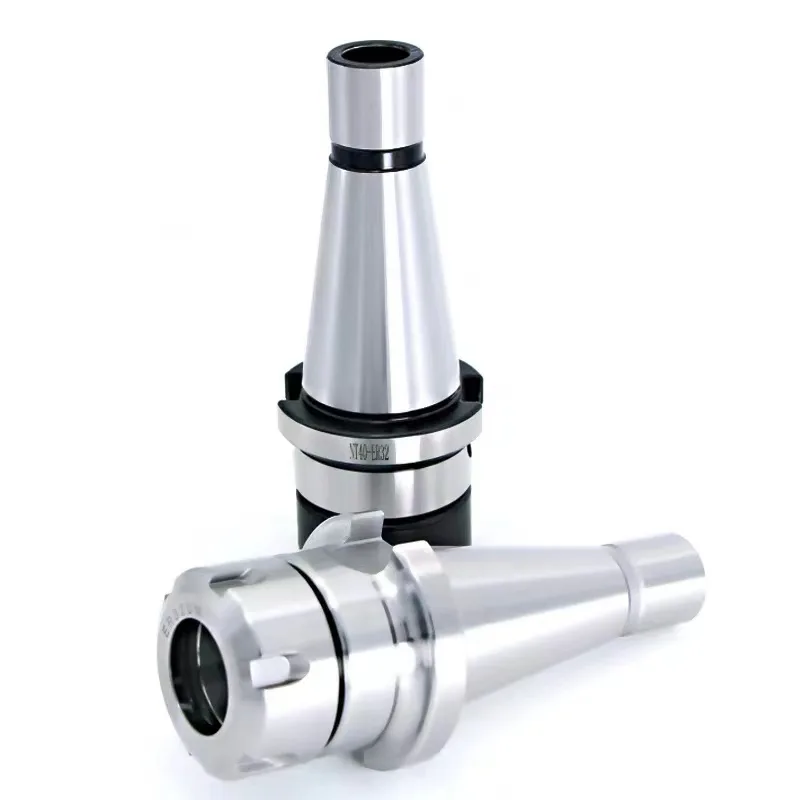
- Body material. Steel, stainless steel, 40Cr and 40CrMnTi appear across the ER and NT records; the arbor records use 40CrMo and alloy steel.
- Hardness. One NT-ER record gives HRC 46-50, the ER collet-chuck records give 45 HRC, the arbor sleeves give HRC 50-55, and one drill-chuck arbor gives HRC 44-48.
- Accuracy. SK chucks are quoted at 0.003 mm and one collet set at 0.008 mm; the arbor sleeves run 0.01 to 0.015 mm or 0.015 to 0.02 mm, and one oil-circuit sleeve carries a run out of 0.008 mm.
- Machines and work. The applicable machine field names the CNC machining centre, the engraving machine, the lathe and the milling machine, with milling, drilling and boring as the work.
None of those figures is a grip figure. Hardness, accuracy and runout describe a part; they do not describe the force it will hold under a cut. The records carry no torque value and no clamping force, and this page does not invent either of them.
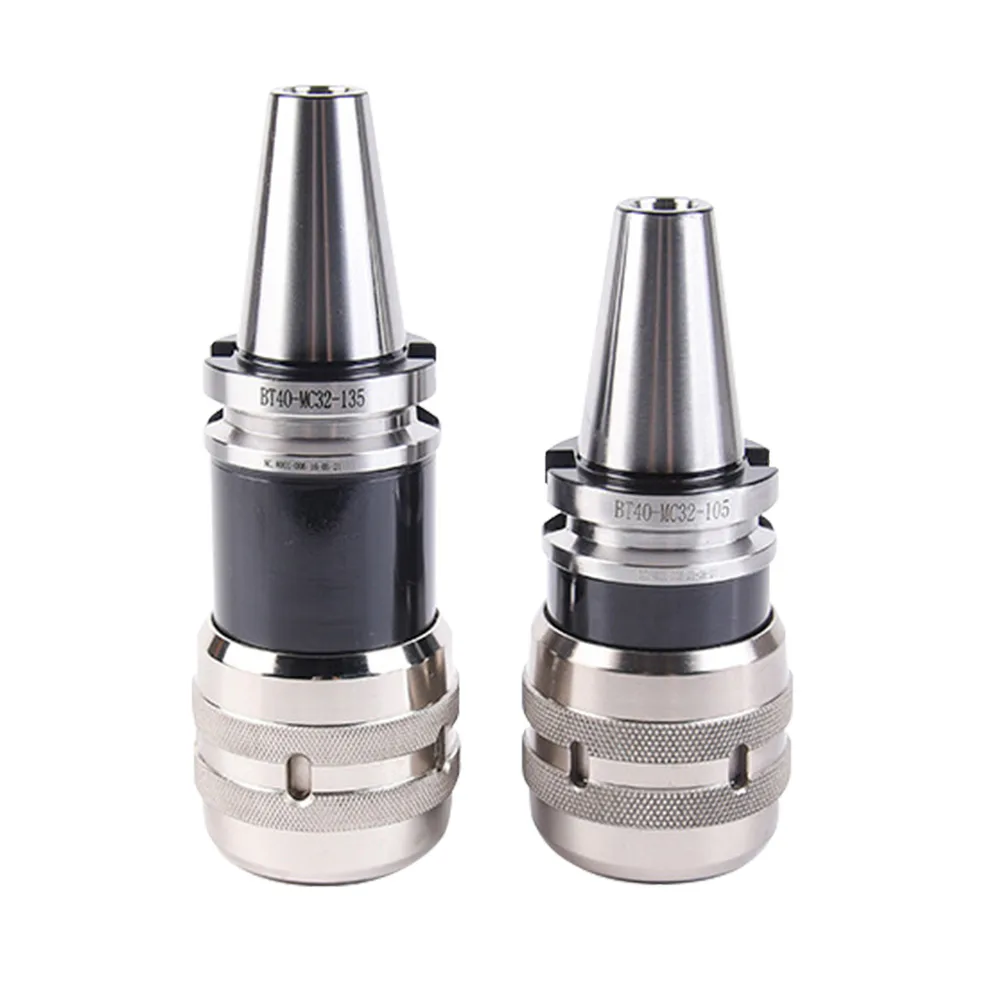
The stamping matters more than the listing name when a holder comes off a machine. The interface, the body type and the length are all on the flange, and two holders that look identical in a photo can be different bodies with different drive geometry inside.
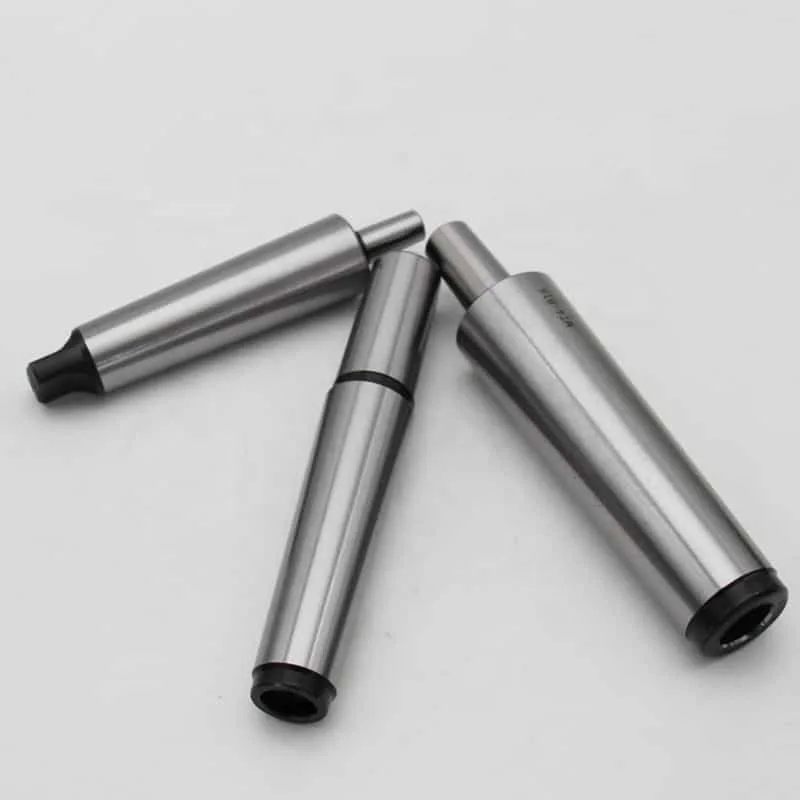
The arbor records make the same point from the other direction. A Morse taper arbor is held by the fit of the taper, but the parts that keep it from turning and from being pushed out are the tang and the drawbar thread, and both are listed in the record. Friction is the seat; the tang and the drawbar are the drive and the retention.
Choosing between them for a job that has already pulled out
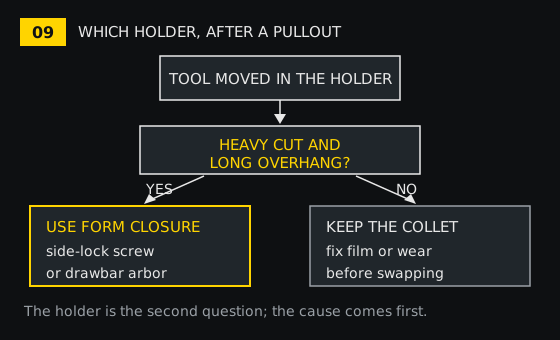
Changing the holder without answering the first question moves the problem rather than solving it. A new side-lock body on a machine that has been pulling tools because the taper was wiped with oil will simply take longer to show the same symptom.
- Stop and mark: put a line on the shank at the collet face, run the pass, and see whether the line moved.
- Clean both tapers, dry them, re-clamp to the specified torque with a nut whose face is not worn, and repeat the pass.
- If it now holds, the cause was the film. Change the cleaning routine, not the holder.
- If it still moves, check the contact band and the seating: a band only at the front means a worn collet, a collet that will not snap in means it was fitted the wrong way round.
- If a sound holder still lets go on a heavy climb-milling pass with a long tool, move the drive to form closure: a side-lock body, or an arbor with a drawbar or a tang.
For finishing, for small tools and for work that changes every hour, the collet stays the better tool: it indexes freely, takes any shank inside its band and indicates well. The mistake is asking it to do the roughing job that a positive drive was invented for.
Related reading and the parts named here
The A3 guide covers the order in which runout should be traced, which is the measurement side of the same interface. The A7 guide covers the band a collet actually grips and why a nominal shank is the worst fit. Both categories are listed under Collet and holder and Arbors.
Bodies cited above: the BT30, BT40 and BT50 ER32 holder, the NT30 and NT40 ER body in 40Cr, the key-type drill chuck arbor and the Morse taper arbor with drawbar and tang. Send the holder stamping, the tool shank size and the cut that pulled it and we will tell you which of the two routes the job belongs to.