Collet and tool-holder runout: the order to check it in
This page is about finding where runout actually comes from on an ER or BT setup. Measuring it more precisely is the easy part; deciding which part to change is the page.
What runout actually does
Runout means the cutting edge is not where the machine thinks it is. A four-flute cutter with runout does not cut four equal chips: one or two flutes carry most of the load and the rest rub. The symptoms are easy to misread — a finish that will not clean up, holes that come out oversize or tapered, chatter that starts at a certain depth, small tools that break long before they are worn out.
None of those symptoms name the part at fault. That is the problem this page is about: not how to measure runout more precisely, but where to look once you know it is there.
Four interfaces, one reading
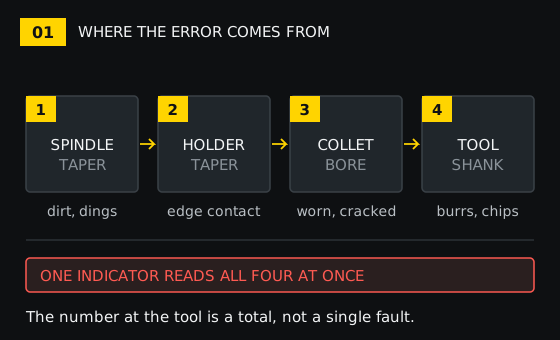
The reading at the tool is a sum. The spindle taper, the holder taper, the collet and the tool shank each add their own error, and the indicator sees all of it at once. Replacing a collet when the taper is dirty, or replacing a holder when the collet is worn, is the usual mistake — because the part that gets replaced is the part that is easy to reach.
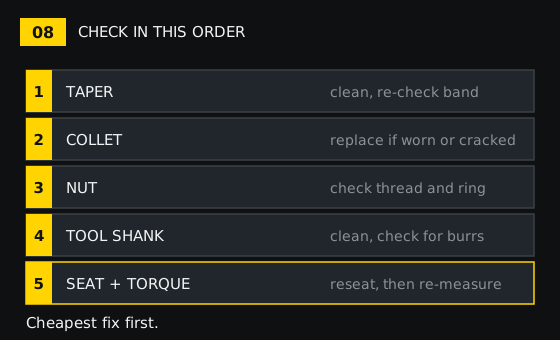
The order below follows cost. Cleaning and re-measuring is almost free. A collet is a consumable. A holder is not.
The parts you are checking
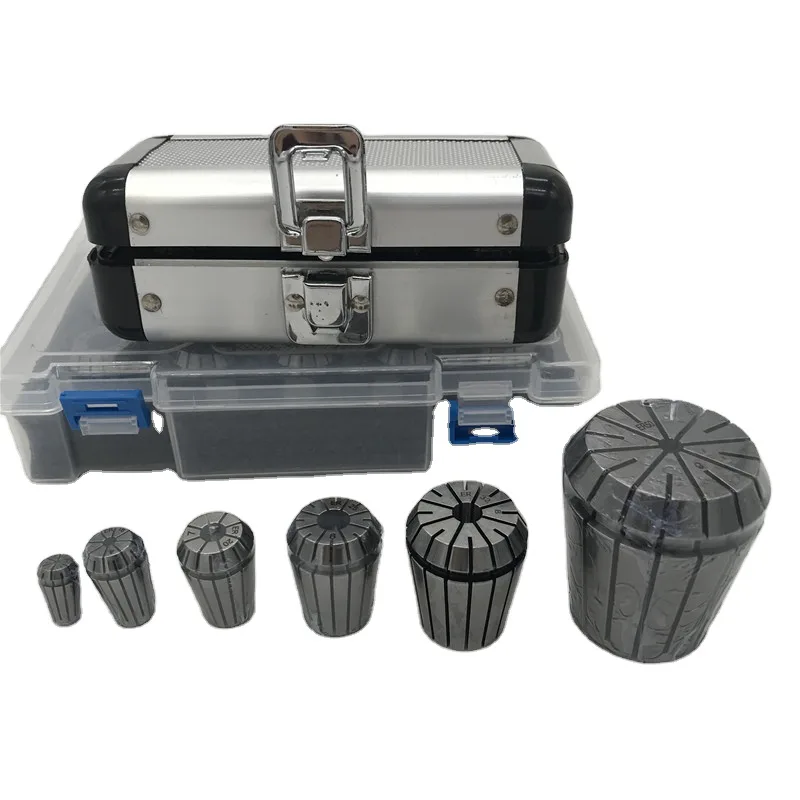
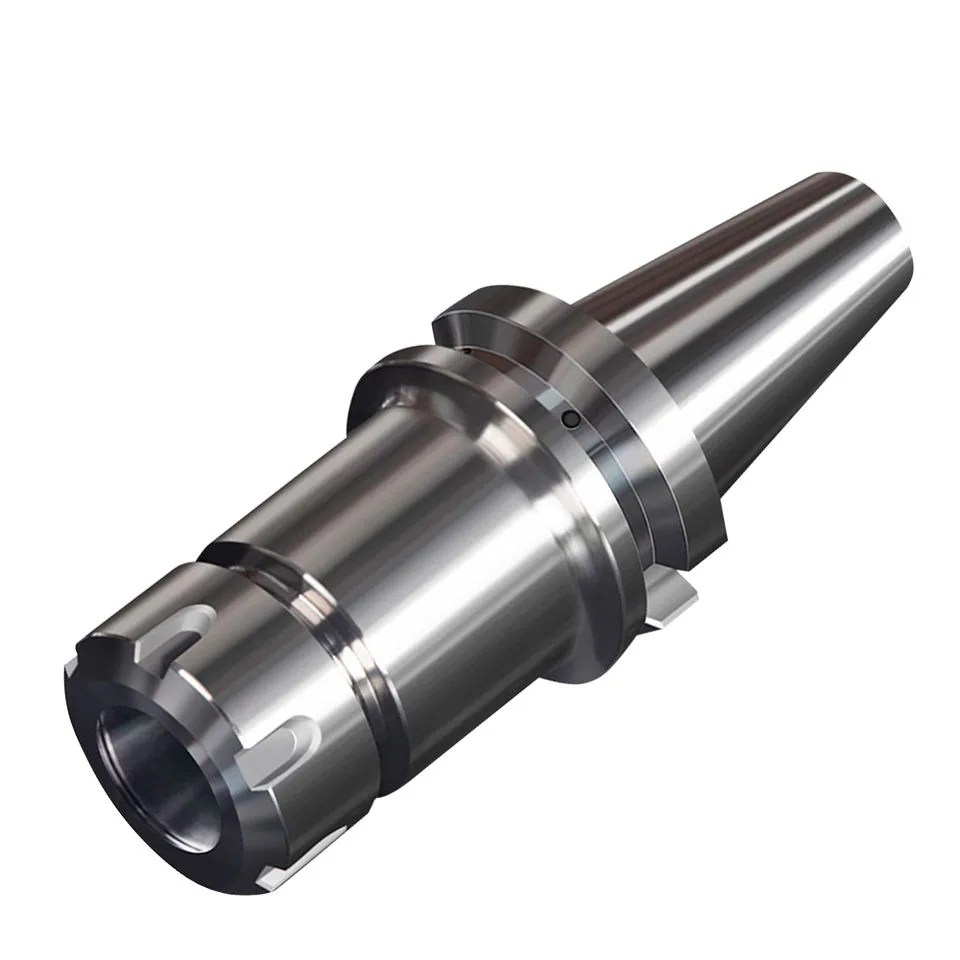
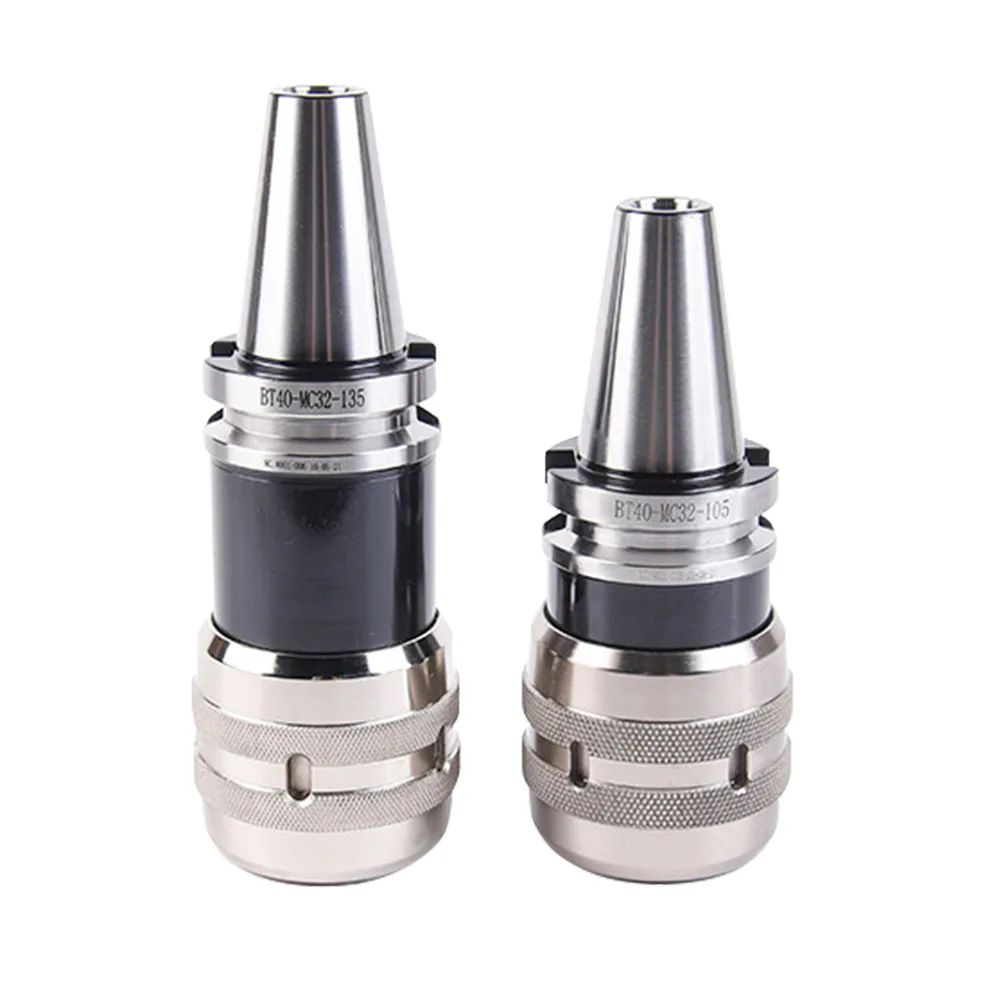
In this catalog the collets are listed as spring steel at 44-48 hardness, and the ER series runs from ER11 to ER50 across the records. Holders are listed as BT30, BT40, BT50, DIN and HSK, with a taper hardness of HRC56-58 on the BT records that state it.
Measure before you change anything
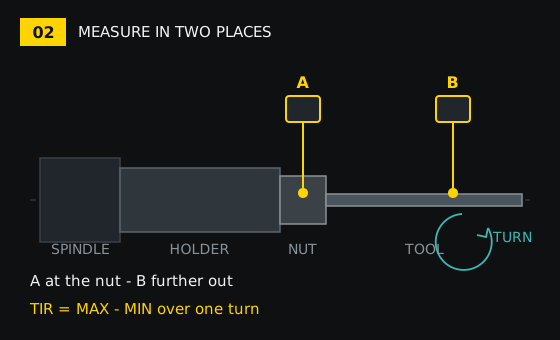
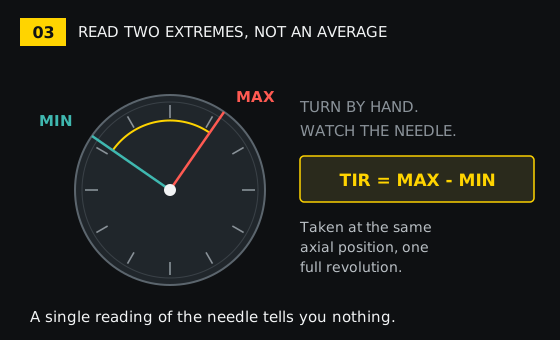
Clean the taper and the collet first — a chip changes the number. Put the tool in, mount the indicator on the table or the spindle face, and put the stylus on the tool shank, never on the flutes. Turn the spindle by hand through one revolution and record the lowest and the highest reading. The difference is the number that matters.
Take it in two places: close to the nut, and further along the shank. Write down the distance between the two. Without that distance the second reading cannot be interpreted, and the pair of readings is what separates the two failure modes further down this page.
Which number counts as acceptable
Take it from the record of the part you are buying, not from a general figure. In this catalog the holder records quote maximum runout below 0.005 mm and a taper tolerance below AT3, while collet records quote accuracy figures of 0.005 mm, 0.008 mm and 0.015 mm depending on the product. Those figures are not interchangeable — they describe different grades of part.
The practical consequence is that the holder sets the floor. An assembly cannot be better than the holder it is built on, and a collet quoted at a looser figure than its holder will absorb that allowance on top. Spending on the collet when the holder is the limit moves the number the wrong way for the money.
Check 1 — The taper

A holder taper has to touch along its length, not at one end. A taper that contacts only near the flange holds the holder square at the back and lets the front move, which shows up as runout that grows with distance and changes when the holder is reseated in a different rotational position.
Check it with marking blue: a thin film on the taper, seat the holder, twist, remove. The pattern should be a band along the full length. A bright ring at the big end with nothing further in is a high spot — usually a ding, a burr or embedded swarf. Clean it, stone it lightly, check again. If the band does not come back, the holder is finished.
Check the spindle taper as well. Dirt there moves the holder, and no collet change will correct it.
Check 2 — The collet
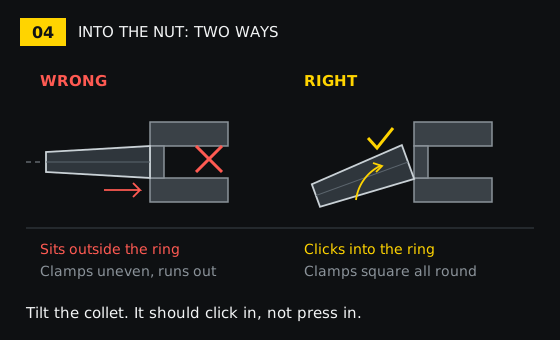
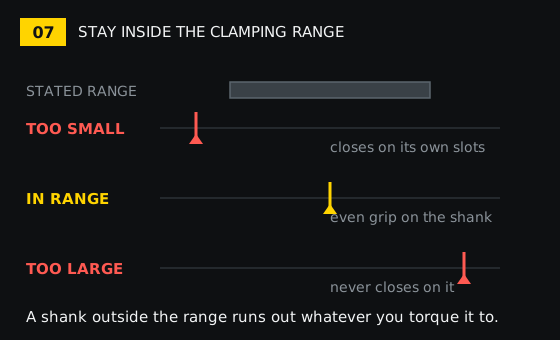
There are two different failures here and they look different. Mechanical: cracks at the root of a slot, a polished ring inside the bore, a crushed or splayed nose. Geometric: the collet no longer closes evenly, either because the tool sits outside its stated clamping range or because the collet was never seated in the nut correctly.
The eccentric ring is the part people get wrong. The collet has to go into the nut at an angle and click into that ring before the assembly goes anywhere near the holder. Pushed in squarely, it sits outside the ring, and when the nut is tightened the collet is drawn in crooked.
On clamping range, do not stretch a collet. A tool below the bottom of the range will grip on the slot edges — badly — and will run out whatever torque is applied. The range is stated on the record; use it.
Check 3 — The nut
The nut does two jobs: it engages the collet ring and it draws the collet into the taper. A worn thread tightens without pulling, so the collet never fully closes and the reading does not move. Look for flattened threads, a chipped ring and knurling worn smooth.
A bearing nut turns more freely and puts less twist into the collet while it is tightened. It is not a cure for a worn collet, but on a setup that is otherwise sound it is the difference between a number that repeats and one that moves every time a tool is changed.
Tighten the nut on the holder, not on the machine, and tighten it evenly. Shocking the nut with a spanner to seat it distorts the collet, which is a reliable way to create the runout you were trying to remove.
Check 4 — The tool shank
The shank has to be round, clean and inside the collet range. A burr left by a previous pull-out, dried coolant, damage on a weldon flat or a shank ground off centre all appear as runout that does not change when the collet is swapped.
Make sure the collet grips the shank and not the flutes. Gripping flutes puts the collet on an interrupted surface and cannot be concentric. There is a minimum engagement length for the shank inside the collet, and it is set by the collet, not by convenience.
Check 5 — Seat and torque
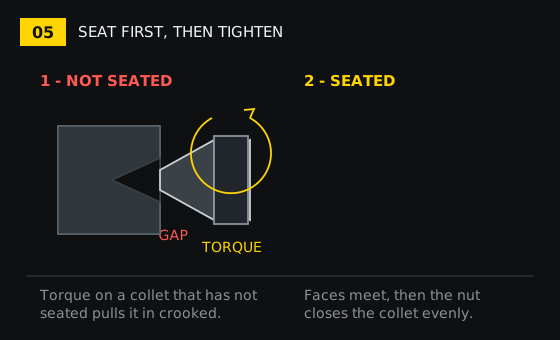
Seat first: the collet and nut assembly goes onto the holder and the tapers meet before any torque is applied. Torquing an assembly that is not seated draws the collet in crooked, and the error is built in before the first cut.
Then measure again. A reading taken after torquing tells you what the machine will cut with. A reading taken before tells you what the parts looked like on the bench. They are not the same number, and it is the first one that matters.
What the pair of readings tells you
- The error grows with distance from the nut. That is a tilt — the taper, the seating or the nut. The further out you measure, the larger it gets, in proportion.
- The error is the same at both positions. That is a parallel offset — the collet bore or the tool shank. The axis is displaced but not angled.
- The error changes when the tool is rotated inside the collet. The tool shank or the collet bore, not the holder.
- The error changes when the holder is reseated in a different rotational position. The spindle taper or the holder taper.
- The error changes between a cold and a warm machine. That is thermal, not wear. Measure again before buying anything.
When replacing beats adjusting
Collets are consumables. A collet that is cracked, polished inside, or being used outside its range will not be recovered by cleaning, and the time spent trying costs more than the collet. Holders are not consumables: a holder with a high spot that will not stone out, or a taper that no longer shows a full band, needs replacing, and no collet choice compensates for it.
The cheapest sequence is the one in the last diagram: clean, measure, re-seat, measure again, then replace the cheapest part the readings point at.
What to send us
If you would rather describe the setup than diagnose it: the holder type and taper (BT30, BT40, BT50, DIN, HSK), the collet series and the size range you need, the tool shank diameter, and the readings you have with the distances at which you took them. That is enough to say which part is the likely cause and which parts to quote.
If the collet turns out to be the limit, the ER32 AA set states its accuracy figure on the record. On the holder side, the BT30 / BT40 / BT50 ER32 holders list runout, taper tolerance and balance. Or send the readings and we will say which of the two the numbers point at.
Classes cited above: Collet & Holder and Collets. If the question is still what to buy rather than what to fix, the category pages carry the ranges and the grades — and the order to check a machine for accuracy loss covers the machine itself, which is the stage before this one.