Both jaws move toward the centre line, so the part is located by the vise rather than by indicating each blank. That is what makes it usable on a 4th or 5th axis, where re-datuming every part would cost more than the fixture.
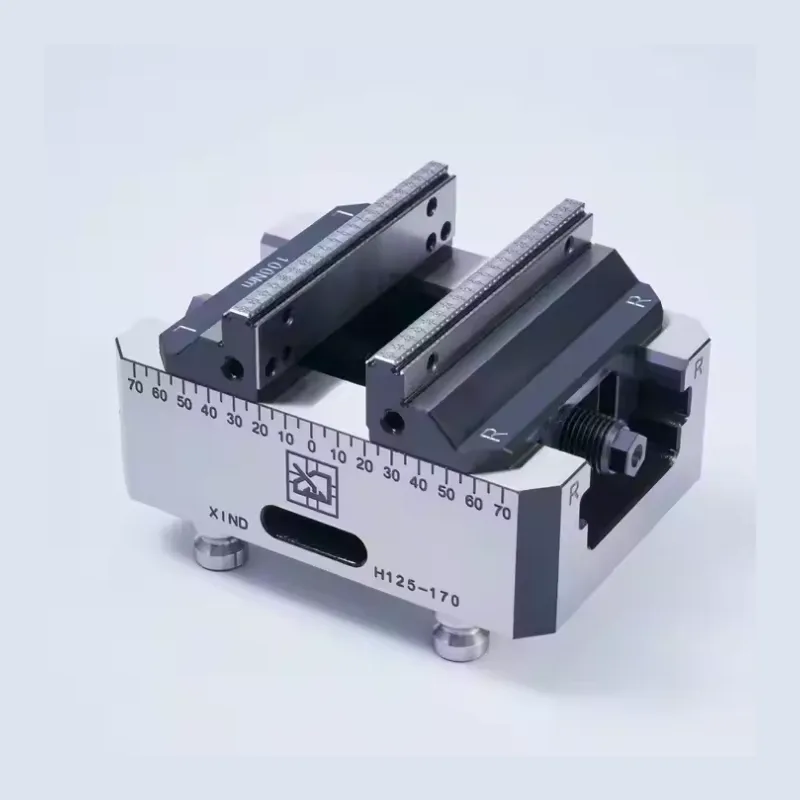 FIG. / PRODUCT VISUAL / 5 VIEWS
Product images are shown for technical review; final compatibility is confirmed before quotation.
TBK-SCV-729980
H125 self-centering vise, 4/5-axis
A manual self-centering vise recorded in the H125 style at 10 kg, listed for 4-axis and 5-axis workholding with a base, screw and jaw as its core components. Self-centering means both jaws move, so a part sits on the spindle centreline without indicating each blank.
- StyleH125
- Weight10 kg
- Drive modeManual
- Core componentsBase, screw, jaw
- ConditionNew
| Style | H125 |
|---|---|
| Drive mode | Manual |
| Weight | 10 kg |
| Core components | Base, screw, jaw |
| Condition | New |
| Type recorded | Bench vise |
| Machinery test report | Not available |
| Warranty recorded | Unavailable |
APPLICATION CHECKCNC machining centres and 4/5-axis workholdingConfirm machine model, interface and drawing before order.
Request this part Ask about an alternativePRODUCT DETAILTECHNICAL INFORMATION
HOW TO READ THE NUMBERSSelf-centering 10 kg H125
That is a fixture you can lift onto a table by hand, which matters on a trunnion where the vise itself becomes rotating mass. Ten kilos at 200 mm from the axis is a real torque load on the rotary, not a detail.
The style number fixes the body size, not the jaw opening. The record does not give a clamping range, so the maximum part width has to be quoted before the vise is chosen.
WHERE IT DOES NOT FIT
It is a manual vise, so clamping force depends on the operator and repeatability between operators is not guaranteed. No test report is recorded, so flatness and parallelism are not presented as inspected values — check them on receipt before trusting the vise for a tight tolerance.
WHAT THIS RECORD ANSWERS
What is the maximum jaw opening?
Not recorded. The style number and weight are given, but no clamping range, so it has to be quoted.
Does it come with a test report?
No. The record lists the machinery test report as not available and the warranty as unavailable.
Can it be mounted directly on a 5-axis trunnion?
The base is a recorded core component, but no mounting pattern or bolt spacing is given, so the interface plate has to be designed against the actual base.
SPECIFICATION INPUT
Exact fit starts with the machine.
Specifications are listed with the part. Confirm machine model, interface, material and drawing before quotation.
INPUT / 2D + 3D DRAWINGCHECK / INTERFACE + MATERIALOUTPUT / QUOTATION ROUTE