Drive mode on a self-centering vise: the label, the mechanism and the gap
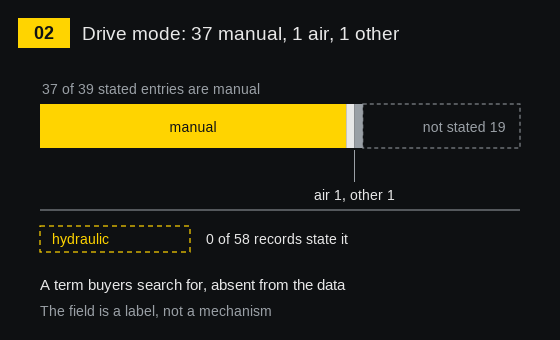
Thirty-nine of the fifty-eight records state a drive mode. Thirty-seven of those say manual, one says pneumatic, one says other, and none says hydraulic. The field looks answered until you try to use it.
A field that looks answered
A drive-mode column looks like the most useful thing in a workholding listing. It tells you how the jaws move, which tells you what the vise needs on the shop floor: a hand, an air line, or a hydraulic unit. Of the fifty-eight records in this family, thirty-nine fill the field in. That is two thirds, which reads as good coverage, and it is the reason the gap is easy to miss.
Read the values instead of the coverage and the picture changes. Thirty-seven of the thirty-nine entries read manual. One reads pneumatic. One reads other. Nineteen records leave the field blank. The word hydraulic appears nowhere in the family, not in any record, not in any field.
That is worth stating plainly, because the search terms that bring buyers to this category assume the opposite. People search for a self-centering vise by drive, and the industrial vocabulary of the last decade has trained everyone to expect a hydraulic option on anything that clamps. The records do not support that expectation. They describe a family that is manual by default, with a single pneumatic exception, and a hydraulic variant that may exist on the market but is not documented here.
Where the density sits
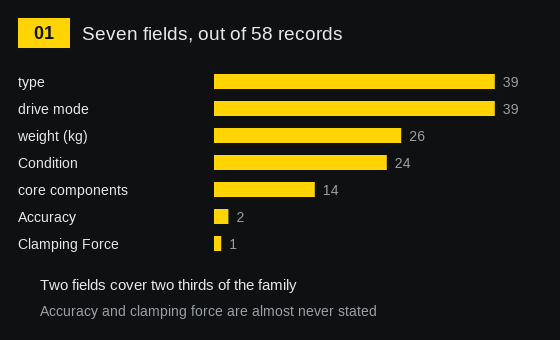
The coverage chart is not random. The fields that are filled in are the fields that are easy to copy from a drawing: a type, a drive mode, a mass. The fields that would let a buyer predict behaviour are almost empty. Accuracy appears in two records. Clamping force appears in one. The two numbers that turn a vise into a specification rather than a catalogue entry are the two this family almost never supplies.
Condition is filled in twenty-four times and every one of those entries reads New. Core components appears fourteen times, and nine of them read base, screw, jaw, which is the honest description of the mechanism. Weight appears in twenty-six records. Everything else falls away quickly.
This is the pattern that makes catalogue data dangerous: the presence of a column suggests the presence of an answer. A buyer scanning for completeness sees a field with two-thirds coverage and assumes the missing third is the exception. In this family the missing third is where the mechanism lives.
Manual is not one mechanism
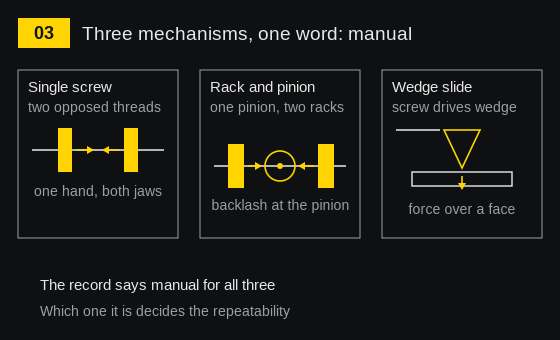
The single most deceptive value in the family is manual. It reads like a specification and behaves like a category. Three different mechanisms hide behind it, and each one repeats differently.
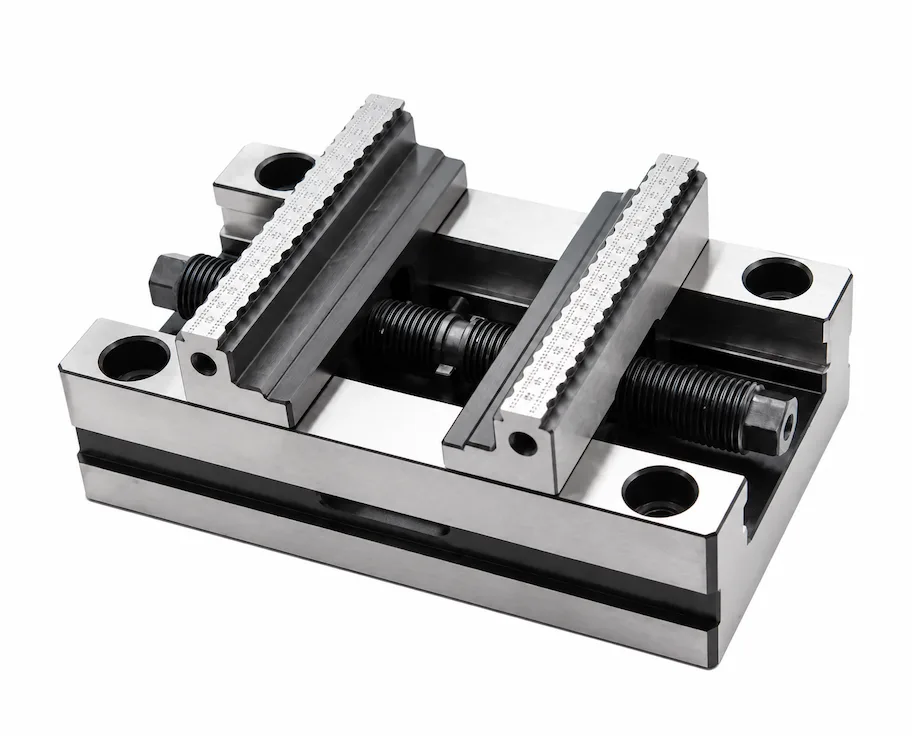
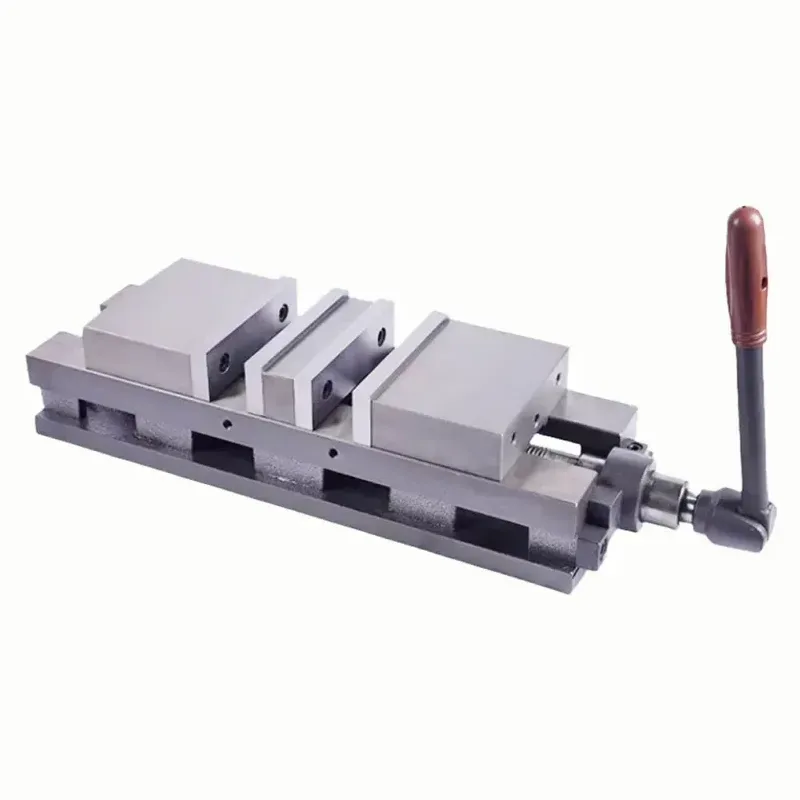
The first is a single screw carrying two opposed threads, one left hand and one right hand, with a jaw nut on each. Turn the screw one way and both jaws travel toward the centre at the same rate. The photographs in this family show exactly that arrangement: one shaft through the body, two nuts, two jaws, and the hand at one end.
The second is a rack and pinion under the body. One pinion drives two racks in opposite directions. The jaws stay coupled through the pinion rather than through a thread, and the clearance between rack and pinion becomes the thing that decides how far a jaw can be pushed back under load.
The third is a wedge. A central screw pushes a wedge along the body and the wedge spreads two slides apart. The clamping force is distributed over a face rather than concentrated on a thread flank.
All three are manual. All three carry the same word in the same field.
What the drive does not decide
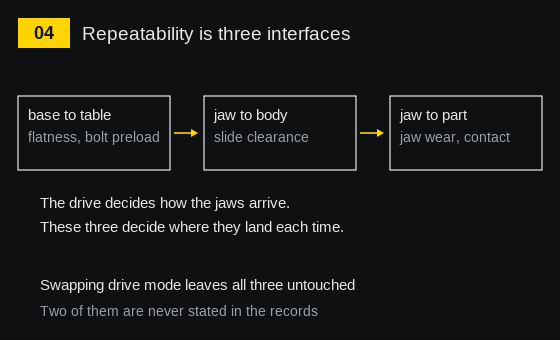
Repeatability is decided at three interfaces, and the drive is at none of them. The base sits on the table, where flatness and bolt preload decide how much the whole body tilts when the jaws close. The jaw sits on the body, where slide clearance decides how far it can rock under an offset load. The jaw meets the part, where jaw wear and contact area decide whether the part sits where the jaw expects.
A manual screw, an air cylinder and a hydraulic piston all deliver the same jaws to those three interfaces. Changing the drive changes how fast the jaws arrive, how hard they push, and whether the push is repeatable without an operator. It does not change the three places where error is generated.
That ordering matters when a fixture is being specified. Settling the drive first is common and backwards: the drive is chosen against a cycle, while the interfaces are chosen against the part.
Air: one record, and the question it leaves open
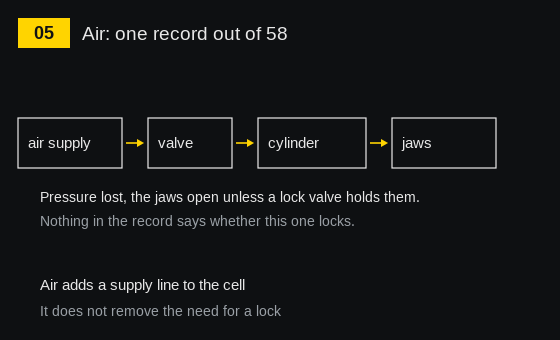
One record names a pneumatic drive. A cylinder replaces the hand, a valve replaces the wrist, and an air supply joins the list of things the cell must provide. On a machine that already runs air, that is a small addition. On a machine that does not, it is a compressor decision made by a vise.
The question the record does not answer is what happens when pressure falls. A single-acting cylinder releases as the air goes away. A double-acting cylinder holds only while the valve holds. Neither keeps a part through a pressure loss unless a lock valve or a mechanical detent is part of the circuit, and nothing in this record says whether one is fitted.
That is not a detail. It is the difference between a fixture that fails safe and one that fails open, and it is the kind of thing a buyer finds out during the first power interruption rather than in the catalogue.
Hydraulic: absent from the data
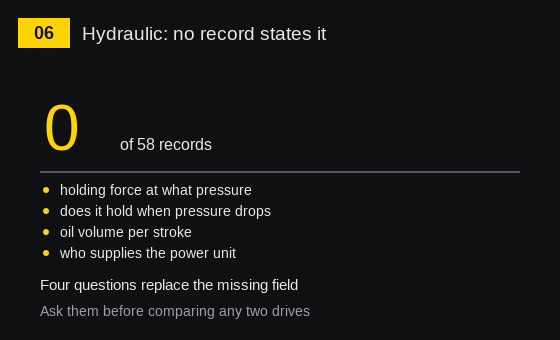
No record among the fifty-eight states a hydraulic drive. That does not mean hydraulic self-centering vises do not exist. It means this family's data does not describe one, and any statement about its pressure, holding force or response time would be invented here rather than sourced.
What a hydraulic drive would add is a pressure source, a way to hold force while the pump is idle, and a decision about what happens when pressure is lost. Those are the same questions the pneumatic record leaves open, at higher stakes, because a hydraulic circuit stores energy.
Four questions replace the missing field, and they are the four to ask before comparing a hydraulic offer with a manual one.
- What holding force is reached, and at what supply pressure?
- Does the vise hold when the supply drops, and by what mechanism?
- How much oil moves per stroke, and what pump feeds it?
- Who supplies and services the power unit?
Clamping force: one number in fifty-eight
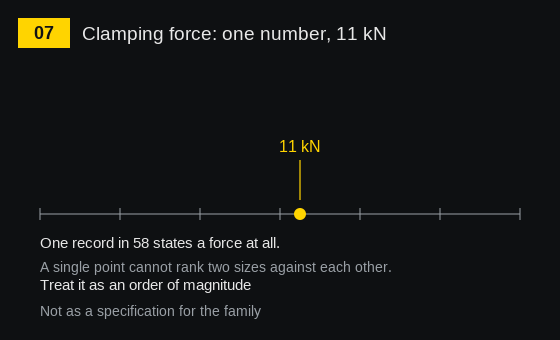
One record states a clamping force, and it states 11 kN. The same record gives a jaw width of 55 mm and a clamping range of 0 to 50 mm, which makes it a coherent small-vise entry rather than a stray value.
A single number cannot rank two sizes, cannot describe a trend, and cannot compare this family with a neighbour. What it can do is fix an order of magnitude: a vise of that size class, in this construction, is expected to clamp in the low tens of kilonewtons rather than in the hundreds.
The honest use of the value is to calibrate a question. When a supplier quotes a force, 11 kN gives a reference point to check it against, and the absence of any second force across fifty-eight records tells the buyer that force is not a field this market publishes. If force matters to the fixture, it has to be requested, not read.
Two accuracy claims that do not rank together
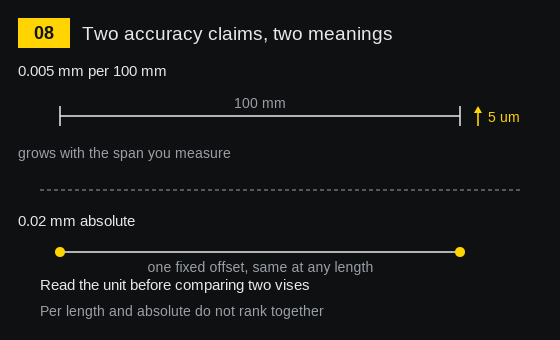
Two records state accuracy, and they do not state the same kind of thing. One gives 0.02 mm. The other gives 0.005 mm per 100 mm.
The first is an absolute figure: a fixed offset that applies wherever the part is measured. The second is a slope, and it grows with the span you measure. Over 100 mm the two look comparable. Over 300 mm a per-length claim allows three times the deviation, while an absolute claim allows the same figure it always did.
Reading them side by side and picking the smaller number is the common mistake. The per-length value is not smaller than the absolute one in any useful sense. They answer different questions, and which one matters depends on whether the part is short and checked at a point, or long and checked across a span.
Mass, jaw width, and two corrupted values
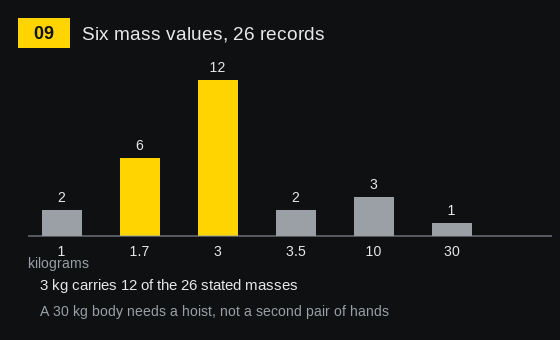
Twenty-six records state a mass, and those twenty-six values collapse into six distinct figures: 1 kg, 1.7 kg, 3 kg, 3.5 kg, 10 kg and 30 kg. Twelve of the twenty-six sit at 3 kg, which makes 3 kg the centre of the family. Six sit at 1.7 kg, three at 10 kg, two at 1 kg, two at 3.5 kg, and one at 30 kg.
Mass is a proxy for size class and a direct constraint on handling. A 30 kg body is a two-person lift at best and a hoist job in practice, and the single record carrying it is the outlier any maintenance plan has to account for.
Jaw width and clamping range are stated three times each: 55 mm, 90 mm, and one record whose jaw-width field reads Clamping Range; then 0 to 48 mm, 0 to 50 mm, and one record whose clamping-range field reads Clamping Force. Two records in fifty-eight carry their values in the wrong column, which is a small reminder that a number is only usable while the label beside it survives the export.
Five questions before the order
- Which mechanism is inside: one screw with opposed threads, a rack and pinion, or a wedge?
- What is the clamping force, and at what input torque or supply pressure?
- Is the accuracy claim absolute, or per unit of length?
- Does the drive hold the part if the power source goes away?
- What is the base interface: plain bolt mount, or a mount that also indexes an angle?
Each question maps to a field that is empty or nearly empty in this family. That is the practical result of the audit: the records cannot answer them, so the buyer has to, before the vise reaches the table.
The related reading on this site covers the two adjacent problems. Self-centering vise jaw travel takes the stroke and the datum, and vise jaw parallelism takes the parallel and the lift that appear when the jaws close on a part that is not sitting flat.
What this changes on the machine
A manual vise with a screw and a manual vise with a lever are both manual, and they behave differently in a cycle. The screw offers mechanical advantage that grows with the handle, and it keeps holding after the operator walks away. The lever offers speed and a fixed stroke, and it releases when the hand releases. Filing both under one word hides the difference that decides whether a second operation is possible with the part still clamped.
The same applies to air, and to any hydraulic unit that arrives later. The drive is a decision about the cell rather than about the vise, so it belongs after the three interfaces have been settled, not before them.
The data makes the point better than any argument. Thirty-nine records answered the drive-mode question, and the answer is still not a specification. A buyer who wants a specification has to ask for one, and this page is the list of what to ask. The H54 self-centering vise is the one record in the family that answers two of the five questions, which is why it appears in the figures above.