That is the cutting-edge length, not the cutter diameter. Micro tools rarely fail from wear; they snap. Every extra millimetre of overhang cuts the lateral load the tool can take, so use the shortest edge that reaches the feature.
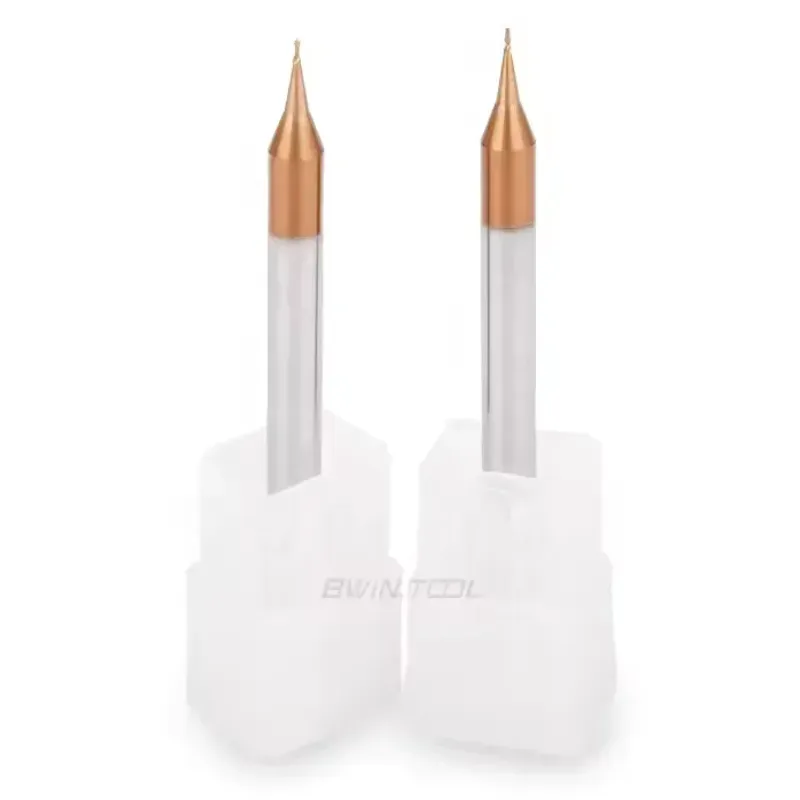 FIG. / PRODUCT VISUAL / 2 VIEWS
Product images are shown for technical review; final compatibility is confirmed before quotation.
TBK-END-60830576620
Micro ball-nose end mill, 0.3–1 mm
A two-flute micro ball-nose cutter in ultra-fine grain carbide, with cutting-edge lengths from 0.3 to 1 mm, two substrate grades (55 HRC and 65 HRC) and a choice of AlTiN, TiCN, TiN or TiSiN coating. Listed for engraving machines, Swiss-type lathes and micro-machining centres.
- Flutes2
- Cutting-edge length0.3 / 0.4 / 0.6 / 0.8 / 1 mm
- Grade55 HRC / 65 HRC (two grades)
- Model exampleR0.5×3×d4×50L-2T HRC55
- SubstrateUltra-fine grain carbide
| Flutes | 2 |
|---|---|
| Cutting-edge length | 0.3 / 0.4 / 0.6 / 0.8 / 1 mm |
| Substrate | Ultra-fine grain carbide |
| Grade | 55 HRC / 65 HRC (two grades) |
| Coating | AlTiN / TiCN / TiN / TiSiN |
| Model example | R0.5×3×d4×50L-2T HRC55 |
| Workpiece materials | Carbon steel, mould steel, copper, cast iron |
| Use | Precision mould finishing, 3D micro contours, electrode machining |
APPLICATION CHECKCNC milling machine and machining-center applicationsConfirm machine model, interface and drawing before order.
Request this part Ask about an alternativePRODUCT DETAILTECHNICAL INFORMATION
HOW TO READ THE NUMBERS0.3–1 mm 55 / 65 HRC 2 flutes
Two substrate grades, not two readings from one tool. The 65 grade is harder and more wear resistant for hardened mould steel; the 55 grade is tougher and resists chipping. Picking the wrong grade breaks more tools than picking the wrong coating.
At micro scale the priority is chip room, not feed rate. Two flutes at 0.5 mm clear the chip; four flutes at that diameter tend to pack and snap.
WHERE IT DOES NOT FIT
Finishing and micro contours only; not for bulk stock removal. Spindle runout has to be held to a few micrometres, because a micro cutter is extremely sensitive to it. With an inaccurate holder, a higher tool grade buys nothing.
WHAT THIS RECORD ANSWERS
Which edge lengths?
0.3, 0.4, 0.6, 0.8 and 1 mm.
What grades?
Two: 55 HRC and 65 HRC.
Which coatings?
AlTiN, TiCN, TiN and TiSiN.
SPECIFICATION INPUT
Exact fit starts with the machine.
Specifications are listed with the part. Confirm machine model, interface, material and drawing before quotation.
INPUT / 2D + 3D DRAWINGCHECK / INTERFACE + MATERIALOUTPUT / QUOTATION ROUTE