A 0.5 mm ball radius means a 1 mm diameter cutter. At that size the tool is for finishing small radii, deep pocket corners and 3D surfaces, and the step-over has to stay in the hundredths of a millimetre to leave a blend-free surface.
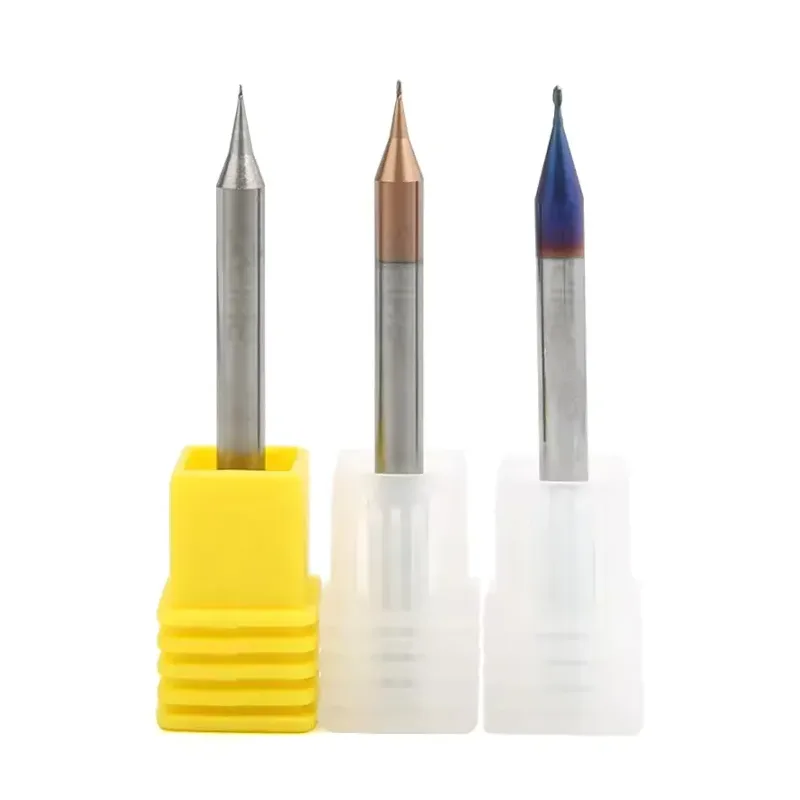 FIG. / PRODUCT VISUAL / 3 VIEWS
Product images are shown for technical review; final compatibility is confirmed before quotation.
TBK-END-1600839820246
HRC65 micro ball-nose end mill R0.5
A two-flute solid carbide ball-nose end mill recorded as model R0.5X3X50L, with a 4 mm shank, 50 mm overall length and 35° helix, listed at 55 HRC and 65 HRC. The 0.5 mm ball radius puts it in the finishing range for small radii and deep pockets rather than bulk removal.
- Model numberR0.5X3X50L-2F HRC65
- Ball radius0.5 mm
- Shank diameter4 mm
- Overall length50 mm
- Flutes2
| Model number | R0.5X3X50L-2F HRC65 |
|---|---|
| Ball radius | 0.5 mm |
| Shank diameter | 4 mm |
| Overall length | 50 mm |
| Flutes | 2 |
| Helix angle | 35° |
| Hardness | 55 HRC / 65 HRC |
| Coating options | AlTiN, TiAlN, TiCN, TiSiN, AlTiSiN |
| Cutting direction | Climb milling |
| Workpiece materials listed | Cast iron, carbon steel, alloy steel |
APPLICATION CHECKCNC milling machine and machining-center applicationsConfirm machine model, interface and drawing before order.
Request this part Ask about an alternativePRODUCT DETAILTECHNICAL INFORMATION
HOW TO READ THE NUMBERSR0.5 35° helix 4 mm shank, 50 mm overall
A 35° helix is a general-purpose finishing geometry: enough rake to shear steel cleanly without the axial pull of a high-helix cutter. It is not a roughing geometry, and it will not tolerate the chip load a 3-flute roughing tool takes.
The shank is four times the cutting diameter, which is what keeps a 1 mm ball from snapping. Even so, gauge length matters more than total length: keep the overhang as short as the pocket allows.
WHERE IT DOES NOT FIT
Not a roughing tool and not for aluminium built-up edges without the right coating — the record lists steel and cast iron as the workpiece materials, and offers no aluminium-specific geometry. The 65 HRC grade is harder and more brittle than the 55 HRC grade, so it belongs in hardened steel, not in interrupted cuts.
WHAT THIS RECORD ANSWERS
Is this one tool or two hardness grades?
The record lists both 55 HRC and 65 HRC against the same model number, and the model suffix reads HRC65. The grade has to be confirmed on the order line.
Which coating should I choose?
The record lists five options without recommending one. For the steel and cast iron it names, AlTiN and TiAlSiN are the usual starting points; the choice still depends on whether the cut is dry or wet.
What is the neck diameter?
It is not recorded. For a 1 mm ball in a deep pocket the neck is the limiting dimension, so it has to be quoted before ordering.
SPECIFICATION INPUT
Exact fit starts with the machine.
Specifications are listed with the part. Confirm machine model, interface, material and drawing before quotation.
INPUT / 2D + 3D DRAWINGCHECK / INTERFACE + MATERIALOUTPUT / QUOTATION ROUTE