One count equals half a micrometre, which is the smallest step the control can see. It is finer than the 3 µm accuracy by a factor of six, so the useful number for a tolerance stack is still the 3 µm.
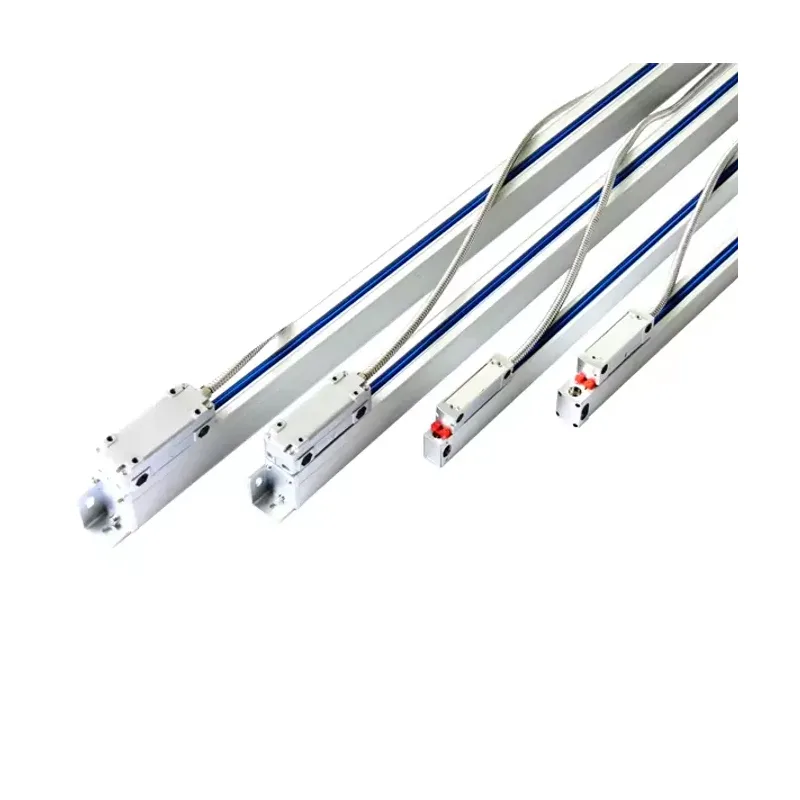 FIG. / PRODUCT VISUAL / 3 VIEWS
Product images are shown for technical review; final compatibility is confirmed before quotation.
TBK-LE-1601113394301
SGC-4.2 incremental linear encoder
An incremental linear encoder with TTL or sine-cosine output, recorded at 0.5 µm resolution and 3 µm accuracy over measuring lengths of 50 mm to 1,000 mm. It is a grating scale: the control counts pulses from a reference mark rather than reading an absolute position.
- Accuracy3 µm
- Resolution0.5 µm
- Grating pitch40 µm
- Measuring length50–1,000 mm
- Supply voltage5–24 V
| Encoder type | Incremental linear, optical |
|---|---|
| Output | TTL / sine-cosine |
| Accuracy | 3 µm |
| Resolution | 0.5 µm |
| Grating pitch | 40 µm |
| Measuring length | 50–1,000 mm |
| Supply voltage | 5–24 V |
| Protection level | IP53 |
| Connection | Connecting plate |
| Working temperature | 0–50 °C |
APPLICATION CHECKCNC machine tools and precision displacement measurement systemsConfirm machine model, interface and drawing before order.
Request this part Ask about an alternativePRODUCT DETAILTECHNICAL INFORMATION
HOW TO READ THE NUMBERS0.5 µm resolution IP53 50–1,000 mm
Protected against dust ingress and against spraying water, not against immersion or a directed coolant jet. On a machine with flood coolant, the scale needs a cover or an air purge regardless of this rating.
A one-metre maximum covers a typical knee mill or a small lathe axis. If the axis is longer, the model does not stretch: the next size up in the series has to be quoted instead.
WHERE IT DOES NOT FIT
Incremental output means the axis needs a reference run after power loss or after the scale is disturbed, so it is the wrong choice where a machine must resume position unattended. IP53 is also not a washdown rating.
WHAT THIS RECORD ANSWERS
TTL or sine-cosine — which do I need?
TTL suits a control that takes square-wave inputs directly; sine-cosine is used where the drive interpolates the signal itself. The record lists both against the same model, so the option must be fixed on the order.
Can I run it from the machine's 24 V supply?
Yes. The recorded supply range is 5–24 V, which is wider than the absolute model in this catalogue.
What does the connecting plate refer to?
It is the recorded connection type — the head terminates at a plate rather than a flying lead, so the mating connector comes from the cable, not the scale.
SPECIFICATION INPUT
Exact fit starts with the machine.
Specifications are listed with the part. Confirm machine model, interface, material and drawing before quotation.
INPUT / 2D + 3D DRAWINGCHECK / INTERFACE + MATERIALOUTPUT / QUOTATION ROUTE