The record labels this as repeatability, but the unit form makes it straightness or parallelism over 100 mm rather than a positional repeatability figure. For EDM what matters is where the electrode sits relative to the workpiece: on a thin rib or a narrow slot, 5 µm of tilt shows up directly in the spark gap.
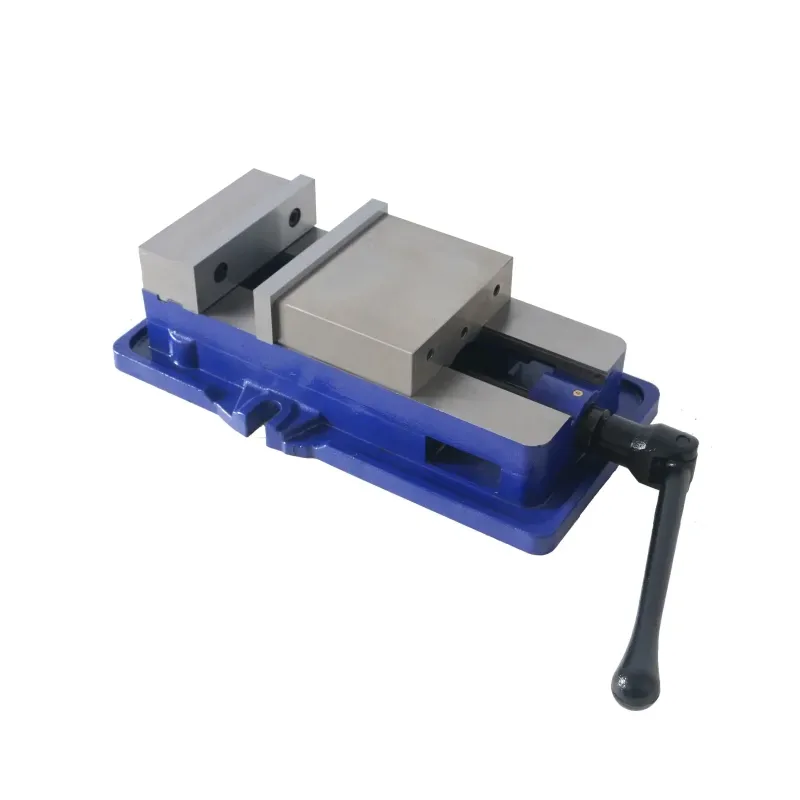 FIG. / PRODUCT VISUAL / 5 VIEWS
Product images are shown for technical review; final compatibility is confirmed before quotation.
TBK-PV-PS-1601688889077
Stainless electrode vise for EDM
A 4.5 kg stainless bench vise for electrical-discharge and wire-EDM work, hand-driven, with a stated repeatability of 0.005 mm / 100 mm and clamp ranges of 0–45 mm and 0–60 mm.
- Weight4.5 kg
- Clamping range0–45 mm / 0–60 mm
- Recorded accuracy figure0.005 mm / 100 mm
- TypeBench vise (electrode vise)
- DriveManual
| Type | Bench vise (electrode vise) |
|---|---|
| Body | Stainless steel, corrosion resistant |
| Weight | 4.5 kg |
| Clamping range | 0–45 mm / 0–60 mm |
| Recorded accuracy figure | 0.005 mm / 100 mm |
| Drive | Manual |
| Use | Sinker EDM, wire EDM |
APPLICATION CHECKCNC machining centers and milling-machine workholdingConfirm machine model, interface and drawing before order.
Request this part Ask about an alternativePRODUCT DETAILTECHNICAL INFORMATION
HOW TO READ THE NUMBERS0.005 mm / 100 mm 0–45 mm and 0–60 mm 4.5 kg
These are two separate sizes, not the adjustable span of one vise. Choose by the widest workpiece you need to hold, not by the midpoint of the range.
The stainless body buys resistance to dielectric corrosion and costs weight against a cast-iron vise of the same opening. At 4.5 kg it is still a one-handed move, which suits work that rotates between several machines.
WHERE IT DOES NOT FIT
Intended for EDM and wire EDM; it does not have the rigidity for milling loads. Stainless resists corrosion but not abrasion, so the jaws still wear when clamping hard blanks. In a coolant bath, avoid long contact with carbon-steel parts to prevent galvanic attack.
WHAT THIS RECORD ANSWERS
What repeatability does it hold?
The record states 0.005 mm / 100 mm, which reads as straightness rather than positional repeatability.
What is the clamping range?
Two sizes: 0–45 mm and 0–60 mm.
Can it be used for milling?
Not recommended; it is an electrical-machining fixture.
SPECIFICATION INPUT
Exact fit starts with the machine.
Specifications are listed with the part. Confirm machine model, interface, material and drawing before quotation.
INPUT / 2D + 3D DRAWINGCHECK / INTERFACE + MATERIALOUTPUT / QUOTATION ROUTE