That is 5 µm of drift over 100 mm of jaw length. It decides whether a block that was milled square stays square once it is clamped, not how wide the vise opens. If your drawing tolerance is ±0.02 mm, this number already accounts for a quarter of it, so leave allowance for clamping distortion.
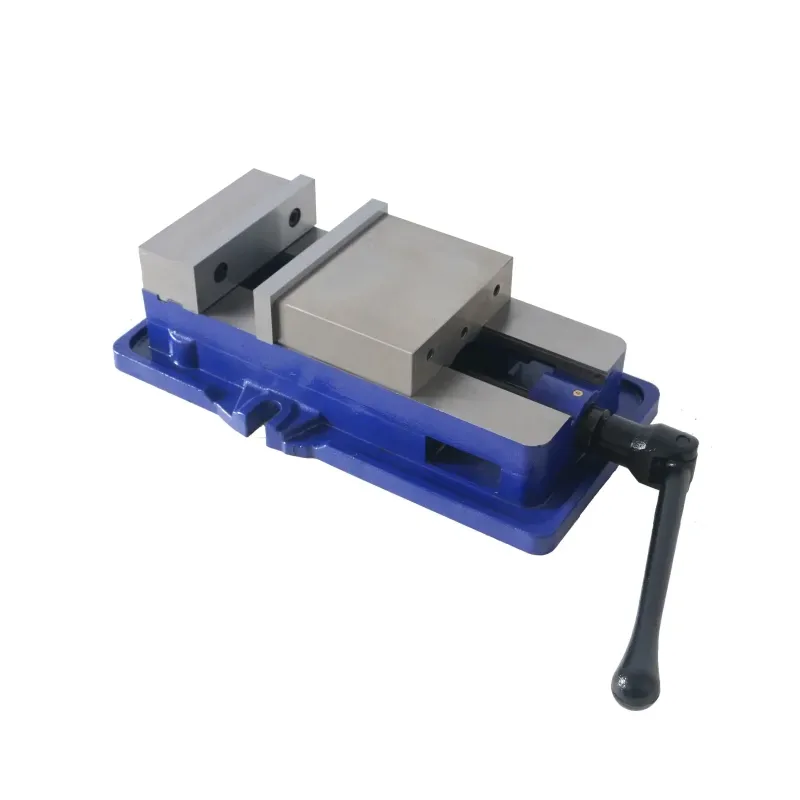 FIG. / PRODUCT VISUAL / 5 VIEWS
Product images are shown for technical review; final compatibility is confirmed before quotation.
TBK-PV-PS-1601043076566
QGG precision modular vise
An 18 kg modular vise in 20CrMnTi, with jaws at HRC 58-62, jaw faces specified at 0.005 mm / 100 mm parallelism and 0.005 mm squareness, and a stated clamping force of 3,000 kg. It is listed for CNC milling-centre work with manual drive.
- Body material20CrMnTi
- Jaw hardnessHRC 58-62
- Parallelism0.005 mm / 100 mm
- Squareness0.005 mm
- Max opening (Smax)100–150 mm
| Body material | 20CrMnTi |
|---|---|
| Jaw hardness | HRC 58-62 |
| Parallelism | 0.005 mm / 100 mm |
| Squareness | 0.005 mm |
| Max opening (Smax) | 100–150 mm |
| Clamping force | 3,000 kg |
| Drive | Manual |
| Weight | 18 kg |
APPLICATION CHECKCNC machining centers and milling-machine workholdingConfirm machine model, interface and drawing before order.
Request this part Ask about an alternativePRODUCT DETAILTECHNICAL INFORMATION
HOW TO READ THE NUMBERS0.005 mm / 100 mm 3,000 kg HRC 58-62 and 20CrMnTi
The clamping force is shared between the body and the moving jaw. A thin-walled part deforms first and springs back afterwards, which makes the finished size smaller than the measured one. Roughing can use the full figure; finishing is better with reduced force or soft jaws.
20CrMnTi is a carburising steel, so 58-62 is the case hardness after quench, not the core. The jaws therefore wear slowly while the body keeps its toughness. The trade-off is that hard jaws mark a finished surface, so use soft jaws or a copper shim on a precision face.
WHERE IT DOES NOT FIT
Manual drive means each clamping force is reproduced by feel or with a torque wrench, which rules out batch finishing that depends on a strictly repeatable force. The opening is specified as either 100 mm or 150 mm, so confirm which one before ordering.
WHAT THIS RECORD ANSWERS
What is the parallelism?
0.005 mm over 100 mm of jaw length, on the record.
How much clamping force?
The record states 3,000 kg.
Is this a sine vise?
The listing title contains the word Sine, but the specification describes a modular vise and carries no angle value. That point needs confirming before quotation.
SPECIFICATION INPUT
Exact fit starts with the machine.
Specifications are listed with the part. Confirm machine model, interface, material and drawing before quotation.
INPUT / 2D + 3D DRAWINGCHECK / INTERFACE + MATERIALOUTPUT / QUOTATION ROUTE