Twenty micrometres of drift per 100 mm. On a ±0.05 mm drawing that is usable without indicating; on ±0.02 mm it is the whole tolerance, so the part still has to be checked.
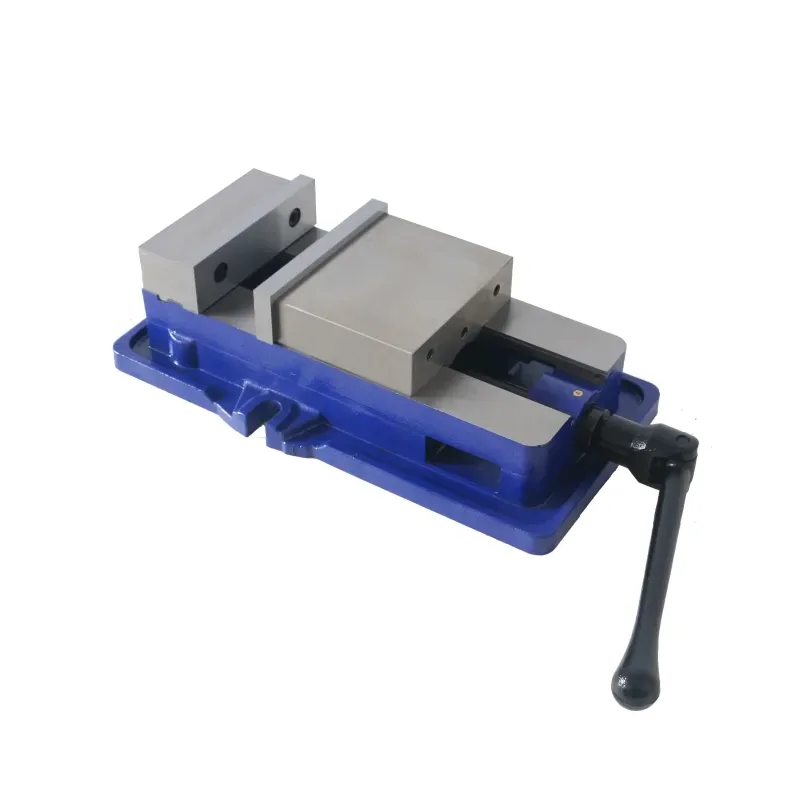 FIG. / PRODUCT VISUAL / 5 VIEWS
Product images are shown for technical review; final compatibility is confirmed before quotation.
TBK-PV-PS-1601034327956
DYV-6-300 compact power vise
A compact hydraulic angle vise recorded as DYV-6-300 in nodular cast iron at 45 kg, with parallelism stated as 0.02 mm per 100 mm. The 300 in the model is the only size marker in the record; jaw width and opening are not listed.
- Model referenceDYV-6-300
- Weight45 kg
- Parallelism0.02 mm / 100 mm
- MaterialNodular cast iron
- ApplicationCNC machining centre
| Model reference | DYV-6-300 |
|---|---|
| Material | Nodular cast iron |
| Weight | 45 kg |
| Parallelism | 0.02 mm / 100 mm |
| Application | CNC machining centre |
| Usage | Workholding precision vise |
| Colour | Silver |
| Condition | New |
APPLICATION CHECKCNC machining centers and milling-machine workholdingConfirm machine model, interface and drawing before order.
Request this part Ask about an alternativePRODUCT DETAILTECHNICAL INFORMATION
HOW TO READ THE NUMBERS0.02 mm / 100 mm 45 kg DYV-6-300
A 45 kg body is what keeps the vise from springing under clamping load, and it is also why the vise stays on one machine. Treat it as a fixed station, not a portable fixture.
The 300 is the only size marker in the record. Jaw width and maximum opening are not listed, so the model number is not enough to confirm the part fits.
WHERE IT DOES NOT FIT
It is a production vise, not a toolroom instrument: at 0.02 mm per 100 mm it is not presented for parts held to ±0.01 mm without indicating. The title calls it a hydraulic angle vise, but no hydraulic unit, pressure or angle range is recorded.
WHAT THIS RECORD ANSWERS
Is it hydraulic or mechanical?
The title says hydraulic angle vise, but the record has no drive-mode field and no hydraulic specification. Confirm the clamping method before ordering.
What is the jaw opening?
Not recorded. Only the model number, weight, material and parallelism are stated.
Why nodular cast iron?
Nodular iron is tougher than grey iron, so the body resists cracking at the clamping wedge, which is where the load concentrates.
SPECIFICATION INPUT
Exact fit starts with the machine.
Specifications are listed with the part. Confirm machine model, interface, material and drawing before quotation.
INPUT / 2D + 3D DRAWINGCHECK / INTERFACE + MATERIALOUTPUT / QUOTATION ROUTE