A 5-inch table with a 100 mm chuck is a small workholding pair: it suits parts up to roughly the chuck bore, not large fixtures. The two sizes are close enough that the chuck nearly covers the table face.
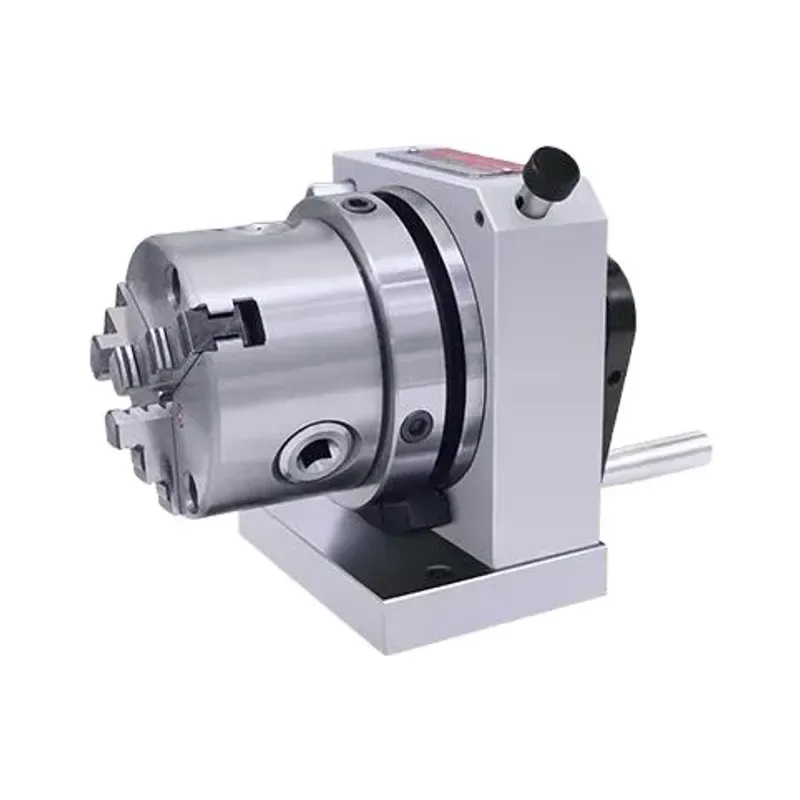 FIG. / PRODUCT VISUAL / 5 VIEWS
Product images are shown for technical review; final compatibility is confirmed before quotation.
TBK-CTG-1601683926186
5-inch rotary indexing table with chuck
A 5-inch rotary indexing table in cast iron, recorded at 16 kg with a 100 mm three-jaw chuck of reverse type. An indexing table divides the circle by fixed steps; it is not a continuously interpolating fourth axis.
- Table diameter5 inch
- Chuck100 mm, three-jaw, reverse type
- Weight16 kg
- Chuck jaws3
- MaterialCast iron
| Table diameter | 5 inch |
|---|---|
| Chuck | 100 mm, three-jaw, reverse type |
| Material | Cast iron |
| Weight | 16 kg |
| Application | Rotary indexing |
| Feature | Long wear resistance |
| Type recorded | Cutter tool grinder |
| Chuck jaws | 3 |
APPLICATION CHECKCNC tool preparation and workshop grindingConfirm machine model, interface and drawing before order.
Request this part Ask about an alternativePRODUCT DETAILTECHNICAL INFORMATION
HOW TO READ THE NUMBERS5 inch / 100 mm chuck Indexing, not interpolating Reverse-type jaws
An indexing table divides the circle into fixed steps and locks. It positions between cuts; it does not feed continuously through an arc like a fourth axis, so it is not presented for helical milling.
Reverse jaws hold on the outside of a part rather than clamping inward. That changes what can be gripped: a ring or a large-diameter disc is easier than a small block.
WHERE IT DOES NOT FIT
It is a manual indexing table without a recorded dividing ratio, so the step size has to be confirmed. It is not presented as a CNC fourth axis: no servo, no brake release signal and no controller interface are recorded.
WHAT THIS RECORD ANSWERS
How many divisions does it index?
Not recorded. The table diameter and chuck are given, but the indexing ratio is missing.
Does the chuck come with the table?
The title names a 100 mm chuck set with the table, and the chuck type and jaw count are recorded, so it is supplied as a set.
Can it be mounted on a mill table?
Yes, it is a 16 kg cast-iron unit listed for rotary indexing. The mounting slot spacing is not recorded.
SPECIFICATION INPUT
Exact fit starts with the machine.
Specifications are listed with the part. Confirm machine model, interface, material and drawing before quotation.
INPUT / 2D + 3D DRAWINGCHECK / INTERFACE + MATERIALOUTPUT / QUOTATION ROUTE