The insert record names a grade and never names a chipbreaker
This category holds twenty-seven records and no two of them were written by the same hand. One calls the same measurement HRC, another calls it hardness, a third writes a deposition process in the coating field. Reading it as a specification table does not work. Reading it as twenty-seven descriptions of one object does.
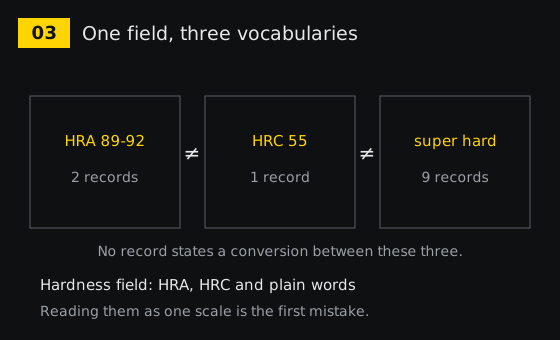
Every record here is a carbide insert or a holder that takes one, and every record carries the same small set of fields. 16 records state an HRC and 16 state a hardness, which sounds like the same number written twice until you read the values: the HRC field holds 55, 45 and 65, while the hardness field holds the words "super hard" nine times, "2.0" three times, HRA 89-92 twice, HRC55 once and "Hard" once. One field is a grade. The other is whatever the seller had in mind that day.
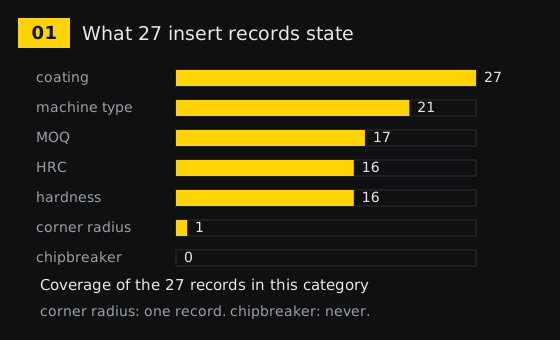
What the records do contain is worth reading closely, because it is specific even where it is inconsistent. The machine field is filled in 21 times, the minimum order 17 times, the grade 16 times. Colour, weight, hardness scale and chip geometry are all either missing or written as a word that cannot be compared with the next record. The category is not empty. It is uneven.
A grade written on three scales
Hardness of a carbide insert is quoted on the HRA scale when the material is very hard and on the HRC scale when it is a steel grade, and the two scales do not convert by a single factor. HRA 89-92 and HRC 55 are both plausible for a milling insert and they are not the same material. The words are worse. "Super hard" can describe a coated carbide grade or a cubic boron nitride insert, and this category contains both, sitting in the same field, separated by nothing.
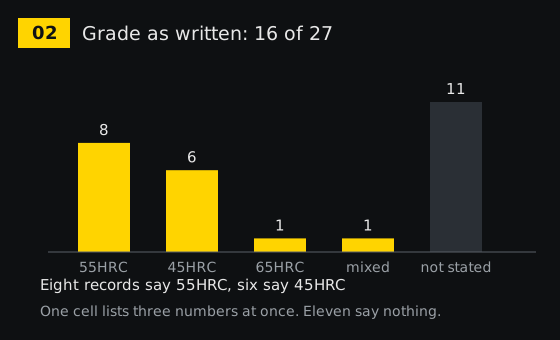
Eight records say 55HRC and six say 45HRC. That is the whole comparable population: fourteen records out of twenty-seven. One record lists 55, 60 and 65 in a single cell, which means the cell describes a range the seller can supply rather than the grade of the item photographed. Eleven records leave the field empty. Any comparison built across this category rests on half of it.
What the step from 45 to 55 buys
Hardness and edge toughness move in opposite directions. Raise the grade from 45HRC to 55HRC and the edge resists abrasion for longer: on a part with a cast skin or hard inclusions the flank wears more slowly and the insert holds size for more pieces. Lower it and the edge survives impact better: an interrupted cut, a weld seam, a thin wall that rings in the fixture. The records contain no wear test, no tool life figure and no cutting speed. They contain a grade, and the grade is the only handle on the trade.
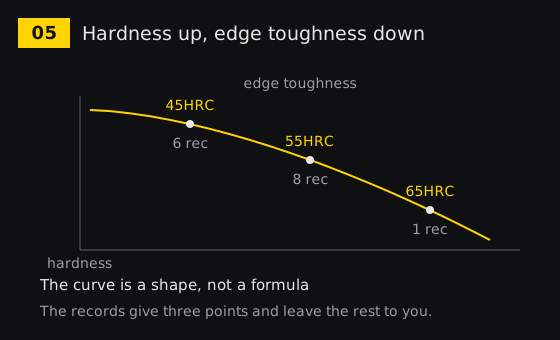
The practical consequence sits with the buyer, not the seller. A record that says 55HRC, used for a light finishing pass in aluminium, is hardness you cannot spend, and the same edge is more likely to chip when the part starts to vibrate. A record that says 45HRC, used on a hardened sleeve, will round off before the batch ends. The record cannot tell you which of those two you are, because it does not describe your machine or your part.
The coating field holds five different statements
All twenty-seven records fill the coating field, and sorting the values by what they actually say produces five groups rather than one. 17 name a coating: AlTiN eight times, TiN eight times, titanium carbide once. 2 name a deposition process instead: PVD. 3 put the body of the insert in the coating field and call it virgin tungsten carbide. 4 say uncoated or no. 1 says other. A buyer comparing these values is comparing a coating name against a process and against a description of the substrate.
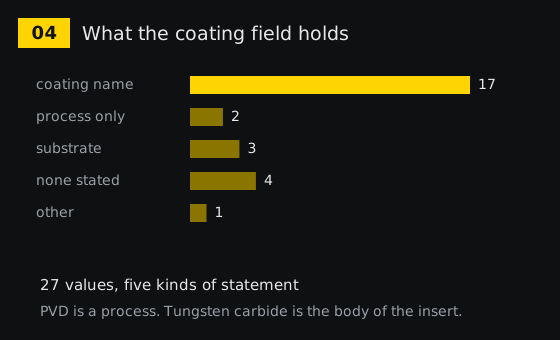
Spelling adds a second layer. AlTiN and AlTin are one coating written by two hands. TiN appears as "Tian" four times, a transliteration that has drifted, and as "Titanium Nitride (Tin)" four times. That is eight records for one coating split across two spellings, so any count run on this field without normalising it is wrong, and the normalising has to be done by reading.
PVD is not a rival to AlTiN. PVD is how AlTiN is put onto the insert. Two records reading "AlTiN" and "PVD" are not two grades: one names the layer, the other names the method. The same confusion runs through the hardness field, where a number from one scale sits beside a number from another with no conversion in between.
The chipbreaker does not exist in this category
Not one of the twenty-seven records names a chipbreaker, a groove width, a land width or a rake angle. The corner radius appears once, as R0.8, and even there it is in the product name rather than in a field. This is the largest gap in the category, because the chipbreaker is the part of the insert that decides whether a chip curls away from the workpiece or wraps around the tool.
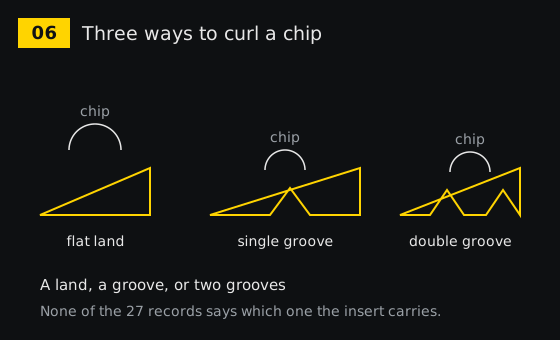
A chip that curls tightly breaks into short pieces and leaves with the coolant. A chip that comes off flat runs along the rake face, heats both the insert and the part, and becomes a bird nest around the spindle. The difference is geometry nobody wrote down. On a manual machine the operator hears it and adjusts. In a lights-out cell it becomes a stopped machine at two in the morning.
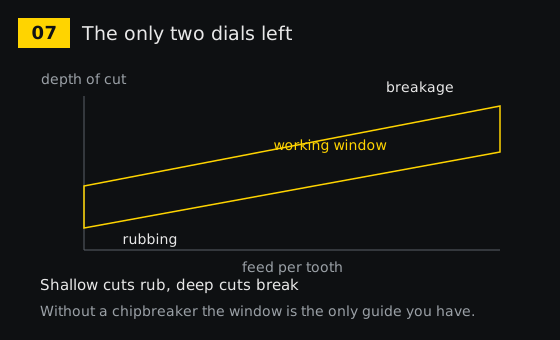
What remains under your control, with the geometry unknown, is the pair of dials that are always available: depth of cut and feed per tooth. A shallow pass rubs instead of cutting, because the edge cannot get under the surface and the flank polishes it. A deep pass on a light feed loads the tip and breaks it. Between those limits there is a window, and the window is narrower when the chipbreaker is unknown, because the groove cannot be trusted to do the curling for you.
Two size tokens, and what they name
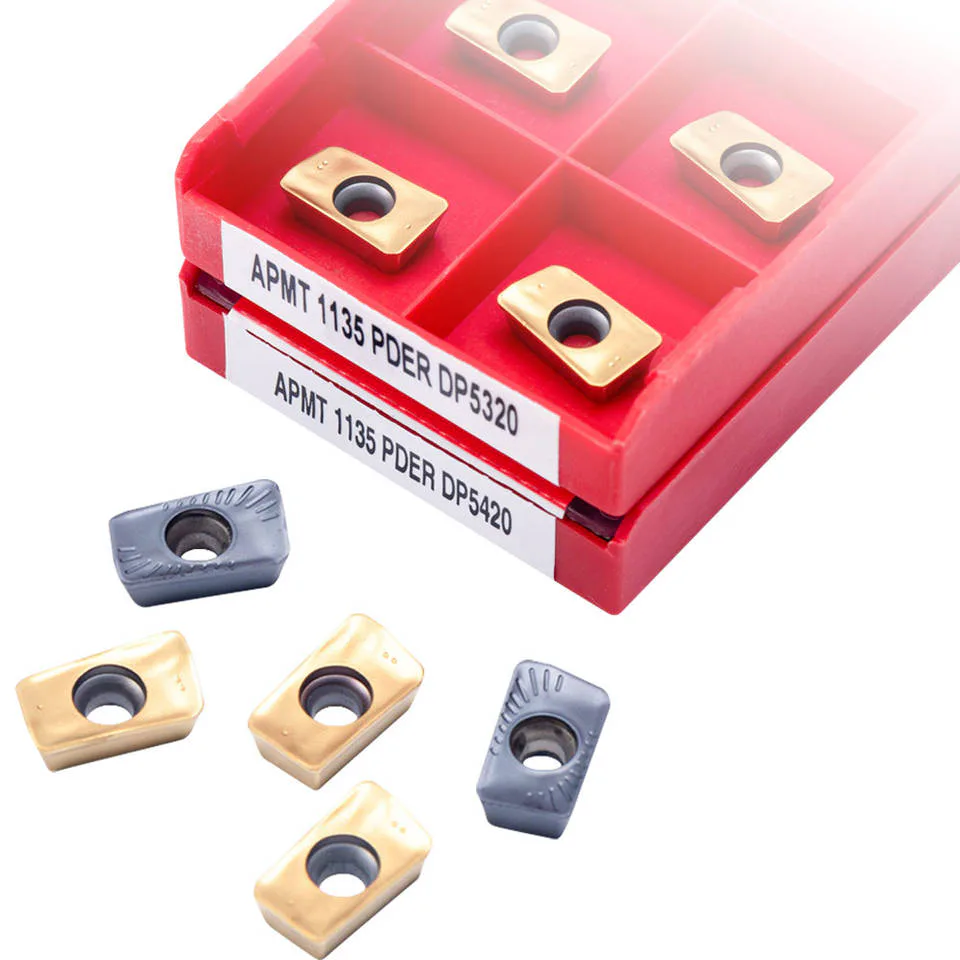
Twenty-one records carry the token 1135 and eight carry 1604, overlapping by two records that name both. These are edge lengths in millimetres, 11.35 and 16.04, not the size of the insert body and not the size of the screw. A 1604 insert will not seat in an 1135 pocket, and an 1135 insert in a 1604 pocket sits low and cuts on the wrong part of the edge.
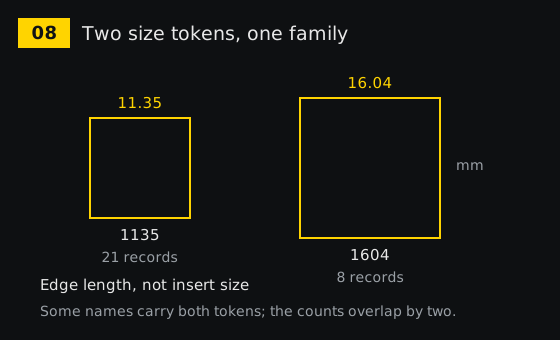
The token is the most reliable item in the category, because it sits in the product name as well as in the field, and the two agree wherever both are present. In a category this uneven, that is worth stating plainly: there is one identifier you can trust without checking.
The rest of the record, and what it is good for
The minimum order appears in 17 records and every one of them says ten pieces, written five ways: ten pieces, one box of ten, ten per box, and two more spellings of the same thing. That agreement is not an accident, it is how the item is packed. The machine field appears in 21 records, but six of those contain a slash and nothing else, so eleven records actually name a machine, and between them they name four: machining centre, lathe, machining centre again, and one combined engraving and machining centre.
The suitable-for field appears in eleven records and nine of them are the identical string listing copper, cast iron, carbon steel and mould steel, with copper misspelled and the four separated by full stops. It is the most useful sentence in the category, and it is the same sentence nine times. Reading it as a claim about each record would be wrong. Reading it as the family the seller stocks is right.
What to ask, and in what order
The record can answer two questions and it cannot answer two more. It can give you the grade, once you check which scale was used. It can give you the size token, reliably. It cannot give you the chipbreaker, and it cannot give you the corner radius, apart from the one name that happens to carry it.
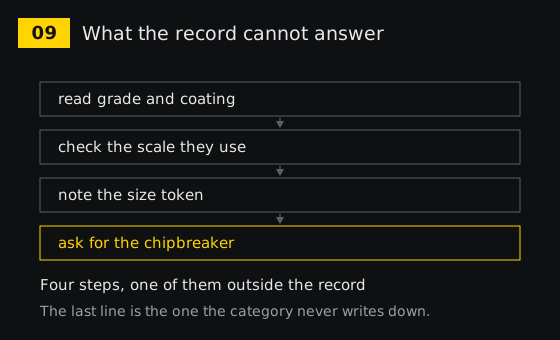
So the order is: read the grade, check the scale, note the token, then ask for the chipbreaker and the radius in the same message as the quantity. That last question decides whether the insert survives its first hour. Sending it before the order is cheaper than finding out after the first batch.
When the answer comes back, compare it with the workpiece rather than with another record in this category, because these records were not written to be compared. A grade of 55HRC, a coating named AlTiN and a token of 1604 is a coherent answer. The same three values with a coating field reading PVD and a hardness field reading 2.0 are answers to three different questions, and only the seller can say which one applies. If you need the geometry before you commit, request the part with the machine and the operation, and if you are still choosing between holders, read how a collet and a side lock differ before the insert.