A drag chain sheet that names three fields and no dimensions
The category holds seven records. All seven repeat one set of spec values, and two of the three values describe the machine the chain is bolted to rather than the chain itself. That leaves the part number to be built from measurements the sheet never asks for.
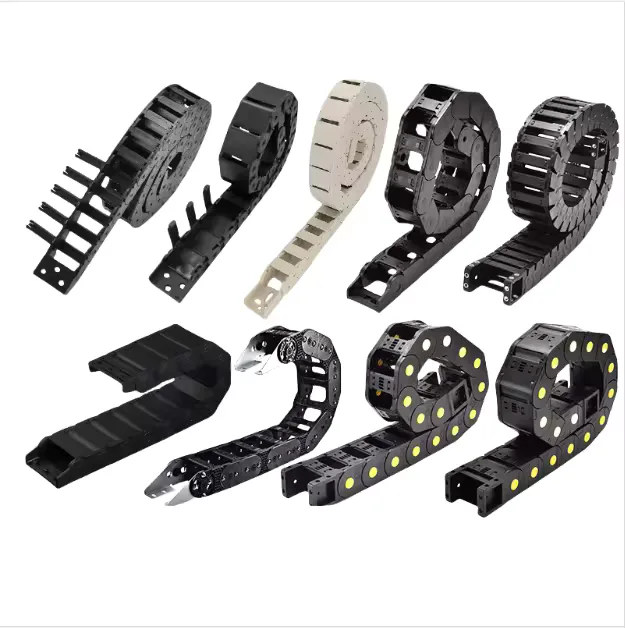
A drag chain is a mechanical guide. It carries cables, keeps them at a controlled radius and stops them rubbing on each other. The seven records in this category are all typed as a Cable Protective Tow Chain, all moulded in plastic, and all described as cable routing and motion protection for CNC equipment. Beyond that shared description the spec sheet is thin, and it is thin in a way that matters at the point of ordering.
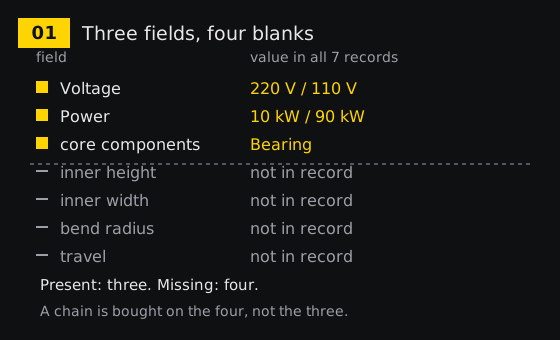
What the seven records actually contain
Every record in the category reports the same three entries: Voltage 220 V and 110 V, Power 10 kW and 90 kW, and core components Bearing. The repetition is the first clue. Seven different chain sizes, from a ten millimetre frame to a ninety millimetre one, do not share one electrical rating and one power figure by coincidence. They share it because the values came from a template that describes the machine family, not the moulded part.
The second clue is what the sheet leaves out. There is no weight column in the category at all. There are no model tokens to sort by, which is why a page of seven records reads as seven near-identical names. Inner height, inner width, bend radius, travel, load and mounting height are absent as fields. Where those numbers appear, they appear inside the product name, written by whoever typed the listing.
Why voltage and power do not choose a chain
Voltage is a property of the cable inside the chain. A control cable rated for a few hundred volts will sit happily in any plastic chain of the right size, and a chain has no opinion about it. Power belongs to the servo or spindle drive at the other end of the cable. Both figures tell you what the machine does; neither tells you what the chain has to be.
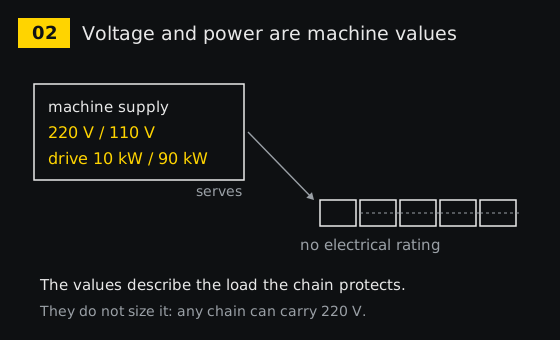
This is not a defect unique to this catalogue. Drag chain listings across the trade inherit the same template, because a chain is sold as an accessory to a machine. The practical consequence is simple: do not filter a shortlist by voltage or by power. Filter by frame size, then by structure, then by the radius the chain can hold.
The only two dimensions that appear
Two records carry a frame size in the name. One is described as 10 x 10 mm, the other as 35 x 90 mm. Read in the order the trade reads them, the first number is the clear height inside the side plates and the second is the clear width between them. Height first, width second. Neither number is the outside of the link, and neither includes the thickness of the plate.
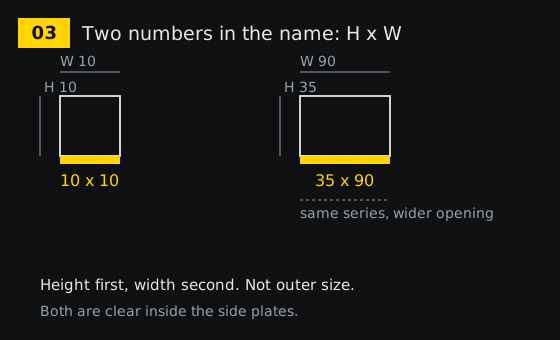
That distinction matters when a bundle is tight. A chain whose outside measures thirty millimetres may hold twenty-two inside. If the drawing you were given quotes the outer profile, the internal clearance is smaller than it looks, and the cables will be pressed against the crossbars on every bend.
From the bundle to the inner width
The width you need is not the widest cable. It is the sum of the outer diameters of everything that travels in that run, plus clearance so the cables can move without chafing, plus the thickness of any separator you fit between power and signal.
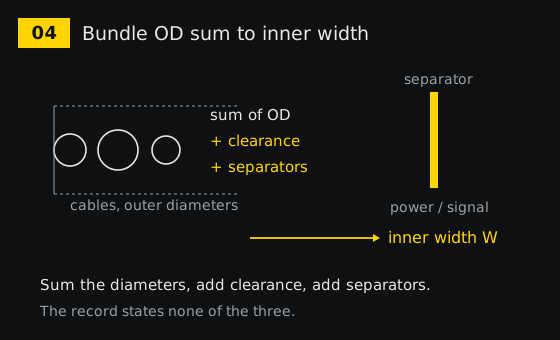
- Measure each cable and hose at its outer diameter, including braid and any sleeve.
- Add the diameters of everything sharing the run. A bundle is not sized by its largest member.
- Leave clearance so cables can slide a little; a bundle pressed tight into the frame wears on the bend.
- Add a separator between power and signal conductors if the drive cable is in the same run.
- Check the total against the inner width, not against the outer profile of the chain.
Bend radius comes from the cable, not the chain
The radius that matters is the one the cable is forced to take. Every flexible cable has a minimum bend radius, usually expressed as a multiple of its own diameter, and that multiple is smaller for a purpose-made continuous-flex cable than for a stiff single-core one. The chain has to hold the cable at or above that radius at every point of the loop.
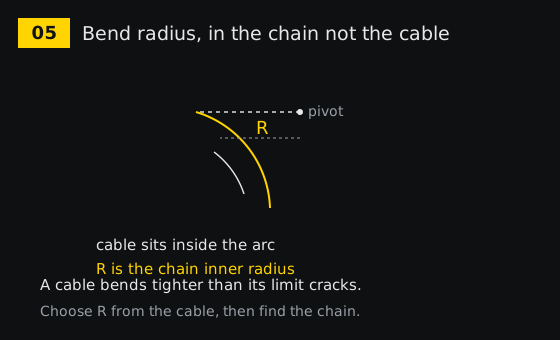
Radius is quoted to the inner edge of the chain, because that is the surface the cable rests on. When a listing gives a frame size but no radius, the radius has to be established from the cable data and then matched to a chain that can form it. A chain that is too small in radius will bend the cable tighter than its limit on every cycle, and the failure shows up as a broken conductor in the middle of the run rather than at either end.
Bridge and enclosed answer different problems
The names in this category distinguish two structures. A bridge chain has open slots between the side plates, so chips and coolant fall straight through. A fully enclosed chain has solid plates, so fine dust, graphite and grinding swarf stay outside the bundle. The same cable can be right for both, and the choice is made by what the machine throws at it.
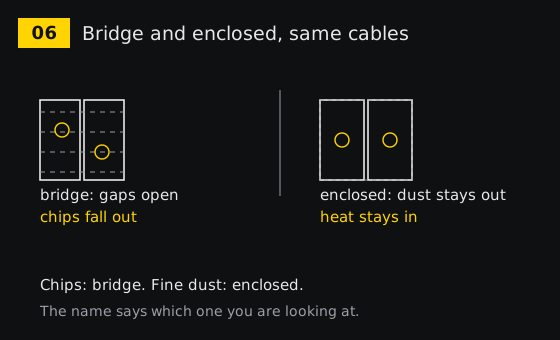
The trade-off is heat and inspection. An enclosed chain traps warmth from a drive cable that is already working hard, and it hides the bundle, so a chafed sheath is only found when the chain is opened. On a router cutting timber or foam, a bridge chain is the easier answer. On a grinder or a graphite mill, the enclosed structure earns its place.
Travel decides length, and length decides support
Travel is the distance the moving end covers. Chain length follows from it together with the loop: the chain has to be long enough to reach the fixed point, turn through its radius and come back. As travel grows, so does the unsupported span of the upper run, and at some point that span sags enough to rub on the lower run or on the machine.
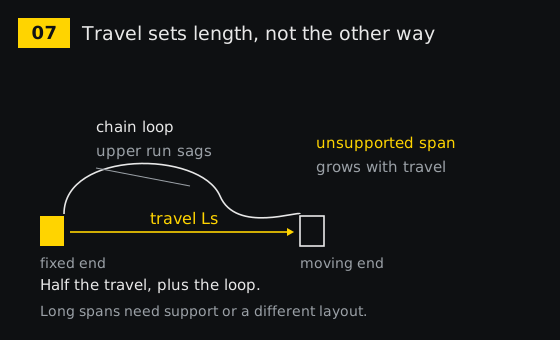
None of this is in the records. Travel is not a field, and support is not a field, so both have to come from the machine drawing. The practical rule is to work out the loop first and then ask whether the upper run can carry itself over that distance without touching anything.
S type: the one record that bends both ways
One name in the category describes a circular-motion chain in PA66 that bends in both directions. That is a different link design from the ordinary tow chain, which is built to bend one way and hold its shape the other way. A bidirectional link is what makes a rotating or reversing layout possible, where the same chain has to form an arc above the axis and then the opposite arc below it.
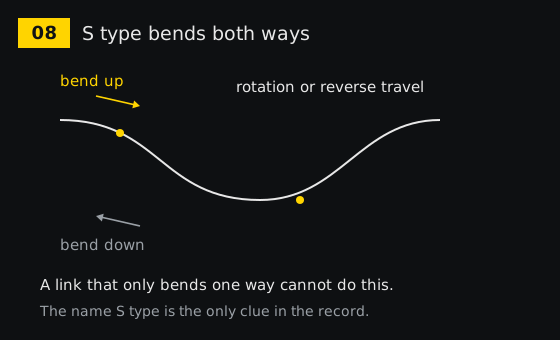
If a machine needs a chain to wrap a rotating table or to run through a reverser, this is the record to start from. If it needs a straight run between a fixed and a moving point, the ordinary link is the right part and the S type is unnecessary.
What the end connectors change
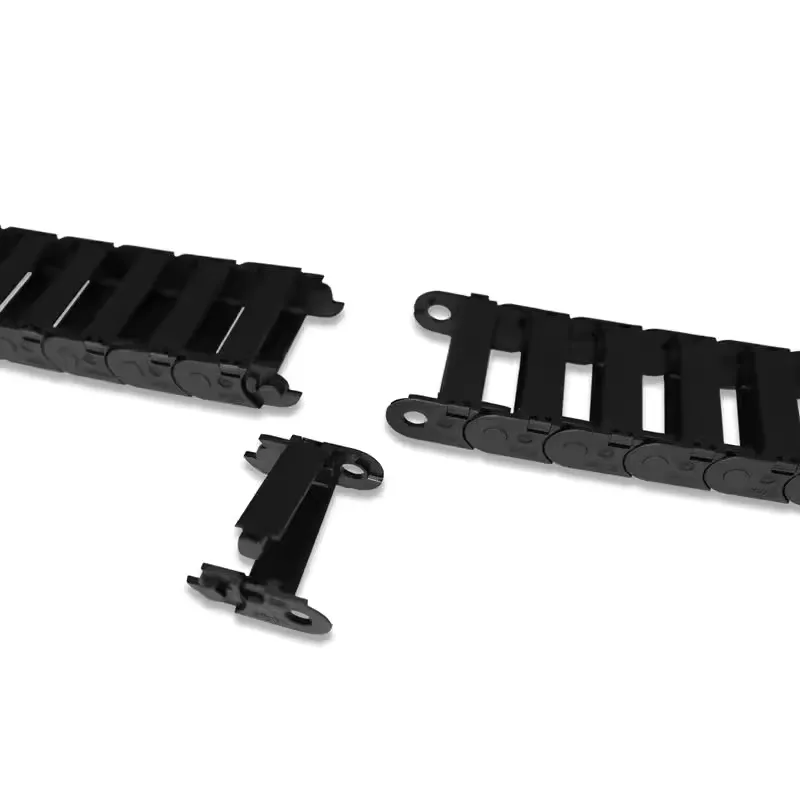
One record is sold as a closed type with end connectors. End connectors are the brackets that pin the first and last link to the machine and to the moving carriage. They matter more than they look: the mounting height at each end sets where the loop sits, and a mismatch of a few millimetres tilts the whole run so that one side of the chain carries the load.
Five measurements to take before ordering
With the sheet giving three values that do not size the part, the order has to be built from the machine. These five figures cover almost every case, and each one is taken with the machine in front of you rather than from a catalogue.
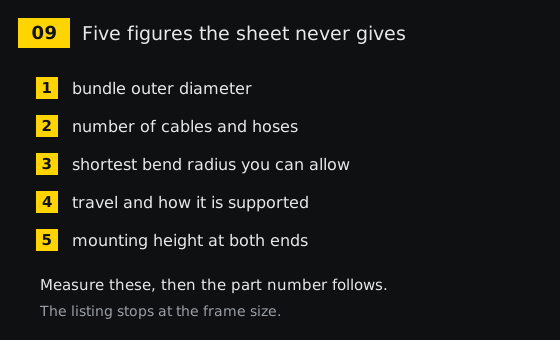
- The outer diameter of the bundle, or the sum of the diameters if the cables are laid side by side.
- How many cables and hoses travel in the run, and which of them must be separated.
- The smallest bend radius the cables allow, taken from the cable data rather than guessed.
- The travel, and whether the upper run can span it without support.
- The mounting height at both ends, measured from the same datum.
What stays unknown
Some questions cannot be answered from this category at all, and it is worth saying so plainly. There is no load rating in any of the seven records, so the allowable fill weight has to come from the supplier. There is no temperature field, so a run near a hot spindle or a drying oven needs a separate enquiry. There is no cycle-life figure, and no data on how the plastic behaves after a long run of short strokes.
Where a record is silent, the article says so rather than filling the gap with a typical value. That is the honest position: seven records give a frame size and a structure, and the rest is measurement. If the run is unusual, the measurements are the only thing worth sending.
Where the catalogue helps, and where it stops
The catalogue is useful for structure and for frame size. It is not a selection table, and treating the voltage and power values as selection criteria will send an enquiry in the wrong direction. Start from the bundle, then the radius, then the travel, then the structure, and use the records only to confirm that a frame of that size exists in the structure you want.
The records discussed here are listed under the chain category of the product range, and the two frames quoted above can be opened directly: the 10 x 10 mm bridge chain and the 35 x 90 mm reinforced bridge chain. For a run where the chain has to reverse, the S type PA66 chain is the record to read. If the measurements are already in hand and the question is which of the structures fits, send them through the contact page with the travel and the bundle diameter, and the answer can be narrowed to one frame instead of seven.